Tuesday, September 15, 2009

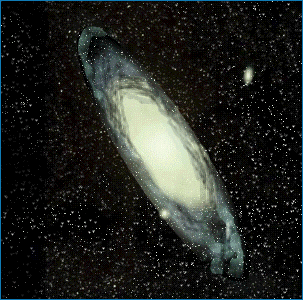
Solar System Might Be "Undigested Sweetcorn"


Tipped to us by a reader, we found a story that begins with a headline that strikes us as very absurd, in the philosophical sense.

“Contemplating the scale of the universe makes a mockery of household chores” it begins, with the subhead: “News that the galaxy Andromeda is eating stars makes it hard to care about putting out the rubbish.”

We love stories like this, because they affirm the absurd perspective again. It seems ridiculous to worry or fret over much of anything that happens on this planet when you think about the bigger picture. Of course, being soft and emotional animals, we can’t help ourselves most of the time. It doesn’t help that we live on a planet full of people who take everything very seriously.

For instance, the wife yesterday was quite upset that somehow our daughter’s favorite pants got bleached out in a few spots. She came into our study and declared: “I am so pissed off about the laundry.” As we were feeling very absurd at that moment, since were noodling around on this blog – which we quickly covered up lest we blow Inigo’s cover - we looked at her like she was mad.

Then we took on the sympathetic role and she proceeded to tell us the story. After she left, we wondered again how little sense it made to worry at all about such things. Really, what is the point? The very fact we are here at all is a complete and happy accident. Just being alive is really the key joy, and ought to be.

Anyway, this a snippet from the story:

“…a group of astronomers has decided that the Andromeda galaxy is expanding by "eating" stars from neighbouring galaxies. Having studied Andromeda's outskirts in great detail, they discovered the fringes contained "remnants of dwarf galaxies".

It took me a couple of reads to establish that Andromeda wasn't literally chewing its way through the universe like a giant intergalactic Pac-Man, and that the "remnants of dwarf galaxies" were living stars, not the immense galactic stools I'd envisaged. That was what had really frightened me: the notion that our entire solar system might be nothing more than a chunk of undigested sweetcorn in some turgid celestial bowel movement; that maybe black holes are actually almighty cosmological sphincters, squeezing solid waste into our dimension. What if the entire universe as we know it is essentially one big festival toilet?”

A great read, you’ll find the whole thing here.

Monday, September 14, 2009

Evolution, God and the Absurd

Over the weekend, we the “Man vs. God” piece on the front page of the Weekend Journal of the Wall Street Journal, the subtitle of which ran “Two prominent thinkers debate evolution, science and the role of religion.” There were two columns. One was by Richard Dawkins, the author of The Selfish Gene and a tireless defender of evolution against the creationists. The other was by Karen Armstrong, author of a variety of books on theology.

Evolution, as we’ve noted, boosts the absurd view of the world as indifferent and our existence as without meaning. Oddly, it is the theological Armstrong who states the case clearly in the beginning of her piece:

“Richard Dawkins has been right all along, of course—at least in one important respect. Evolution has indeed dealt a blow to the idea of a benign creator, literally conceived. It tells us that there is no Intelligence controlling the cosmos, and that life itself is the result of a blind process of natural selection, in which innumerable species failed to survive. The fossil record reveals a natural history of pain, death and racial extinction, so if there was a divine plan, it was cruel, callously prodigal and wasteful. Human beings were not the pinnacle of a purposeful creation; like everything else, they evolved by trial and error and God had no direct hand in their making.”

The rest of Armstrong’s piece was weak beer. It seemed a gooey effort to try and make religion like painting or music, and therefore an art form and somehow beyond reason. But these opening lines are a pretty good start on the absurd path as it admits life is essentially an accident, a result of a blind process. From there, you are only a few steps from absurdity.

Dawkins’ essay made a good point near the end, which also touches on the absurd, in particular those who acknowledge the absurd, but insist on creating meaning anyway. I’ll quote from Dawkins here, as this is worth thinking about:

“Now, there is a certain class of sophisticated modern theologian who will say something like this: "Good heavens, of course we are not so naive or simplistic as to care whether God exists. Existence is such a 19th-century preoccupation! It doesn't matter whether God exists in a scientific sense. What matters is whether he exists for you or for me. If God is real for you, who cares whether science has made him redundant? Such arrogance! Such elitism."

Well, if that's what floats your canoe, you'll be paddling it up a very lonely creek. The mainstream belief of the world's peoples is very clear. They believe in God, and that means they believe he exists in objective reality, just as surely as the Rock of Gibraltar exists. If sophisticated theologians or postmodern relativists think they are rescuing God from the redundancy scrap-heap by downplaying the importance of existence, they should think again. Tell the congregation of a church or mosque that existence is too vulgar an attribute to fasten onto their God, and they will brand you an atheist. They'll be right.”

On this blog, we’ve had comments whereby people admit that the life has no meaning, but then go on to say that that insight is not important. What is important is whether meaning exists on a personal level, echoing Dawkins’ theologian. “If meaning is real for you, who cares whether there is or isn’t meaning on an objective level.”

We’ve long maintained that is a very slippery slope, at best, and flat out contradictory and wrong, at worst. It seems to us if you accept the absurd premise that life is essentially meaningless, then you can’t pretend that you can carve out an exception for yourself. That is the equivalent of recognizing evolution as true, but then insisting in some way that God did create you.

Anyway, these are just a few reactions to the columns. You can find the whole of Armstrong and Dawkins here.

The fallacy of achievement

We have taken great pains in this blog to point out what we see as one of the easiest and most destructive traps for people to fall into--namely, the sense that "things" (be they objects, relationships, or achievements) will make you happy. Such striving, while endlessly praised in Western (and increasingly Eastern) society, is, in our opinion, the main source of suffering for human beings.

Put simply, the man who relies on external objects or events to be happy will never be satisfied, as the high from achieving one goal will eventually morph into angst about something new. Got good grades in school? Great. Where are you going to college? Grad school? How about that first job? Promotion? And on and on and on.

Nevertheless, many people dismiss such concerns, stating that if only they could have...this job, or that spouse, or those children...then they would be happy. Thus, we found it fascinating to watch Michael Jordan's acceptance speech into the Hall of Fame last week. In a nutshell, Jordan--considered by many the best to ever play the game--used his speech as an opportunity to build himself up and tear foes down. As Yahoo columnist Adrian Wojnarowski put it: "When basketball wanted to celebrate Jordan as the greatest player ever, wanted to honor him for changing basketball everywhere, he was petty and punitive....Once and for all, Michael: It’s over. You won."

What is so fascinating is that despite this clear evidence that Jordan is, at root, an unhappy person, we have no doubt most people would jump at the chance to switch places with him, confident they would appreciate what should be, based on the standards of Western society, a very satisfying life. Yet what is missing in this analysis is that you cannot separate Jordan the superstar from Jordan the vindictive anti-hero. In other words, Jordan became "great" because of his legendary will to win at all costs--it is, in short, an integral part of "who" he believes himself to be. Thus the terrible irony that this character trait both drove him to greatness and prevents him from being happy.

The obvious lesson is that true happiness comes not from external "stuff," but rather from within. As Pico Iyer put it in a recent NY Times piece on remembering 9/11, he has met many "cheerful people" in his travels. "But if that cheer is genuine, I’m not sure if they’d be feeling better or worse now than they were on Sept. 11, 2001. Only more compassionate, perhaps. Looking to our circumstances for strength, solace or support is like dancing at the edge of a very deep grave."

Friday, September 11, 2009

Winston Churchill, anti-absurd man


Sometimes it is useful to define something not in terms of what it is, but in terms of what it isn’t. There is the absurd man and then there is the anti-absurd man.

The absurd man is free in his knowledge that life has no meaning. He lives in the present moment and remains unconcerned about his legacy… and then there is the anti-absurd man. The anti-absurd man invests his existence with great meaning, worries about the future and is very concerned about his legacy.

We therefore nominate Winston Churchill as the anti-absurd man. We thought about this after reading Max Hasting’s “Man of War” in the Financial Times over the weekend. Hastings, who has a new book coming out called Winston’s War, comments: “[Churchill] believed that destiny had marked him to be the savior of western civilization and this conviction infused his every word and deed.”

A more anti-absurd outlook can scarcely be imagined. We submit that such people thinking such thoughts are very dangerous for the rest of us – at least those of us who want to be pretty much left alone to work out our own path in life.

(This reminds us of D.H. Lawrence’s observation that only robots start revolutions because real people are too busy living their lives. And the Tang dynasty poets and sages often taught that public life was inane and futile and without significance.)

All of this busyness about interfering with other people’s lives seems to lie at the root of much human misery and angst, and, at its worst, bloodshed.

It is hard to imagine WWII, for example, in a world of absurd men. The bombing of Pearl Harbor would have been impossible if the Japanese were absurd. Japanese aggression had its roots in a race-superiority ethos, a belief in the godliness of their emperor and a sort of Japanese manifest destiny. The absurd man would’ve seen through all this nonsense and unreality. He would’ve stayed at home tending his rice paddy, enjoying the warmth of the sun, the sound of his children playing at his feet and pondering what he might have for lunch that day.

It is rather hard to imagine the wide scale bloodshed of the 20th century if the world were even half peopled with absurd fellows.

On this question of how the absurd man values life – which might seem contradictory given the absurd view that life is meaningless – we quote from the ever eloquent Camus. In The Rebel, Camus says: “The final conclusion of absurdist reasoning is, in fact, the repudiation of suicide and the acceptance of the desperate encounter between human inquiry and the silence of the universe. Suicide would mean the end of this encounter, and absurdist reasoning considers that it could not consent to this without negating its own premises… it is obvious that absurdism hereby admits that human life is the only necessary good since it is precisely life that makes this encounter possible and since, without life, the absurdist wager would have no basis….”

So, the absurd man values life. And this value judgment makes the casual handling of lives by men in power all the more offensive to absurd sensibilities. We think this aggrandizement and hero worship of such public personalities is also a sort of screen to cover the bare naked realities of our existence. It masks our essential creatureliness, the fact that we are defecating animals, inconsequential, marooned on this blue planet, in a vast and indifferent universe.

It is true that the absurd has a way of tearing down some of our notions about heroes, but is that such a bad thing? The absurd view sees the labors of the baker or the grocer or delivery man on the same level as the general and the president – which is to say one is of no greater importance or significance than any other.

Thursday, September 10, 2009

Keeping perspective

We were on a plane the other day and happened to have a window seat. As a result, we spent a good deal of time watching the houses, cars, trees, etc recede (as we ascended) and come back into view as we landed. We imagine many people have experienced the unusual feeling of detachment that comes from this - basically, the sense that all our worldly concerns seem ridiculous when we see how small we actually are. The cars and houses look like toys, and the people (when you can see them) like ants - the feeling that everything happening "down there" is irrelevant can be incredibly powerful.

This, of course, is what the absurd is all about, but what we want to focus on today is how to keep that feeling of detachment when you are not at 30,000 feet. In fact, we consider this to be one of the most critical aspects of the absurd. How do you keep your perspective when you are not only predisposed by genetics to non-absurdity, but also surrounded (for the most part) by people who are not absurd?

It would be nice if there were some sort of soundbite answer for this. Unfortunately, it is a great deal easier to recognize the absurd than it is to maintain this perspective on a day-to-day basis. One can, of course, meditate, read books, and generally try to maintain a sense of inward calm, but this is difficult for the majority of people (we among them) who live in the hectic world of modern society.

For us, the process of writing this blog (and responding to reader comments) has become a powerful contributor to our own sense of absurdity. This was something we did not necessarily expect - our primary motivations for creating the blog were that we thought it would be an easy way to share what we have found to be an incredibly liberating outlook on life with others, and also that we hoped to develop a community of like-minded individuals. But in effect, writing this blog helps us stay absurd.

We have other tricks, of course. As discussed on the blog, we like to view life as "pushing our rock," or playing a role in a movie, and Inigo and I have a meeting place we have dubbed "absurd HQ." But how you choose to remember the absurd is irrelevant. We, for example, tend to "worry" our wedding ring, and thus decided to "remember the absurd" every time we catch ourselves doing it - this is but one of many "triggers" we have for remembering our own irrelevance.

Not surprisingly, the more of these habits you adopt, the less you need them. When we first adopted the wedding ring "trick," it would often shift us from bring quite worried about something (whatever it was) to a far more calm and relaxed state. But now we generally find it to be more a reinforcement of our current mood.

To being this full circle, our newest "tool" for remaining absurd is to simply remember the view out the plane window and how it made us feel. Why, we ask ourselves, should we feel any differently now than we did then? Why shouldn't we always take the 30,000 foot view?

This is water. This is water. This is water.

Tuesday, September 8, 2009

Happy and busy?

We recently stumbled across a Wall Street Journal column titled "The Myth of the Overscheduled Child," which sought to expose society's misguided worries about children with too much to do. In the author's (Laura Vanderkam) view, "most children are not at risk of being overscheduled. They're at risk of having too little to do with their time and thus never learning the joy of being...happy and busy."

As George Will might say...Well.

Ms. Vanderkam's thesis is that since children today spend much of their free time watching television or eating junk food, they would be better off joining the glee club, or learning Russian, or taking AP Physics, etc. Essentially, she claims kids with more to do are likely to be happier and in better shape, while those with too much free time (i.e., most of them) simply fritter it away.

As an example, Ms. Vanderkam cites a 17-year old high school junior named Erika Debenedictis. Ms. Debenedictis has a jam-packed school schedule that includes several AP classes taken concurrently with a "multivariable calculus" class, while in her spare time she works on computer-programming projects for science fairs, takes piano lessons and sings in a choir.

According to Ms. Vanderkam, this is an unalloyed positive. "So is Ms. DeBenedictis facing a nervous breakdown as she enters her senior year? Hardly. 'I'm very happy when I'm busy,' she tells me. It's when she doesn't have enough to do that she starts 'moping around.'"

Ah - now we are getting somewhere! The question, of course, is does Ms. Debenedictis feel good because she is busy, or does she keep busy in order to not feel bad? These are not the same thing, and the distinction is, in our mind, critical. Indeed, we wonder why Ms. Vanderkam does not ask what seems to us the obvious question - namely, why does Ms. Debenedictis "mope around" when she has nothing to keep her occupied? What is so bad about having nothing to do?

But such questions rarely get raised in our accomplishment-obsessed society. Rather, it is taken as a given that more is always better, despite the fact that vast numbers of highly-educated, well-paid professionals are miserable in their lives (and have no clue why). Indeed, the increasing volume of data on school "effectiveness" almost always focuses on the difference in earnings between those with different levels of education, as opposed to whether people with more education lead happier, more fulfilled lives. (This is more difficult to quantify, of course, which makes it far less appealing to researchers.)

The question we would ask Ms. Debenedictis is why she feels so miserable when she has nothing to do. To us, that is the real issue. Ms. Debenedictis (and Ms. Vanderkam, for that matter) is just pushing her rock like the rest of us. But, unlike the absurd man, she is perpetually mystified when it rolls back down the hill.

Monday, September 7, 2009

Is Sherman absurd?


Sherman’s Lagoon is a comic strip featuring a shark named Sherman who lives at the bottom of a lagoon with his coral reef friends, such as Filmore the sea turtle. This was a bit from Sunday’s strip:

Sherman: “Fish are always going somewhere. Where are they going?”

Filmore: “Appointments, meetings.”

Sherman: “Boy, I wish I had appointments and meetings. I’ve got no place to be.”

Filmore: “That’s because you haven’t found your purpose in life.”

Sherman: “My purpose?”

Filmore: “Yeah. Something that will get you going every morning. You wake up, you see it. And you start chasing it. The purposeful life.”

Sherman: “I don’t think that’ll ever happen to me.”

(The punch line is when he sees his wife coming and disappears, at which his friend observes “At least he’s got something to run from.”)

We enjoyed this strip, as it is an obvious parody of human busyness. Replace “fish” with “people” and it becomes spot-on social commentary.

The absurd, which is what this blog is all about, offers a different perspective than the rat race view pursued by so many. The absurd man accepts that life has no meaning and he uses this insight as his ticket to freedom. Like Sherman, we don’t think we’ll ever adopt the “purposeful life.” But unlike Sherman, we have no wish to join the crowd in chasing something that doesn't exist. We take life as it is.

So, on Labor Day, we reflect on the meaningless nature of existence. Enjoy your day off from the rat race. And if you choose, every day can be like today, as the absurd man well knows.

Sunday, September 6, 2009

The fact of evolution

Albert Camus writes in his introduction to The Rebel: “Man is the only creature who refuses to be what he is.”

It is profoundly true and we find plenty of examples in contemporary life. Let’s take evolution.

This post was inspired by a review of Richard Dawkins’ new book, The Greatest Show on Earth: The Evidence for Evolution, which appeared in the Economist. The reviewer writes “two-fifths of Americans still refuse to accept that human beings share a common ancestry with animals, preferring to believe that they were created in their present form in the past 10,000 years.”

This has always astounded us. The evidence for evolution is overwhelming. As Dawkins says, it is “as incontrovertible a fact as any in science.”

As the reviewer notes:

“And what a lot of evidence there is. The fossil record, far from the tenuous succession of gaps described by creationists, provides an admittedly incomplete but beautiful and coherent set of clues to life in the distant past.”

And we love the quote from British geneticist J.B.S. Haldane, when asked what would disprove the theory of evolution: “Fossil rabbits in the in the Precambrian era.”

Of course, no such thing has ever been found. The passage of time only makes the case grow stronger as more gaps are filled in and more and more of it just makes sense.

Yet, the urge to deny our simian roots is strong. People want to believe humanity is a special case, separate and apart from the animal world around it. Again, 40% of Americans believe God created man complete, only 10,000 year ago – an observation cleanly at odds with the facts.

We observe too, how this applies to the absurd. For one thing, the theory of evolution reinforces the essential absurd insight that life has no meaning, no purpose. It reinforces our insignificance in the scheme of things.

For another thing, the whole evolution “debate” reminds us of resistance we encounter when discussing the absurd. People seem loath to believe that their life has no meaning and that “nothing matters.” Instead, people cling to ideas and beliefs that soothe their egos and make them feel apart of something larger, something with a purpose, something that will last and is important.

The absurd is like an acid to the ego and we think that is why the idea is hard for many to swallow.

Evolution is not the only example of such thinking, as today’s Bloomsbury comic strip reminds us.

Saturday, September 5, 2009

An absurd moment


“We wonder where you get these obsessions,” we said to our wife one Saturday mid-morning. We had been happily engrossed in our reading when she called for us to help her with the “big bushes.” We walked out in the backyard where she then outlined, to our consternation, how she wanted to uproot these two big bushes.

Frankly, we had barely known of their existence before, as they seem to blend in with the other foliage that grows in this corner of the yard. “What is wrong with these bushes?” we wondered, annoyed as the absurd perspective leaked away for some moments and the simian emotions took over. “They provide fine cover.”

“They are ugly,” our wife countered.

“They have been here for years.”

“And I’ve been meaning to dig them up for years,” she proceed. “And these wild violets,” she said waving disgustedly at the things. “We’ll need to get a tiller and tear these up and try to grow grass here.”

We were flummoxed. “That’s just a lot of work for nothing,” we protested. “It’s like you are creating work.”

Our wife sighed audibly, exasperated at our apparent disinterest in the bushes and the violets.

“You know,” we said, the absurd returning to our veins, coursing through the soft gray matter of our brains. “Life is short. And should we be lucky enough to look back on it all near the end, I don’t think we’ll care a whit about the bushes or whether there was grass here or not. None of it matters, don’t you see?”

“You're so dramatic,” she said. “I actually care about what our yard looks like.”

We wanted to laugh, but thought better of it. We have had these discussions before and we admit our wife is not one for the absurd perspective. We thought back on how, on another occasion, she tried to distract us from a football game we were watching on TV by saying that whatever it was she wanted us to do – it escapes now, as does the particulars of the football game – was “more important than that football game you're watching.”

Of course, we didn’t say it was more important. They are both equally unimportant, we offered at the time, with some satisfaction, though our wife was used to this kind of reasoning by now.

We snapped back to the present moment… our wife standing there, the big bushes looking on patiently and violets spread around. We heard the cicadas sounding off in the trees, oblivious to what was going on.

At this point, we picked up the clippers. It was a beautiful morning. The sun was bright overhead. The shade of the trees warded off its heat. The air smelled lightly of pine and wet earth, and mint, of which she had clipped in her efforts to get at the offending bush. The grass was moist with dew and cool beneath our bare feet. It was a very nice morning indeed.

Friday, September 4, 2009

It's good to be lucky


We have always found the subject of luck a fascinating one. Chance plays such a large role in life; it’s hard to grapple with sometimes. The odds of things existing just as they have come to be are so mind-bogglingly long, it is hard to compute. Today is the end result of a long chain of events that had to happen just so or everything could be very different. As American paleontologist George Simpson elegantly put it:

“Man is the ultimate end of a twig. Even slight changes in earlier parts of the history would have profound cumulative effects on all descendent organisms through the succeeding millions of generations... Thus the existence of our present depends on a very precise sequence of causative events through some two billion years or more.”

In other words, that fact that we exist at all is a pretty damn lucky thing! A mere chance occurrence some billions of years ago and humanity as we know it never exists.

From a philosophical point of view, it also highlights a few absurd points. It shows how tenuous our existence is, how little control we have over how things come to be and just how limited we are in being able to understand what happens next.

We’re at the mercy of forces much larger than us, forces we don’t really understand and may never figure out. Every answer we find about how, for example, the world began or what lies at the rim of universe only brings more questions. It is a never-ending process.

There are lots of ways to deal with this. And we’re the only animals that have to deal with this. The German shepherd down the street doesn’t worry about what it is or what it will become. It just is. As Eric Fromm, a celebrated psychologist once put it:

“Man is the only animal that can be bored, that can be discontented, that can feel a need to be evicted from paradise. Man is the only animal for whom his own existence is a problem which he tries to solve and from which he cannot escape.”

This reminds me of a line from Jim Harrison, where he writes “if only I had the genius of a cabbage or an onion to grow myself.” It’s a sort of plea for acceptance of things as they are. In another place he writes how “a tree by its nature seeks its future moment by moment.” We can find our way, too, by focusing on the present moment and living each experience day to day.

We are not saying we want to be a vegetable or a tree or a German shepherd. We are happy to have such problems as these to wrestle with, as Sisyphus was happy to push his rock, however futile the quest may be.

And this is, in fact, the absurd view. In a world devoid of meaning, the absurd man chooses to live his life anyway and does so with relish and passion. There is also the notion of acceptance of things as they are.

We would not want it any other way. In our view, it is good to be lucky, to have that element of chance. We are glad the future continues to frustrate our ability to penetrate it. The mystery is the thing. Life, like a book, draws you in because you don’t know what will happen next.

Let us be thankful that our future continues to outwit us and revel in the absurd nature of our existence!

Wednesday, September 2, 2009

Living with passion

We have made numerous references to the concept of living with passion. Indeed, we believe this is one of the most important aspects of the absurd. Yet what does such a statement mean? Further, is such a stance not inconsistent with the recognition that life is meaningless?

Living with "passion" simply means one should enjoy life for what it is (i.e., meaningless). One should not live "for" material things, or family, or friends, or indeed anything other than the present moment - that being, in point of fact, all one can directly experience and influence. Thus, living with passion simply extols the benefits of embracing the world as it is.

The man who lives for material things is easily derided, of course. It has become de rigueur to criticize those who seek fulfillment in possessions; however, such comments are often misguided in that they assume it is better to live for things such as family and friends. But the man who lives for his family (or friends) does not live with passion. Instead, he deludes himself into believing there is meaning in his relationships; that his love for his wife and children (or network of friends) in some way transcends the physical world and creates import and meaning. Thus, he is no different from the man who believes "things" will bring him happiness.

The absurd man, by contrast, eschews all such beliefs. We, for example, went to a business dinner tonight. We ate, drank, and were generally quite merry, in large part because we did not assign meaning to the proceedings! We did not worry what the other participants would think of our comments, or our behavior, or whether we drank too much (or too little). We simply enjoyed the experience. Just as important, now that it is over we have moved on.

The concept of living with passion is really quite simple. All it entails is one's commitment to embracing the current moment and living it to the fullest extent possible. Such commitment is not possible if one is worried about what happened earlier today, or what might happen tomorrow, or whether his companions are angry at him. It is only possible if one truly embraces the meaninglessness of life, and chooses to thus live each moment as it comes.

As we have previously argued, we believe life is best lived as if one is merely playing a role. Thus, our dinner tonight was simply another scene in an ongoing play; one that will, like all plays, someday come to an end. Thus, our actions simple represented a "performance," or said a different way, our interpretation of the role played by our current character.

As we have also noted, these ideas are not particularly new (although that does not lessen their power). Consider, in closing, Shakespeare's timeless words:

All the world's a stage,
And all the men and women merely players:
They have their exits and their entrances;
And one man in his time plays many parts,
His acts being seven ages. At first the infant,
Mewling and puking in the nurse's arms.
And then the whining school-boy, with his satchel
And shining morning face, creeping like snail
Unwillingly to school. And then the lover,
Sighing like furnace, with a woeful ballad
Made to his mistress' eyebrow. Then a soldier,
Full of strange oaths and bearded like the pard,
Jealous in honour, sudden and quick in quarrel,
Seeking the bubble reputation
Even in the cannon's mouth. And then the justice,
In fair round belly with good capon lined,
With eyes severe and beard of formal cut,
Full of wise saws and modern instances;
And so he plays his part. The sixth age shifts
Into the lean and slipper'd pantaloon,
With spectacles on nose and pouch on side,
His youthful hose, well saved, a world too wide
For his shrunk shank; and his big manly voice,
Turning again toward childish treble, pipes
And whistles in his sound. Last scene of all,
That ends this strange eventful history,
Is second childishness and mere oblivion,
Sans teeth, sans eyes, sans taste, sans everything.

Monday, August 31, 2009

Jim Harrison, Absurd Man


We’ve never read anything by Jim Harrison before. Harrison is a poet and novelist, perhaps best known as the author of Legends of the Fall.

We picked up a copy of his latest poetry collection, Saving Daylight. We were immediately hooked. Right away, the opening poem is fairly absurd, in the philosophical sense:

“Before I was born I was water.
I thought of this sitting on a blue
chair surrounded by pink, red, white
hollyhocks in the year in front
of my green studio. There are conclusions
to be drawn but I can’t do it anymore.
born man, child man, singing man,
dancing man, loving man, old man
dying man. This is a round river
and we are her fish who become water.”

Throughout the collection, Harrison is sensitive to our essential mortality and insignificance in the larger scheme of things. He focuses on the simple pleasures of being alive and the beauty of nature around us and the ceaseless march of lost time.

“You can’t row or swim upstream on the river.
This moving water is your continuing past
that you can’t retrace by the same path
that you reached the present, the moment by moment
implacable indifference of time.”

Harrison is also aware of the mystery of the ego, of the “I”. As he writes: “There is no ‘I’ with the sun and moon. Time means only the irretrievable. If I mourn myself, the beloved dead, I must mourn the deaths of galaxies.”

He repeatedly returns to the theme of insignificance, of the absurd nature of our existence, in lines such as:

“Both cat and man are bathed in pleasant
insignificance, their eyes fixed on birds and stars”

And

“The beetle takes half an hour on a leisurely
stroll across the patio, heading
northwest as if it truly mattered.
I think of Wallace Stevens in his office
doing insurance work as if it truly mattered.”

Among others…

This all seemed too much of a coincidence to us. Upon further investigation, we find that Harrison found Camus inspirational. In a book Conversations with Harrison, we find the following:

“The most inspirational literature I ever read was Dostoevsky or Camus. Then I believe his assertion when he says you only have one choice in your life: it’s whether or not to commit suicide. If you don’t commit suicide, you have to treat your life with a great deal of energy and assertiveness.”

Jim Harrison, absurd man…

Saturday, August 29, 2009

Building sand castles


We recently spent a day playing at the beach with our six-year-old son. We built the standard things - castles, moats, little villages - all of which were eventually wiped out by "tidal waves" crashing over them. Our son reveled in the experience, frantically building castles and protective moats, then laughing hysterically when they were overrun by water, only to dive in and start building again.

This, of course, got us thinking about the absurd. Specifically, building sand castles seems a wonderful allegory for all the things we "build" in life, such as family, careers, and social networks, not to mention the incredibly seductive (yet ultimately ephemeral) sense of who we "are." (Along similar lines, a reader recently mentioned a woman named Byron Katie to us - she is another promoter of the absurd lifestyle. She recently published a book with the terrific title "Who would you be without your story?")

The point is that all the things we "build," the people, events, and experiences that seem so all-encompassing and critically important, are nothing more than sand castles with longer lifespans. These lifespans, of course, prevent us from seeing the transitory nature of everything we do, since we get constant and persistent feedback that such things do, in fact, matter. In other words, it is very difficult to view your family or career as meaningless when you not only spend decades cultivating and maintaining them, but are also surrounded by people constantly telling you they do matter.

We found our son's behavior to be a wonderful template for how to go through life. We also found it illuminating given recent reader comments that have suggested we are not capable of "enjoying" experiences as much as people who find meaning in them. But as we have pointed out, lack of meaning need not equate to lack of enjoyment - in fact, we find it to be quite the opposite. Our son, for example, was under no illusions that his sand castles would be permanent, or indeed that they had any significance beyond his immediate enjoyment (or for that matter, than one castle was more "meaningful" than another, even if only to him), and yet he found tremendous joy in building them. (And, we would note, in seeing them destroyed...)

Carpe diem!

Tuesday, August 25, 2009

On vacation

"Wherever you go, there you are."--Anonymous

We have been traveling the past couple of weeks, which got us to thinking about the concept of vacation. Now, there is certainly nothing profound about pointing out the reality that going "on vacation" simply changes one's physical location. Or, for that matter, the inherent absurdity that one man's vacation spot is another's daily grind.

However, one of the messages we continue to pound away at here is that the absurd can be found everywhere, often without looking for it. For example, we went on a dolphin watch the other day, during which we heard a couple of fellow passengers discussing the inherent wisdom of dolphins.

"They sure have the life," said one. "Yup," replied the other, "just eat, play, and sleep. Wish I could live like that."

We will pause a moment to let this sink in....

In fact, what struck us the most was not the discussion itself, but the fact that such discussions almost certainly happen on all dolphin cruises! Such lamentations have become virtually boilerplate, with people constantly complaining about their stressful and put-upon lives. If only, they wail, I could live the carefree life of that...dolphin, or dog, or cat, or some other animal that seems to spend all its time lounging around while I have to go stare at my computer screen.

Well, we have a revelation for you. You can live that life! And you don't need to wait until you have enough money saved, or until your children are grown, or until you are "ready." You can do it today - now - this minute.

Once you accept there is no "greater meaning" to life, you can choose to live however you want. And please understand - this does not necessarily mean quitting your job and retreating to a Buddhist monastery (although it could). The point is that once you realize things don't matter, it doesn't matter what you do. This is not only incredibly liberating, but is also a potent tonic against worry (about the future) and regret (about the past).

So go ahead and take a vacation - NOW. Stop worrying about what happened earlier today, and what may or may not happen tomorrow. Stop thinking about your job, your retirement, your family - whatever. Just...STOP. Then, spend some time in the present. Enjoy what you are doing right now, without all the baggage of yesterday and tomorrow and next week. Just be.

We understand this is difficult to do consistently - we ourselves struggle to maintain our perspective on a day-to-day basis. But try this. Next time you find yourself slipping back into old patterns, try spending a few minutes marveling at the wondrous miracle that is life - that some random collection of atoms can see, and hear, and smell and taste and touch...and actually attempt to comprehend this miraculous universe we inhabit. It might just make that very serious problem (whatever it is) seem a bit less overwhelming.

We'll be home in a few days. But our vacation will never end...

Monday, August 24, 2009

Busyness dulls awareness

More absurd thoughts uncovered while reading the Wall Street Journal (of all things…)

An excerpt, then some of our own thoughts below it:

“We will die, that much is certain; and everyone we have ever loved and cared about will die, too, sometimes—heartbreakingly—before us. Being someone else, traveling the world, making new friends gives us a temporary reprieve from this knowledge, which is spared most of the animal kingdom. Busyness—or the simulated busyness of email addiction—numbs the pain of this awareness, but it can never totally submerge it. Given that our days are limited, our hours precious, we have to decide what we want to do, what we want to say, what and who we care about, and how we want to allocate our time to these things within the limits that do not and cannot change. In short, we need to slow down.

Our society does not often tell us this. Progress, since the dawn of the Industrial Age, is supposed to be a linear upward progression; graphs with upward slopes are a good sign. Processing speeds are always getting faster; broadband now makes dial-up seem like traveling by horse and buggy. Growth is eternal. But only two things grow indefinitely or have indefinite growth firmly ensconced at the heart of their being: cancer and the corporation. For everything else, especially in nature, the consuming fires eventually come and force a starting over.”

Full piece is here.

The absurd man cultivates an awareness – in this he has many fellow travelers. The absurd man’s unique awareness centers on his absurd condition – the indifferent universe and the meaningless nature of existence. The absurd man cherishes this insight, which he finds liberating. (Like finding out you can play a game for the sake of playing and in which the outcome is irrelevant).

There are many consequences of this awareness, but one of them is a focus on living in the present moment, the idea of trying to stay in the present. (Life being a series of present-day moments.)

It is interesting to think about how the modern world clashes with this idea. The idea of always being “plugged in” either to one’s laptop or PDA or what, seems to discourage reflection or awareness of anything in the real world. We know people who can’t take a simple walk around the neighborhood without their iTunes in their ears. Televisions that are nearly always on, e-mail accounts that can’t go more than an hour without being checked, telephones that are not allowed to ring themselves to silence – all of these things seem rather unhealthy.

As the writer above puts it, all this busyness numbs of the pain of our awareness. We take issue with the pain part. We don’t find the realities of our existence painful. We accept them as they are, however we can see how other people would find the idea of death painful.

But the larger point is that much of our society and technology seems geared to keeping us pre-occupied, so we are never alone with our thoughts. Elevators play music – as if you couldn’t stand there for the 15 second elevator ride. Restaurants pipe in music or put televisions on the wall. The barbershop down the street has the TV on all the time.

We think it is important, whether one embraces the absurd philosophy or not, to put time aside for calm reflection, for some quiet solitude. It’s too easy to get lost in the matrix of everyday life and then put too much stock in what happens in that everyday life. These things will inevitably disappoint.

But if you cultivate an awareness of the absurd condition, it is easier to let the slights and disappoints of the real world slide by. We argue that the absurd philosophy makes it easier to enjoy your life as it is, in the present moment. And that, after all, is the main thing. Absurdity declares that a life is an experience to be lived with no appeal to anyone or anything.

Saturday, August 22, 2009

The Impermanence of All Things


The absurd man does nothing for the eternal, Camus once wrote. In a meaningless world where our eventual death is the only sure thing, there is no point in legacy-building. Instead, the absurd man lives in the moment, happily relieved of the burden of making a lasting mark on his fellow men.

The absurd man appreciates the life cycle of all things and his place in it.

Recently, we read Shelley’s famous poem “Ozymandias.” We think it carries within it the spirit of the absurd and the futility of all man’s works, even those he dubs great…

Ozymandias

by Percy Bysshe Shelley
(1803-1882)


I met a traveller from an antique land
Who said: "Two vast and trunkless legs of stone
Stand in the desert... Near them, on the sand,
Half sunk, a shattered visage lies, whose frown,
And wrinkled lip, and sneer of cold command,
Tell that its sculptor well those passions read
Which yet survive, stamped on these lifeless things,
The hand that mocked them, and the heart that fed:
And on the pedestal these words appear:
'My name is Ozymandias, king of kings:
Look on my works, ye Mighty, and despair!'
Nothing beside remains. Round the decay
Of that colossal wreck, boundless and bare
The lone and level sands stretch far away."

Friday, August 21, 2009

Everything matters!


Interesting looking novel "Everything Matters" by Ron Currie, Jr., reviewed in the LA Times.

A snippet from the review:

What would you do if you knew the world was coming to an end? What if you were the only person who knew it, and you knew it irrefutably and without any hope of deliverance? Would you tell anyone? How would you live your life?

Junior, the protagonist of Ron Currie Jr.'s superb novel "Everything Matters!," is 3 when he receives a prophecy from the television: The world will end in 36 years. Junior is already a special child. Beginning in utero, he has had an unassailable voice in his head that tells him things no baby or toddler can know. Now this voice corroborates. The obliteration of the planet is inevitable. From that moment on, understandably, Junior is not a happy child.

Not that there is much to be happy about. His mother is an alcoholic. His brother is a baseball phenom permanently brain-damaged from a childhood cocaine problem. His girlfriend's mother abuses her. His father was severely damaged in the Vietnam War. And the voice in his head won't shut up. It tells him things he would rather not know.

Currie's first book, "God Is Dead," is a collection of stories linked by the premise that God is, in fact, really truly dead, having expired in the form of a starving Sudanese woman, powerless even to help herself. The stories are dark and disturbing and hilarious. Obviously, Currie is at home with the apocalypse.

In "Everything Matters!," he romps through the bleakest of landscapes. Cancer. Addiction. Stardom. Torture. Abuse. Secret and all-knowing government agencies. Flesh-eating disease. Suicide and terrorism.

Like his earlier work, this is a comedy, albeit a scary one. Some scenes make you laugh out loud. There are passages of beauty and wicked turns of phrase.

The novel is violent and disgusting, then sweet and romantic. It is carefully sentimental, never becoming maudlin. Occasionally, Currie runs into problems: A chapter narrated by Junior's girlfriend, Amy, sounds too much like Junior. And at the end, there is one too many extraordinarily precocious kid.

But these are minor quibbles when, marvelously, Currie suffuses his unhappy and disparate characters with salvation -- not in a post-death heaven of harp playing and endless ice cream, but in the awareness right here on Earth of what makes life worth living.

It's no accident that Amy has a dog named Camus. The question Albert Camus poses in his philosophical essay "The Myth of Sisyphus" resides at the heart of this book. What is the point of living if death is the inevitable conclusion? Doesn't that render life absurd?

Junior's father emerges as Sisyphus, pushing the same boulder up the same hill every day at his two jobs, barely making ends meet, having given up his dreams for his family. He is not a saint, but he cannot stand the way his co-workers complain.

"Maybe what really bothers me," he explains, "is that guys like Dan never own up to their mistakes, never accept their lives as they are today, with all the accumulated blunders that brought them to this place and time. In some fundamental way they are not really here. They're in a past that never really existed, or a future that never will exist, even while their bodies are in the present, in this warehouse, loading real packages onto real semis, with real wives and children at home, and very real opportunities for small but meaningful pleasures all around them. Pleasures that I enjoy, in my way, and never pass up."

That passage comes early in the book, but its strength becomes more apparent as things progress. It is this unflagging endurance, this loyalty and determination that frames the answer to Camus' question. Yes, the boulder rolls back down every night, but what would he do without it?

Full review here.

Be Merry


“Sir, I have never complained of the world; nor do I think I have reason to complain. It is rather to be wonder at that I have so much.”

- Samuel Johnson, in Boswell’s Life of Johnson

When you first think about absurd nature of our existence, it seems somewhat abstract. And for a lot of people the idea of a meaningless existence seems sad and bleak.

We find the insight practical in many respects, as we’ve talked about on this blog. And we also find it uplifting. At bottom, we think the absurd philosophy contains within it a simple message that many of societal pressures that constrain our lives shouldn’t. In fact, if nothing matters in the end at all, you are pretty much free to create your life as you wish without the burden of living up to anyone else’s plans or expectations for you.

This is what we think lies beneath Samuel Johnson’s quote above. He recognizes that while it is easy to complain about our lot, the truth of the matter is that we have a lot more than we think. Existence itself is a treasure chest of many wonders, if we would only open it up and take a look. Absurdism is a key to getting in that chest.

Absurdity does not mean one takes life complacently. The absurd man does not sit there and absorb indifferently the experiences that roll his way. The absurd man, as we take him, grabs life with both hands and rides it as far as he is able. Absurdity is his key to freedom, to experiment, to seek out experiences for their own sake.

Since we were recently re-reading pieces of Hodgkinson’s book, we share with you another quote of his that we like:

“Lap up experience rather than complain about it. Celebrate the bad, celebrate the good, as they may even be the same thing.”

It is, we know, hard to live like this all of the time. However, we think the benefits of keeping a bigger perspective on life make it worth trying.

Tuesday, August 18, 2009

Self-Important Puritans Must Die

This blog’s name is in the form of a question: Who is the Absurd Man? It is in part a searching question, because we are not sure ourselves and aim to explore absurdity here.

The absurd man is a rare bird. And as part of our doings, when we find an absurd man, we like to highlight him here, as one who walks along a beach finds a particularly interesting shell and sticks it in his pocket.

Today, we highlight another absurd man. His name is Tom Hodgkinson and he is the founder of a U.K. publication called The Idler. He also wrote a book called the Freedom Manifesto. The subtitle is quite a mouthful: “How to free yourself from anxiety, fear, mortgages, money, guilt, debt, government, boredom, supermarkets, bills, melancholy, pain, depression, work and waste.”

The chapter headings also give you a feel for the book: “Reject Career and All Its Empty Promises” “Smash the Fetters of Fear” and “Say No to Guilt and Free Your Spirit.”

Hodgkinson is an absurd man. He sees the meaningless of existence and it is his key to achieving a kind of happiness.

Take the idea of self-importance. Hodgkinson is against it. He lays it at the feet of the Puritan ethic, which makes one live for some afterlife. But it’s more than that, as Hodgkinson says today that consumer products and job promotions have taken the place of the Puritans. These things promise to make you feel like someone. Hodgkinson mockingly writes, “No, you are not just a quintessence of dust, a speck of nothing, you are a Senior Branch Manager… You are somebody!”

Mobile phones are decidedly non-absurd. Mobile phones trade on self-importance, as Hodgkinson writes. You can’t miss a call! You can’t not be reached! You are too important! (This explains, perhaps, why we so seldom carry our cell phone, much less turn it on. We are always amazed at how we can sit at lunch with someone who must interrupt this otherwise peaceful interlude by answering his buzzing Blackberry. Our advice: turn the damn things off.)

Hodgkinson uses a great quote from Bertrand Russell: “One of the symptoms of the approaching nervous breakdown is the belief that one’s work is terribly important & that to take a holiday would bring all kinds of disaster.” The Freedom Manifesto is a lot of fun, just for the quotes.

The great summing up on self-importance by Hodgkinson pretty much nails the ideal of the absurd man:

“Self-importance is a trap, because the moment we start to think that we actually matter is the moment when things start to go wrong. The truth is that you are supremely unimportant and nothing matters. All of man’s striving is for nothing; all effort is wasted. To realize that everything is meaningless is tremendously liberating, since it then leaves us completely free to create our own lives and ignore the plans that others have for us.”

We couldn’t have said it better ourselves…

Monday, August 17, 2009

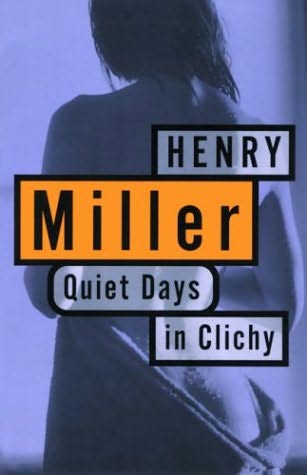
Quiet Days in Clichy


We enjoyed this passage from Henry Miller’s Quiet Days in Clichy. The book covers some of Miller’s adventures living there in the 1933. The character “Carl” below is his flat mate Alfred Perles, the Austrian writer.

Give this passage a minute of your time. We like Miller’s outlook here and find him very much an absurd man:

“For an artist bad situations are just as fertile as good ones, sometimes even more so. For him all experience is fruitful and capable of being converted to credit. Carl was the type of artist who fears to use up his credit. Instead of explaining the realm of experience, he preferred to safeguard his credit. This he did by reducing his natural flow to a trickle.

Life is constantly providing us with new funds, new resources, even when we are reduced to immobility. In life’s ledger there is no such thing as frozen assets.

What I am getting at is that Carl, unknown to himself, was cheating himself. He was always endeavoring to hold back instead of giving forth. Thus, when he did break out, whether in life or with the pen, his adventures took on a hallucinating quality. The very things he feared to experience, or to express, were the things which, at the wrong moment, that is to say when least prepared, he was forced to deal with. His audacity, consequently, was bred of desperation. He behaved sometimes like a cornered rate, even in this work. People would wonder whence he derived the courage, or the inventiveness, to do or say certain things. They forgot that he was ever at a point beyond which the ordinary man commits suicide. For Carl suicide offered no solution, if he could die and write his death, that would be fine. He used to say on occasion that he couldn’t imagine himself ever dying, barring some universal calamity. He said it not in the spirit of a man filled with a superabundance of vitality; he said it as one who refused to waste his energy, who had never allowed the clock to run down.

When I think of this period, when we lived together in Clichy, it seems like a stretch in Paradise. There was only one real problem and that was food. All other ills were imaginary. I used to tell him so now and then, when he complained about being a slave. He used to say I was an incurable optimist, but it wasn’t optimism, it was the deep realization that, even though the world was busy digging its grave, there was still time to enjoy life, to be merry, carefree, to work or not to work.”

Just a few comments on this passage. The absurd elements are palpable here: The emphasis on experience in the beginning and the fruitfulness of all experiences, “good” and “bad.” And especially, the last paragraph, which sums up the cheerful aspects of the absurd life – trying to always find a way, trying to always find some time, to just be.

Friday, August 14, 2009

The Enormous Absurdity of Nature

A reader and frequent commentator on this blog, Jack Sparrow, who has an eye for absurd things himself, sends us the following. It is an excerpt from “The Enormous Absurdity of Nature” by Paul Allen Carter:

“However, Griffen continues, if we took time to consider nature, we could understand more fully the raw beauty of the life cycle, that without the rot on the forest floor there would be no iridescent hints of new life." That cycle includes us as much as the falling sparrow or the vanished dinosaur. And we fight it: "In the natural rhythm of life, things are born, grow up, grow old, die, and rejoin the Creator. But we have become nature's misers, hoarding our youth."

"The culture," adds adventure-fiction writer (and, at times, social philosopher) John D. MacDonald, "has labeled death unthinkable and unspeakable. One is forbidden even to think about it. That repression generates a deep cultural sickness: "Unable to turn inward, all fear turns outward," manifested in the "pinched, bitter, ugly, suspicious faces in Florida, California, Arizona--wherever the old ones gather for dying." But this particular anxiety neurosis long precedes old age. Egged on by profitable cosmetic and medicinal industries "our horror of the aging process," Lauren Griffen asserts, keeps us chained to the myth that we can be forever young, sexually attractive and virile. We cannot avoid aging, but think that we can delay it by becoming slaves to products that promise to tinker with nature."”

Full text, if you are interested, is here:

We like the excerpt because we think it is true. Society harbors an unhealthy denial of aging and of death. The absurd perspective would be to appreciate our part in the life cycle of the universe and to put no special brackets around humanity. We are defecating animals like the rest.

Accepting that condition, though, is part of the absurd man’s freedom. He finds peace with that and lives his life to the fullest without anxieties over his eventual death.

Thursday, August 13, 2009

Seeking clarity

It is often said that the stock market abhors uncertainty. In other words, investors would rather hear bad news than worry about what the news will be.

We see a corollary for this in life, with people seeking certainty about inherently uncertain things such as their health, job prospects, and family status. Further, we believe this search for certainty is behind much of the pain and conflict in modern life. As one of our readers recently noted, western cultures do not deal well with the certainty of eventual death. As she put it, "When it happens it is 'devastating, tragic, sad, unfair' as if it is not supposed to happen. A fluke rather than a rule."

This, of course, is a relatively new development, tied largely to the dramatic increase in lifespans over the past century or so. Prior to the development of modern medicine, people saw death in much more realistic terms--not only as a certainty, but one about which they could do little (if anything). Thus the widespread appeal of religion, which not only gave people hope (for life after death), but also nurtured the illusion that things happened "for a reason." Getting sick and dying, in short, was seen as a natural part of the ebb and flow of life, with death often greeted as an occasion for rejoicing rather than weeping (as the deceased was in a "better place").

Today, by contrast, we labor under the far more dangerous illusion that we can not only delay but perhaps...someday...if we keep working on it...actually prevent death. Not many people would actually admit to this, of course. But how else can one explain the vast resources we as a society devote to keeping people alive?

Indeed, people are arguably more humane in their treatment of pets than of family members. When a pet gets sick, we are far more likely to "put it out of its misery" rather than desperately attempt to prolong a life we know is drawing to a close. Yet when family members get chronically ill, most of us go into full-scale denial, refusing to accept (or even acknowledge) the ultimate certainty of their mortality.

Thus, while the rapid advance of medicine has certainly benefited society as a whole, it has also instilled the (largely unacknowledged) belief that we can cheat death if we only try harder. (After all, look at all the ways we can prolong life that did not even exist a few decades back!)

The tragedy is that, human nature being what it is, people forget the advances we have made and ask "what have you done for me lately?" They do not, in other words, celebrate the fact that they do not have polio (for example), but rather fret that the lead level in their drinking water may be slightly too high. Or that they must take a daily regimen of expensive pills. Etc, etc, etc.

This is yet another consequence of most people's refusal to accept their own mortality. Rather than viewing illness and death as just another part of life, modern society sees death as the ultimate horror, to be delayed by any means necessary in the (futile) hope that it can ultimately be cheated. The supreme irony, of course, is that in so doing we end up denying ourselves the joy of living in the moment and taking each experience as it comes.

In seeking to cheat death, we unwittingly cheat ourselves of the wonders of life.

Wednesday, August 12, 2009

Camus: A Life

We recently read a new biography on Albert Camus by Elizabeth Hawes, titled Camus: A Romance. If you want to find out more about the life of Camus, and what sort of fellow he was, without tackling the doorstopper tomes of Lottman or Todd, then we recommend the book. It is not a straight-ahead biography, but more an exploration of a life by a writer who is a fan. Hawes brings her own journey into the story. It makes for easy reading.

Hawes does not deal as much with Camus’ ideas as she does with his life. She gives a lot of the backstory on where Camus was, what was happening in his life and in the greater world around him, as he wrote his various works.

Camus was born in Algeria in poor circumstances. He was a good student, though, and that was his ticket to get out of poverty, attend school and enter the literary world. He contracted TB at 17, which would affect him the rest of his life.

At this early age, the absurd starts to make its appearance. Camus remembers the episodes of coughing up blood and his mother being no more worried about it than if he had a headache. Hawes writes:

“But if he was initially disconcerted by his mother’s “surprising indifference” to the gravity of his condition, he also knew that in his seventeen years he, too, had learned indifference, which was both a cover-up for suffering and a commitment to getting on with life.”

After reading Hawes, we want to read some of Camus’ other works that we have not tackled yet, such as The First Man, which is largely autobiographical or his Notebooks, which Hawes quotes from liberally.

In the course of her portrait, we also see Camus as a very human figure. He is the absurd man, but he is hardly always so. He frets about criticism, has black episodes of depression and has all the emotional highs and lows of any man. At one point, in one of his many bouts with TB, he is feeling particularly sick and tired and he writes in a letter, as if to dispel the gloom: “It’s necessary to know how to make friends with your rock.”

This is a reference to the myth of Sisyphus, where Camus imagines Sisyphus as happy. We love this quote, as it again shows the indomitable spirit of the absurd man to persevere, to find happiness in whatever circumstance.

There are other gems. Another favorite quote Hawes finds is also from a letter. Camus writes: “That’s what I call happiness, to talk about sausages when the others are interested in the soul’s destiny.” This gets at the idea of enjoying the moment and the experience of the present rather than worrying about the future or about things we cannot know or control.

There are interesting connections Hawes makes along the way. For instance, there are several pages devoted to A.J. Liebling, the great New Yorker writer, and his relationship with Camus. As Liebling is one of our favorite writers, we found it interesting that, as Hawes writes, “Liebling loved Camus.” It seems the affinity between the two writers as mutual. They went pub crawling together in New York and had some adventures in the seedier side of the city. Hawes writes: “Camus loved seeing the underside of the city with such a wry and seasoned guide.” Both loved sports, women and good food and wine.

Liebling also wrote the obituary for Camus that appeared in the New Yorker. He wrote of his old friend: “He felt the world as close as water then and never grew the scales appropriate to a Big Fish. He was without insulation – the antithesis of the detached Stranger.”

Readers will also find Camus as essentially a moralist. Hawes quotes from a letter, in which Camus writes: “For my part, I have always thought that there was more to admire in a man than to despise. That is why it is always necessary to begin with kindness.” That is interesting, because critics of Camus’ absurdism – even in the comments of this blog – often accuse him of dancing on the lip of the volcano of nihilism. The man himself, though, had many beliefs about how to live well and in harmony with your fellows. He was greatly concerned with moral questions and wrote about them (such as his opposition to capital punishment or his opposition to bloody revolt – the latter belief was, in part, behind his famous break-up with Sartre. Camus thought Stalin a thug; Sartre, a communist, thought otherwise. History judged Camus correct, though it was a very unpopular position at the time, especially in France.)

In reading her portrait, you will get to know Camus, the man, a little better. You will learn more about the context of his thoughts and works. And it will send you scurrying to a bookstore to track down some of his books. We enjoyed it, too, as it made Camus a much more human and flawed figure, and thus even more admirable.

Tuesday, August 11, 2009

Living without fear

There are many facets to living the absurd life. Indeed, we are often struck by how broad and deep the concept of meaningless turns out to be--just when we think we have it figured out, along comes another fascinating application. How can something so simple, we sometimes wonder, also be so complex?

For example, one of the most liberating parts of the absurd is that once you realize nothing matters, there is no need to be afraid. Think about this for a minute. Consider the source of your fears--not just of physical harm, but that you will lose your job, or not have enough money to retire, or be abandoned by your friends, or that something horrible will happen to a loved one--and examine why you fear such things. Where does this fear come from? What purpose does it serve? In short, are there valid reasons for fear, and (most importantly) would you be better off without it?

This concept plays into a theme we have previously explored, which is the large number of people who are sympathetic to the absurd, but only to a point. After all, they argue, what about loved ones? What if something really bad happens? What if, what if, what if...

We sense this is a fairly common viewpoint, the idea that certain things "matter," such as family, or friends, or health. Of course, if the world is meaningless there is no reason to view anything as more (or less) meaningful than anything else, even such culturally sacrosanct ideals as these, but nevertheless a great many people reject this simple (to us, anyway) explanation.

This is certainly understandable, particularly given enormous and persistent societal pressure to do so. However, in our opinion this is a tragic error. In short, by accepting that certain things matter more than others, such individuals unwittingly create the source of their own fears. This is ironic, since they no doubt believe they are doing the opposite (i.e., increasing their happiness) by caring about such things.

Consider: If you have no fear of death, why be afraid of pain? If you know your children will die someday, then why fret about their education, their marriage prospects, their "place in the world"? If you live moment to moment, for experience rather than meaning, what does it even mean to "retire"?

The bottom line is that fear is divisive, destructive...and entirely self-created. We all have the ability to live without fear if we choose to do so. But we cannot live this way so long as we cling to our hope--the hope that things matter, that our life has purpose and meaning, that we are something more than random collections of atoms thrown together in a fantastic cosmic accident.

The wonderful thing about embracing the absurd is not only that it frees one to live as one chooses, but also that it strips away these self-created impediments to loving freely, unconditionally, and without reservation. When the fear is gone you find that all that remains is peace and harmony with the world as a whole, which is simply not possible when one "wants," and "prefers," and "chooses" one thing over another.

As with many issues, we have found Krishnamurti enormously helpful in this area, and we close with what we consider to be one of his most thought-provoking passages--on how to live peacefully (i.e., free of fear) in a violent world.

"If you are free of violence in yourself the question is, 'How am I to live in a world full of violence, acquisitiveness, greed, envy, brutality? Will I not be destroyed?' That is the inevitable question which is invariably asked. When you ask such a question it seems to me you are not actually living peacefully. If you live peacefully you will have no problem at all. You may be imprisoned because you refuse to join the army or shot because you refuse to fight, but that is not a problem; you will be shot. It is extraordinarily important to understand this."

Sunday, August 9, 2009

The Wind in the Willows


We were reading The Wind in the Willows by Kenneth Grahame to our kids last night. It’s one of those classic children’s books. But we were surprised and delighted by its absurd moments.

The easy-going, affable and happy water rat, for instance, is quite the little absurd water rat. He lives along a riverbank, where he is content with things as they are. In describing how he loves to go “messing about in boats,” the water rat says:

“In or out of ‘em, it doesn’t matter. Nothing seems really to matter, that’s the charm of it. Whether you get away, or whether you don’t; whether you arrive at your destination or whether you reach somewhere else, or whether you never get anywhere at all...”

That’s a nice summary of an absurd life. The rat lives for every moment and the experience of that particular moment is less important than enjoying the moment itself.

Another character, the mole, has some flashes of absurd insight he discovers by hanging around the water rat. The rat’s infectious joy of life seems to rub off on mole. As one point mole is charged with packing the picnic basket. Grahame writes:

“Packing the basket was not quite as pleasant work as unpacking the basket. It never is. But the Mole was bent on enjoying everything…”

This, too, is an absurd insight. In a world where nothing matters, each experience is as good as any other. Mole does his best to enjoy the experience of life, even mundane experiences such as chores.

We’re not finished reading the book, but so far we are pleased with its absurd subtext. Such wisdom in a children’s book! We could all learn a little something from the water rat and the mole.

Friday, August 7, 2009

What is the absurd?

What is the absurd?

When we talk about the absurd in common speech, we get pretty close to what the absurd philosophy is all about. Really, the absurd is born of a comparison.

If a man walks up to you and says he is going to lift his car above his head with his own hands, you would say that is absurd. Why? Because you recognize the futility of his effort. You see the conflict between his means and his reality. He can’t, no matter what, raise that car above his head.

The absurd, then, springs from a comparison between what people are trying to do and what the reality of their existence is. There are absurd wars and absurd politics… there are absurd marriages, absurd jobs, absurd universities, etc. Anywhere the goal (say, for the war on drugs) seems impossible given the reality (there will always be some group of people doing drugs no matter what), we say that is absurd.

The philosophical absurd view of life begins with the idea that life has no meaning (at least, not one that is possible for us to know). Therefore, the absurd sees man’s quest or longing for meaning as futile. Any attempt to create meaning then puts you in conflict with the way the world is. Or, put another way, the absurd is the gap between “the mind that desires and the world that disappoints,” in Camus wonderful phrase.

The great metaphor is still Sisyphus. He rolls his rock up a hill, only to have it roll back down the hill where he has to start over again. He never will get the rock up the hill. It will always roll back. But Sisyphus continues anyway. He accepts his fate. Sisyphus is the absurd hero.

Imagine Sisyphus as happy and there you have the absurd man.

The absurd philosophy, then, is about how to live in an absurd world – a world that has no meaning, and where all of our efforts are ultimately futile. There are some logical deductions one can make from that premise. And we’ve tried to examine a few in past posts, such as we do here.

We aim to explore more of these ideas on our blog.

Thursday, August 6, 2009

Why do you care what other people think?

We were having a conversation recently with someone we consider "semi-absurd." (And of course, as explored in our recent piece on consistency, by semi-absurd we really mean not absurd...) This individual recognizes the validity of the absurd (i.e., he agrees there is no meaning beyond the physical world), but can't quite bring himself to embrace its ultimate conclusions. (That, for example, there is no reason to care more about one's biological family than about other people.)

Anyway, during this particular conversation he told us something was bothering him (we can't recall what it was), and referred to it as "self-imposed" stress.

But, we protested, isn't all stress self-imposed, being that it originates and resides in one's brain?

Well, sure, he said with an annoyed wave of his hand, if you don't care what other people think!

We have nothing further for this witness...

Tuesday, August 4, 2009

In Praise of Consistency

"A foolish consistency is the hobgoblin of little minds, adored by little statesmen and philosophers and divines. With consistency a great soul has simply nothing to do. He may as well concern himself with his shadow on the wall. "--Ralph Waldo Emerson

With all due respect to Emerson, we have always been mystified by this quote. It seems to us that true consistency is something to be admired, as it speaks to a unified vision of the world, one not swayed this way or that by events and emotion.

Let us be clear. We are not talking of someone who is (for example) a consistent Republican. It is not consistent to resist government intervention in your bank account but welcome it in your bedroom. (Indeed, we find the rampant inconsistency of most people's political views more than passing strange. But this is not a political column.) We define consistency as a worldview that does not differentiate based on race or creed, wealth or poverty, educated or illiterate. It is the practice of looking at things broadly, not (as is often assumed) to incorporate multiple points of view, but rather to view people and events with true objectivity.

We admit this is a tall order. Indeed, the list of those we consider truly consistent is short indeed. Krishnamurti and the Buddha jump to mind, as does Thich Nhat Hanh. Others we have quoted in this blog (Bemelmens, Bukowski, Mencken, Henry Miller) are close enough for government work. And surely a number of individuals have lived their life according to a stable vision yet never come to be widely known.

All the individuals cited, of course, would also be considered absurd. But this is not the only way to be consistent. For example, we recently had a visitor post several comments attacking us and our philosophy. After a bit of back and forth, we discovered he is (in his words) "a believer." He added that he has"always felt that a true Christian has much in common with an atheist: the urgent need to disbelieve in a thousand false gods."

We found this an interesting way of putting it. In fact, religious fundamentalism is no less consistent than being absurd. We may (and do) feel it is incorrect, but it is a consistent belief system. It is indeed possible that God, or Allah, or some other deity is in fact the creator of the known universe, and thus our assumption that life is meaningless is simply...wrong.

However, such a statement applies only to fundamentalist beliefs. Indeed, we shudder when we hear people praise religious "moderates" for embracing a "practical" worldview. We have little patience for those who attend church out of some vague "duty," or say they believe in most scripture, but are willing to give a pass to evolution. This is not consistent. If your religion says God created the world in six days a few thousand years ago, then either this happened or it did not happen. There is no in-between. You can't claim to believe in a God who created man in his own image, and also believe man evolved from single-celled organisms. These views are simply not compatible. Thus, while we do not agree with religious fundamentalists, we do respect the consistency of their belief systems. (It is true, of course, that religions may have internal contradictions, but that is beyond the scope of this essay.)

Consistency is not, we should mention, what drew us to the absurd. But it was a vital factor in our accepting its premises. Indeed, we have always marveled at the wonderfully simple consistency of the absurd. Even its seeming contradictions turn out to be illusory. (The most significant of these is the question, explored by Camus in The Rebel, of whether the absurd man should be opposed to murder given that life is meaningless anyway. Camus' elegant solution was to point out that by not committing suicide, the absurd man has, whether consciously or not, imposed a belief system on his worldview [i.e., it is better to live than not live]. Thus, it is not consistent to take the life of another.) We also find it interesting (and a bit sad) that so many understand the basic premise of the absurd, but shrink from the broad implications of fully accepting the meaninglessness of life. (They are, in a word, inconsistent.)

It may well be that the consistent individual has "nothing to do." But in contrast to Emerson, we find this something to be celebrated rather than derided. Indeed, the absurd man by definition has nothing he must "do," and yet it is through this release, this unlocking of chains, that he finds true peace and contentment.

Boost Your Creativity

We’ve talked a lot about the benefits of the absurd – of embracing this idea that life has no meaning and all that spins from that insight. Part of that is cultivating a detached view of yourself.

By cultivating a detached view of yourself, we mean that you try to achieve a little distance in how you look at what you are doing. You see the bigger picture around you. You see yourself as playing a role. Kind of hard to describe, but we know sometimes we sit at our favorite cafĂ© and “zoom out” – like in those commercials where they show a guy, then the guy around his house, then zoom out to his neighborhood, then the U.S., then the planet… It’s just a way to disengage your immediate emotional self and gain perspective. You pull away and see things at a more abstract level.

Well, it turns out this kind of detachment can also boost your creativity.

A reader of ours, Jack Sparrow, forwarded to us a piece in Scientific American about this idea of “psychological distance.” It concludes that achieving this state of mind can actually boost creativity. An excerpt:

“Psychological distance affects the way we mentally represent things, so that distant things are represented in a relatively abstract way while psychologically near things seem more concrete. Consider, for instance, a corn plant. A concrete representation would refer to the shape, color, taste, and smell of the plant, and connect the item to its most common use – a food product. An abstract representation, on the other hand, might refer to the corn plant as a source of energy or as a fast growing plant. These more abstract thoughts might lead us to contemplate other, less common uses for corn, such as a source for ethanol, or to use the plant to create mazes for children. What this example demonstrates is how abstract thinking makes it easier for people to form surprising connections between seemingly unrelated concepts, such as fast growing plants (corn) and fuel for cars (ethanol).”

And the conclusion:

“This research has important practical implications. It suggests that there are several simple steps we can all take to increase creativity, such as traveling to faraway places (or even just thinking about such places), thinking about the distant future, communicating with people who are dissimilar to us, and considering unlikely alternatives to reality. Perhaps the modern environment, with its increased access to people, sights, music, and food from faraway places, helps us become more creative not only by exposing us to a variety of styles and ideas, but also by allowing us to think more abstractly. So the next time you’re stuck on a problem that seems impossible don’t give up. Instead, try to gain a little psychological distance, and pretend the problem came from somewhere very far away.”

You can find the full piece here.

Monday, August 3, 2009

Living the absurd life

There is an interesting conversation taking place here in response to the “Embracing the Abyss” post. One thing that is missing from this conversation that deserves a fresh post is some idea of what living the absurd life means in a practical sense.

Some thoughts on that idea follow (by no means comprehensive or exhaustive) and then a pair of examples…

The absurd man is relatively indifferent about the future; his focus is on the immediate because that is more certain. This is important, because the more you try to arrange your life to certain aims and create meaning, the more you create barriers that confine your life to those aims and meanings. The more you insist on living with concerns about the future, the more you lose your absurd freedom, or inner freedom that comes from releasing those concerns.

Therefore, as absurd men we try as much as possible to be in the present moment. Is it hard? Yes. Do we do it 100% of the time? Of course not. We get better at it as time goes on. But again, we find the idea itself is liberating and worth pursuing.

Experience is all we have. The absurd man is passionate about life; he has rejected suicide. He accepts his futile struggle, like Sisyphus pushing his rock up the mountain only to have it roll back and have to start over again. Sisyphus is the absurd hero, happy in the meaningless struggle. The struggle, life itself, is enough.

As absurd men we don’t pine to be somewhere else or hope for a better or different life. We accept our lot and try to make the best of it by, among other things, living it fully, collecting experiences, trying new things and not being afraid of death.

The absurd man lives in full awareness of his absurd condition. What sets the absurd man apart is his awareness – awareness of his temporal limitations (he knows he will die) and awareness of the absurdity of his existence.

Just being aware has great benefits as we’ve written about before. It is hard to describe in words what it feels like to just be somewhere, be at complete peace with the world.

The absurd life is a life without regret. The absurd man does not live in the past. Regret in a world that has no meaning is a wasteful emotion, in fact it is practically a contradiction.

The practical effect here is that what is done is done and we don’t worry about things we can’t change.

These are, again, just some thoughts, banged out here in the lunch hour… Our whole blog is, in part, an exploration of what it means to live the absurd life and many of our posts have touched on these ideas.

As an aside, Camus often talked about the three consequences of the absurd – revolt, freedom and passion were the words he used. It might help also to go over these broadly…

Revolt essentially means to keep living without despair or resignation that some might think comes with the knowledge that all is meaningless and death and oblivion await us all.

Freedom means living indifferent to the future, living in the present, free of constraints and worries that plague those who put undo importance on what happens on this earth.

And passion means living a full life of experiences, not passing judgment on those experiences (abandoning a scale of values as Camus put it), but valuing all experiences, being aware of them and aware of the passing moments.

Albert Camus also gives examples of absurd lives in Myth of Sisyphus. The most powerful to us is the actor.

The actor is always assuming new roles, each of them is fleeting and he knows this. He plays them to the fullest and remains aware that he is acting, that it is not “real”. In a similar way, we’ve often looked at our own lives this way – as if we were playing a role. We find this detached look at one’s own life to be very helpful and calming.

We’d throw professional athletes in this mix too, very similar to the actor. He plays a game, which no one puts any special meaning on. He plays it fully (most of the time) and with passion, but again he is under no illusion that what happens on the field makes the world better or has some greater meaning. It is just a game. This, too, is a good metaphor for life. We are playing a game and we aim to play it well and play it to the hilt, but in the end it is only a game.

These are just snippets on what living the absurd life is about, but we aim to explore more of these ideas and others on this blog.

Saturday, August 1, 2009

War is Absurd


We saw The Hurt Locker the other night. The movie follows a bomb tech team charged with disarming “unexploded ordinance” like roadside bombs and other traps in Iraq during the U.S. occupation. The movie was very well done.

We also have to say that if anything brings one closer to the absurd realities of life, it seems war would do it. The characters are constantly reminded of their mortality and the seeming futility of their struggle.

In the movie, as in most war movies, the characters take up different roles.

There is the soldier who can’t stop worrying about his own death. He is obsessed with it and is afraid. There is the soldier who buries his emotions in his duty. He is the one who follows the rules, does his job and swallows down the emotions inside of him.

Then there is the main character of the movie, Sgt. James, who is the absurd hero of the film in our view. James is fearless. He is referred to, more than once, as a wild man. He seems to even enjoy what he does, seems to get a thrill from it. Sgt. James is nearly always loose and calm. He is the absurd man, facing down death.

As we mentioned, the team has to diffuse bombs. They face their own death every time out. Sometimes the bombs go off and techs are killed. And every tech knows this every time they go out on a mission. The pressure and intensity they face is incredible. The strain of daily life is almost unbearable.

We won’t give away the ending, but we recommend the movie. It will give you some food for thought, something to chew on while you enjoy your creature comforts here way away from the hell hole of war.