

 Posts
Posts


"I devoted my life, longer than you can possibly imagine, in service of a man who told me that everything was happening for a reason, that he had a plan, plan that I was a part of, when the time was right that he'd share it with me, and now that man's gone so...why do I want to die? Because I just found out my entire life had no purpose."--Richard Alpert, character from Lost.
We were chatting with Inigo the other day about Karl Popper, the philosopher who said (among other things) that the way to empirically test scientific theories was not to seek confirmatory evidence, but rather to do one's best to falsify the theory. His famous example was that while one could see only white swans one's entire life and (quite reasonably) assume all swans are white, the sighting of a single black swan instantly invalidates the premise.
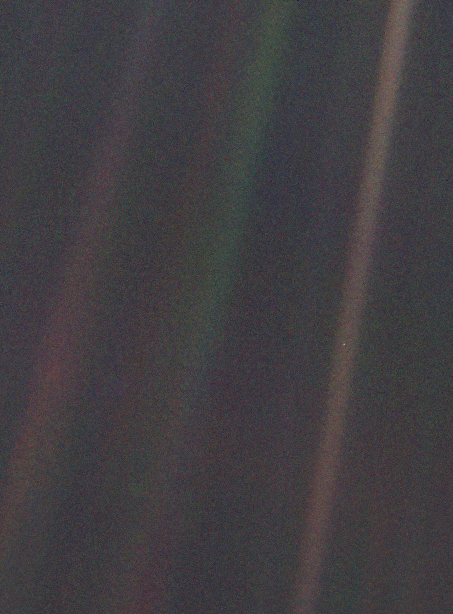
We find this to be of use with the absurd, as anti-absurd views often bring the benefits (and logic) of the absurd into sharp relief. For example, we keep a copy of Carl Sagan's famous "pale blue dot" picture on our wall as a reminder of our incredibly tiny and insignificant place in the universe. (For those who do not know the story, Sagan had the Voyager spacecraft take a picture of Earth from the edge of the solar system.) A colleague recently asked about the picture, and seemed visibly upset when we explained it to him. Shortly thereafter, he sent us an email with the subject line "More than a dot," with a full-scale picture of the Earth in all its technicolor glory.
While the email was at least partly tongue-in-cheek, it gets at what is so difficult about the concept of the absurd for so many people. Put simply, we live our entire lives being told, either implicitly or explicitly, that things matter--as Richard Alpert so aptly put it, that our lives have purpose. Thus, it can initially seem shattering when that sense of purpose is threatened.
Another example. We are quite fond of Cormac McCarthy's book The Road, and recently loaned a copy to another colleague. (For those who have not read it, the "plot" is that a man and his son are struggling for survival in a post-apocalyptic world. The entire novel seemed to us an allegory for the absurd--i.e., that "hope" is a false god--with the glaring exception of the ending, where the man dies and his son is inexplicably "rescued" by another man who can only be described as "one of the good guys." This, needless to say, was our least favorite part of the book.)
Anyway, our colleague said she liked the book a lot--while most of it was very bleak, she explained, she really liked the end(!) We, being unable to help ourselves, pushed on this point. "You know," we said, "the takeaway is really that all of us are on 'the road.'" She looked briefly panicked, then replied, "Well, that's depressing!"
But why? Why do people cling so desperately to the idea that things have meaning? Why must our actions have significance? Why are we so inextricably wrapped up in the ruinous cycle of achievement and accomplishment that inevitably lead to disappointment and strife?
We recently read Joe Simpson's book Touching the Void, about his near-death experience while mountain-climbing. While we heartily recommend the entire book, one passage in particular was particularly pertinent. Simpson and his climbing partner had just ascended the summit, and he recorded his reaction thus:
"I felt the usual anticlimax. What now? It was a vicious circle. If you succeed with one dream, you come back to square one and it's not long before you're conjuring up another, slightly harder, a bit more ambitious--a bit more dangerous. I didn't like the thought of where it might be leading me. As if, in some strange way, the very nature of the game was controlling me, taking me towards a logical but frightening conclusion; it always unsettled me, this moment of reaching the summit, the sudden stillness and quiet after the storm, which gave me time to wonder at what I was doing and sense a niggling doubt that perhaps I was inexorably losing control - was I here purely for pleasure or was it egotism? Did I really want to come back for more?"
For a moment, we found this terrifically insightful. For a moment. But then we read the next passage. "But these moments were also good times, and I knew that the feelings would pass. Then I could excuse them as morbid pessimistic fears that had no sound basis." (Emphasis added.) Indeed, when we searched the Internet for this passage we actually found it in a thesis that argued "if we do have a good reason for living, if we can give life meaning, impending
death is easier to bear. Some desires to die are the result of a lack of worthwhile purpose."
No doubt this is the case--many people find it so difficult to come to terms with our lives' lack of meaning that they contort themselves into all manner of logical fallacies to avoid accepting this simple fact. We have spent much time on this blog, for example, disputing the notion that individuals can create "meaning" for themselves, partly because we believe it is a bit silly, but also because it is the idea of meaning--rather than whether that meaning is defined as universal or personal--that ultimately creates conflict and unhappiness. In short, if one believes certain things "matter" more than others--regardless of why--it is inevitable that one's life will at some point not conform to these preferences.
The absurd man, by contrast, recognizes the folly of all such beliefs. While he certainly feels such things--he is human, after all--he laughs at his own foibles the same as any other individual. He rejects the notion of the "self," instead choosing to view life as akin to acting in a play, where actions seem to have consequences, but ultimately have no significance whatsoever.
To bring this full circle, we take great comfort in our own irrelevance. Rather than despairing over our lack of purpose, we celebrate it!
Until next time...
Tuesday, March 16, 2010


Tuesday, March 9, 2010
Gone Bamboo

"Here lies one whose name was writ in water.”
John Keats requested that those words appear on his tombstone.
We like it, as a kind of absurd statement. We also thought of these words after we recently had a shocking conversation with a very old friend, which we will share below. We found it inspirational and it plunged us into deep thought for several days...
But first, a few thoughts on Keats' words. The idea recognizes the temporal nature of our existence and its meaningless “here today gone tomorrow” sort of nature. It’s our contention that one can live a full and content life embracing the absurdity of existence. We need no goals or mission or meaning. We simply are.
It’s not a popular opinion. And some even feel vaguely threatened by it. We came across this recent editorial, which laments the decline of Judeo-Christian traditions and our “moral compass.”
“[W]e are threatened with the thought that human existence is absurd and pointless,” the editorial says. “That was the dread possibility explored by Albert Camus and the pessimistic existentialists in the 1940s and 1950s. For them it raised the question of whether, faced with meaninglessness, one would do better to kill oneself; and this prompts the question whether rising rates of self-harm and suicide among young people today may be connected to a similar sense of the absence of human meaning.”
If this were a political arena, you can see how the debate would unfold. People who espoused an absurd point of view would quickly be dubbed “pro-suicide” regardless of the arguments. Makes us think the absurd is better off on the comfortable fringe.
In any event, this is always the challenge. The absurd doesn’t really offer a formula for living in the same way the world’s religions do. The absurd is an expression of doubt – doubt about the meaning and significance people put on life, the universe and everything. It is an effort to live free.
Few can master this, it seems. Almost everyone feels the tug of societal pressures of some form or other – and gives in. Part of what we do on this blog is gather examples of people who didn’t or don’t give in, or at least resist better than others. (Rebels, as Camus would say…)
One good example came to us recently when we spoke to an old high school and college buddy. We haven’t spoken to him in 5 years, when he ditched the U.S. and decided to live in Nicaragua.But our business will take us through Central America in the coming months and we thought to find our old friend.
We were surprised to find an absurd man.
We say surprised… well, we knew he had absurd inclinations, as did we. But he seems to have really bloomed into an absurd man par excellence.
We chatted over the phone. We found out he doesn’t work. Well, he works sometimes as a general handyman, you might say. And otherwise doesn’t. It’s very cheap in Nicaragua and one can live very well on very little - even more so if you save and forgo luxuries we don't think twice about spending money on here, but which you could readily do without when you think about it. As he put it, with a laugh, “This is how I can work for a year and take off for a year.”
He has a Thoreau-like lifestyle. He lives by the beach, the grand Pacific Ocean at his doorstep. He watches the sea roll in and out. “You know there are people who pay money for CDs with these sounds,” he told us. “Here you have all you want for free.” The sea lulls him to sleep at night, the sky a canopy of bright stars here, invisible to most people who live near city lights.
He eats fresh seafood and locally grown fruits and vegetables for practically nothing. He reads tattered second-hand books. Takes long walks. Enjoys the culture of living near an old Spanish town that dates to the 1500s. He watches sports on TV. He has plenty of friends around the town in which he lives.
The man has no occupation at all and no ambitions. And he seems completely fine with that. He’s “gone bamboo” as the saying goes. He told us, “I don’t really care about the future. I just live my life in the here and now the way I want to live it…” To think we were in business school together nearly 20 years ago. Wow.
That’s not to say he has been foolish with his money. He told us, “I have saved almost enough to live on my savings alone. I bought some lots around here when they were very cheap. So, I am not poor. Either way I am very happy here.”
No wonder he’s not come back to the states. We made plans to visit him on our trip there. But it was refreshing to find an absurd man in an old friend. A man who completely rejected the normal measures of success, who finds no compulsion to seek a career or do any of the things society expects of a man.
And why not? We are all merely names writ in water…
Friday, March 5, 2010
Uncertain Destiny

Financial markets, it is said, abhor uncertainty. Put another way, stock markets tend to suffer their worst falls not due to some terrible event, but rather in anticipation of a future occurrence where specifics remain unknown. This, of course, is due to the fact that humans tend to overestimate the impact of future events (both good and bad). Indeed, studies have shown that people who lose their sight, or both their legs, or some other "critical" function deemed "necessary" by most of us, tend to generally adapt quite well to their new state of affairs. Conversely, the positive effect of things we expect to make us happy (new job, big house, beautiful wife) tend to wear off must faster than we expect (again, as we adapt to our new reality).
In short, reality is relative. Thus, many people remain unhappy despite the fact that large swaths of humanity today live better than the most powerful king a few hundred years ago. The fact that we have central heat, and air conditioning, and unimaginably plentiful food supplies is simply not all that impressive when our neighbor has a new boat...
But this is not really the path we want to follow today. Instead, we have been thinking about uncertainty as it relates to our own destiny. The ultimate destiny is well known, of course (even if we take extreme measures to avoid acknowledging this fact), but the timing remains uncertain. But what if it were not?
Consider, for the sake of argument, that the maximum human lifespan has been conclusively proven to be 50 years. While people can die before reaching 50, no one survives past this age. Society, therefore, is organized a bit differently. People who fall ill in their late 40s, for example, generally reject expensive and involved treatments, instead opting for smaller measures that simply make them more comfortable. Moreover, there is little grief for those who die at or near 50--after all, they lived as long as possible!
Indeed, 49th birthday parties are generally lavish affairs where people celebrate their achievement of this penultimate milestone. Time Magazine interviewed someone on the day before his 50th birthday and asked if he were afraid. "Of what?" he answered. "I know what is coming, and there's nothing I can do to stop it. I made peace with my destiny many years ago."
Often, when we see stories about terminally ill patients, the patients themselves have come to terms with the inevitability of their own death (even as family members have not). The knowledge that death will come soon, in other words, forces one to confront death as real (as opposed to some abstract concept). No need to save for retirement! No need to worry about next week's party! Promotion? What promotion?!?
Hmm...sounds like a pretty good way to live. Pity it's only available to those with a finite lifespan...
Sunday, February 28, 2010
Happiness from Within, Unhappiness from Without
“We all carry within us our prisons.”
- Albert Camus
Most of us live in a sort of unthinking routine. We get up in the morning. We eat breakfast and read the paper. We go to work. We come home. We have dinner. We go to sleep. And the next day we do it all over again.
It’s a comfortable pattern. It has its own rhythms. We are barely conscious of the ceaseless passing of days. But then one day we start wonder “Why?” This when all things begin, says Camus. The chain of daily existence is broken. This is when some of us will experience feelings of the absurdity of existence.
Those feelings run along familiar grooves, Camus thought. Among them: An awareness of the inevitable grinding away of our physical existence, knowing the end is our inevitable death. A sense that the powerful forces of nature mock our frail physical existence; that there is this big, incomprehensible universe that is unmoved by anything we do. A feeling of being alone or apart from other people, even a sense of alienation from “self,” a questioning of what is self, like lingering over an old photograph of “yourself” and wondering who that was, doubting it was the same person who gazes at the photograph today.
All of these things Camus writes about. And though they may sound depressing, Camus turned it all on its head. He instead leads us to embrace absurdity. And in this embrace is a release, a kind of liberation. He stresses the joy of life in the flesh, of living in the moment.
Happiness or equanimity, then, comes from within.
Ah…
But modern life conspires against this idea. That is the thesis behind a new book titled “The Age of Absurdity: Why Modern Life Makes It hard to Be Happy” by Michael Foley. If happiness comes from within, then unhappiness comes from without.
We caught this review and found the idea of the book fascinating. After all, we’ve made the same case on this blog.
As the reviewer (who seems to get the idea of the absurd) writes:
“Modern life, Foley argues, has made things worse, deepening our cravings and at the same time heightening our delusions of importance as individuals. Not only are we rabid in our unsustainable demands for gourmet living, eternal youth, fame and a hundred varieties of sex, but we have been encouraged – by a post-1970s "rights" culture that has created a zero-tolerance sensitivity to any perceived inequality, slight or grievance – into believing that to want something is to deserve it. As Foley puts it: "Is it possible that a starving African farmer has less sense of injustice than a middle-aged western male who has never been fellated?"
(Well… that’s an interesting question!)
We agree with the idea that society is decidedly anti-absurd. It wants us to buy things. It wants us to realize our potential – a potential defined by societal norms like having physical things… a nice house, a new car (you deserve it!), a sleek body, a college education, a promising career and on and on it goes…
The futility of the ceaseless striving is obvious when we reflect that our drive for these things is never satisfied. As the reviewer goes on to write:
“It's not even as if we want what we have once we've got it. Foley calls this "the glamour of potential", a relentless churning of desire by which the things we have are devalued by the things we want next. The only way out of the churn is "detachment", an idea as compelling to the Greek and Roman stoics as to Sartre and Camus: if you can't change the world, don't let it change you.”
Many great minds have arrived at the same general conclusions. Happiness is within and we make ourselves miserable with unmet desires. The great point of absurdity is that you find happiness in the absurdity of existence itself.
The book’s opening chapter is titled “The Absurdity of Happiness” and the last chapter is titled “The Happiness of Absurdity.” Sounds like a nice progression. And it also sounds like something we have to read if only for the pleasure of finding a fellow traveler in this absurd world!
- Albert Camus
Most of us live in a sort of unthinking routine. We get up in the morning. We eat breakfast and read the paper. We go to work. We come home. We have dinner. We go to sleep. And the next day we do it all over again.
It’s a comfortable pattern. It has its own rhythms. We are barely conscious of the ceaseless passing of days. But then one day we start wonder “Why?” This when all things begin, says Camus. The chain of daily existence is broken. This is when some of us will experience feelings of the absurdity of existence.
Those feelings run along familiar grooves, Camus thought. Among them: An awareness of the inevitable grinding away of our physical existence, knowing the end is our inevitable death. A sense that the powerful forces of nature mock our frail physical existence; that there is this big, incomprehensible universe that is unmoved by anything we do. A feeling of being alone or apart from other people, even a sense of alienation from “self,” a questioning of what is self, like lingering over an old photograph of “yourself” and wondering who that was, doubting it was the same person who gazes at the photograph today.
All of these things Camus writes about. And though they may sound depressing, Camus turned it all on its head. He instead leads us to embrace absurdity. And in this embrace is a release, a kind of liberation. He stresses the joy of life in the flesh, of living in the moment.
Happiness or equanimity, then, comes from within.
Ah…
But modern life conspires against this idea. That is the thesis behind a new book titled “The Age of Absurdity: Why Modern Life Makes It hard to Be Happy” by Michael Foley. If happiness comes from within, then unhappiness comes from without.
We caught this review and found the idea of the book fascinating. After all, we’ve made the same case on this blog.
As the reviewer (who seems to get the idea of the absurd) writes:
“Modern life, Foley argues, has made things worse, deepening our cravings and at the same time heightening our delusions of importance as individuals. Not only are we rabid in our unsustainable demands for gourmet living, eternal youth, fame and a hundred varieties of sex, but we have been encouraged – by a post-1970s "rights" culture that has created a zero-tolerance sensitivity to any perceived inequality, slight or grievance – into believing that to want something is to deserve it. As Foley puts it: "Is it possible that a starving African farmer has less sense of injustice than a middle-aged western male who has never been fellated?"
(Well… that’s an interesting question!)
We agree with the idea that society is decidedly anti-absurd. It wants us to buy things. It wants us to realize our potential – a potential defined by societal norms like having physical things… a nice house, a new car (you deserve it!), a sleek body, a college education, a promising career and on and on it goes…
The futility of the ceaseless striving is obvious when we reflect that our drive for these things is never satisfied. As the reviewer goes on to write:
“It's not even as if we want what we have once we've got it. Foley calls this "the glamour of potential", a relentless churning of desire by which the things we have are devalued by the things we want next. The only way out of the churn is "detachment", an idea as compelling to the Greek and Roman stoics as to Sartre and Camus: if you can't change the world, don't let it change you.”
Many great minds have arrived at the same general conclusions. Happiness is within and we make ourselves miserable with unmet desires. The great point of absurdity is that you find happiness in the absurdity of existence itself.
The book’s opening chapter is titled “The Absurdity of Happiness” and the last chapter is titled “The Happiness of Absurdity.” Sounds like a nice progression. And it also sounds like something we have to read if only for the pleasure of finding a fellow traveler in this absurd world!
Tuesday, February 23, 2010
Why Tiger Still Doesn't Get It
"Buddhism teaches that a craving of things outside ourselves causes an unhappy and pointless search for security. It teaches me to stop following every impulse and to learn restraint. Obviously, I lost track of what I was taught."--Tiger Woods
"If this is true, he's one of the worst Buddhists of all time."--Bill Simmons
A couple of months ago we penned an essay about why Tiger Woods was not happy. Unfortunately, things seem not to have changed much in the interim. Not that we particularly care one way or the other about Tiger's state of mind, but the fact that he chose to invoke the tenets of Buddhism--which closely resemble our outlook--caused us to reflect on his situation once more.
One of the things we have discussed frequently in this blog is the perplexing fact that so many people are willing to go right to the edge of the absurd...but unable to follow through. For example: "Yes, I accept that all is meaningless, but family - that's what really matters." Or: "Material possessions don't matter, but having a robust network of friends is essential to a happy life." Etc.
With that in mind, go back and read Tiger's comment again. The first sentence is...well, we couldn't have said it better ourselves. Indeed, we have often written about this illusory (and counterproductive) search for security. And yet, it is clear from the rest of Tiger's speech that he has simply substituted one set of things that "matter" (his wife and children) for another (cocktail waitresses).
In short, he is falling into the well-laid trap of believing family occupies some special and exalted niche in this purely physical world--that our protective feelings toward relatives come not from evolution and simple biology, but are instead...well, somehow different.
A craving of things outside ourselves causes an unhappy and pointless search for security.
It seems pretty clear that Tiger's wife and children exist outside him, so why the double standard? Why do we delude ourselves into believing one set of things (family) is more meaningful than the other (possessions, or even other people not related to us)?
The answer, of course, is that for all our delusions of grandeur, for all the hoping, striving, and achieving we undertake on a daily basis in the vain hope of validating our nebulous and ephemeral self, we remain gene replication machines and nothing more. However, we want so desperately to believe this is not the case that we set up vast, elaborate structures to distract ourselves from our true nature, codified by established (and strictly enforced) social mores.
Think back to why Tiger got in trouble in the first place - he violated the terms of his marriage contract. But so what? As we once noted, the idea that it "matters" whether a spouse has intercourse with another person is merely an idea certain human civilizations have codified, for a variety of reasons. As we put it then, "such beliefs--drilled into us by society--are like religion, in that we accept them wholly and unquestioningly, despite the lack of any logical reason for doing so."
This commitment to family is so hard-wired into our nature that most people are unable to even converse about it. For example, we recently watched an episode of the (often absurd) television show House, in which a character questioned his wife as to why he should care more about his son than about others simply because they are biologically related. His wife looked at him with horror and replied: "Because he's your son!" (We, feeling mischievous, turned to our wife and commented that the patient had a point. We are still awaiting a reply.)
The problem, of course, is that there is no answer, but this concept is so overwhelming to most people that they retreat behind elaborate defenses ("He's your son!) to avoid dealing with it. There is no objective reason to favor one's family over other, unrelated individuals. It is not "better" for Tiger Woods to spend time with his family than with cocktail waitresses. Any and all preferences we think we have are mere manifestations of biological processes and millions of years of evolution, mixed together with our present and past environments.
To clarify: we do indeed have wants and desires, but we recognize their transient and ephemeral nature. We had a wonderful bottle of wine last night, and today we are at work in an office. But we are not wishing we were back enjoying the wine. We are content where we are, with what we are doing. It is this simple insight that continues to elude Tiger Woods.
"If this is true, he's one of the worst Buddhists of all time."--Bill Simmons
A couple of months ago we penned an essay about why Tiger Woods was not happy. Unfortunately, things seem not to have changed much in the interim. Not that we particularly care one way or the other about Tiger's state of mind, but the fact that he chose to invoke the tenets of Buddhism--which closely resemble our outlook--caused us to reflect on his situation once more.
One of the things we have discussed frequently in this blog is the perplexing fact that so many people are willing to go right to the edge of the absurd...but unable to follow through. For example: "Yes, I accept that all is meaningless, but family - that's what really matters." Or: "Material possessions don't matter, but having a robust network of friends is essential to a happy life." Etc.
With that in mind, go back and read Tiger's comment again. The first sentence is...well, we couldn't have said it better ourselves. Indeed, we have often written about this illusory (and counterproductive) search for security. And yet, it is clear from the rest of Tiger's speech that he has simply substituted one set of things that "matter" (his wife and children) for another (cocktail waitresses).
In short, he is falling into the well-laid trap of believing family occupies some special and exalted niche in this purely physical world--that our protective feelings toward relatives come not from evolution and simple biology, but are instead...well, somehow different.
A craving of things outside ourselves causes an unhappy and pointless search for security.
It seems pretty clear that Tiger's wife and children exist outside him, so why the double standard? Why do we delude ourselves into believing one set of things (family) is more meaningful than the other (possessions, or even other people not related to us)?
The answer, of course, is that for all our delusions of grandeur, for all the hoping, striving, and achieving we undertake on a daily basis in the vain hope of validating our nebulous and ephemeral self, we remain gene replication machines and nothing more. However, we want so desperately to believe this is not the case that we set up vast, elaborate structures to distract ourselves from our true nature, codified by established (and strictly enforced) social mores.
Think back to why Tiger got in trouble in the first place - he violated the terms of his marriage contract. But so what? As we once noted, the idea that it "matters" whether a spouse has intercourse with another person is merely an idea certain human civilizations have codified, for a variety of reasons. As we put it then, "such beliefs--drilled into us by society--are like religion, in that we accept them wholly and unquestioningly, despite the lack of any logical reason for doing so."
This commitment to family is so hard-wired into our nature that most people are unable to even converse about it. For example, we recently watched an episode of the (often absurd) television show House, in which a character questioned his wife as to why he should care more about his son than about others simply because they are biologically related. His wife looked at him with horror and replied: "Because he's your son!" (We, feeling mischievous, turned to our wife and commented that the patient had a point. We are still awaiting a reply.)
The problem, of course, is that there is no answer, but this concept is so overwhelming to most people that they retreat behind elaborate defenses ("He's your son!) to avoid dealing with it. There is no objective reason to favor one's family over other, unrelated individuals. It is not "better" for Tiger Woods to spend time with his family than with cocktail waitresses. Any and all preferences we think we have are mere manifestations of biological processes and millions of years of evolution, mixed together with our present and past environments.
To clarify: we do indeed have wants and desires, but we recognize their transient and ephemeral nature. We had a wonderful bottle of wine last night, and today we are at work in an office. But we are not wishing we were back enjoying the wine. We are content where we are, with what we are doing. It is this simple insight that continues to elude Tiger Woods.
Sunday, February 21, 2010
The Overexamined Life
 "On the way back,
we passed by
the stone walls again.
The stones had no mortar;
they were just stones
balancing against the sky."
- Simon Ortiz, "Toward Spider Springs"
The unexamined life is not worth living, Socrates once said.
But, we would add, the overexamined life isn’t worth living either. We like the thought expressed in the Ortiz poem quote above. Sometimes, it's good to just be the stones - to just be.
But for many people that won't be enough. They will seek out the mortar. And if it isn't there, they will invent one. In other words, they can't live a life without believing that something holds it together, shapes it, gives it meaning and purpose.
We have a friend who is very interested in defining himself through his chosen pursuits. He lays them out with great thought and vision, rationalizing and justifying choices he's made. He speaks often about personal performance and achievement, as if life was a kind of self-improvement plan.
We are not passing judgment. To each his own. If he finds contentment in this self-analysis, then so be it.
But we can't help but wonder about the wisdom of investing so much of a sense of self in external things, achievements or pursuits.
If you want freedom, or emancipation from societal or personal chains ... if you want equanimity - that sweet sense of "unattached awareness of one's experience as a result of perceiving the impermanence of momentary reality... a peace of mind and abiding calmness that cannot be shaken by any grade of both fortunate circumstance and unfortunate one" - as the Wikipedia puts it - then this would seem counterproductive to that idea.
The reason is because these external things will not abide your wishes. You cannot always be what you want to be. Life and circumstance force changes upon you. How you react to life's vicissitudes will determine whether you can maintain that sense of equanimity or not.
If you have important life goals, activities that you believe define who you are, then you are less likely to maintain that equanimity.
The words of Albert Camus come to mind. "To the extent to which he imagined a purpose to his life, he adapted himself to the demand of a purpose to be achieved and became the slave of his liberty...
To the extent to which I hope, to which I worry about a truth that might be individual to me, about a way of being or creating, to the extent to which I arrange my life and prove thereby that I accept its having a meaning, I create for myself barriers between which I confine my life."
He goes on to write:
"The absurd enlightens me on this point: there is no future."
All that is, is the here and now. At some point, we're all dead men. The absurd man draws strength from this insight. "Death," Camus writes, "has patrician hands which, while crushing, also liberate."
In conclusion, we prefer to let life happen. Whatever wish or goal we have, we hold to it lightly, like a little bird we coddle gently in the palms of our hands. If it should flutter away, our life will be no poorer for having lost it.
Friday, February 19, 2010
Absurd Man v. Simian Man

So, are there ways to change your behavior, to mold the hard-wiring of your brain in some way? That is the focus of a new book titled Switch: How to Change things When Change is Hard.
The answer is yes. The authors maintain there are psychological principles you can use to change your behavior and overcome some hard-wiring. We’ve not read the book and don’t plan to. We saw a review in this morning’s Wall Street Journal and the thoughts in there inspire today’s post.
See… we’ve often talked about how there are parts of us that are hard-wired to be anti-absurd. And so in the past we’ve written about ways to be more absurd and overcome this hard-wiring.
The authors have some ideas… and it begins with the idea that humans don’t have one central decision-making unit. You may think of the brain as one unit, but in fact, our brains have two halves. There is a rational and logical part of the brain. And there is an emotional and impulsive part of the brain.
For our purposes, let us call the first the Absurd Man and the second, Simian Man. The first is what writes this blog. It’s our thinking, deliberate side. The side that weighs evidence and does the heavy lifting of (trying) to figure stuff out.
The Simian Man is the anti-absurd part of our brains that make us do un-absurd things – like getting upset in traffic or ticked off at work. It is the reactive, emotional part of our brains.
Having these two sides is like having your own internal Jekyll and Hyde show. Absurd Man tries to wrestle down monkey brains and keep things copacetic, while Simian Man has his own ideas and plays havoc with Absurd Man’s neat view of the world.
Simian Man can get in the way of the liberating feelings of absurdity. In the past on this blog, we’ve often talked about this Simian Man as something to beat down and control. But we are leaning more and more to accepting Simian Man and his non-absurd impulses as part of what it is to be human. If sometimes we act non-absurd, then so be it. Recognize it and move on.
The authors, however, have a few other useful ideas we thought we’d pass on. They say that in order to change your behavior you have to address both sides of your brain. So if you want to be more absurd, you have to appeal to both reason and emotion. You need concrete information (the rational arguments of the absurd) and you need a more emotional mental image of why it is “good” to be absurd (say, peaceful images of how calm and care-free you might be, of equanimity and acceptance, of the idea of emancipation).
The bottom line is you need to bring both systems onboard for change to occur. You need good rational arguments to appeal to Absurd Man… but he can’t do it alone. You also need to appeal to Simian Man.
The authors have other principles, too. One is to recognize that we are influenced by those around us. Our environment is an important part of the puzzle of our behavior. So, in order to be more absurd, the authors would advise you seek out like-minded people and create an environment more conducive to want you want to do.
This blog, we suppose, can serve that kind of purpose. It creates, in a way, a place where like-minded people can find some reinforcement and swap ideas about the absurd and similar viewpoints. It’s helped us be more absurd in our daily living. After all, absurdity, like a good offal restaurant, is a rare thing in today’s society. Even Simian Man would agree with that.
Wednesday, February 17, 2010
Options and Choices
If today was your last day
And tomorrow was too late
Could you say goodbye to yesterday?
Would you live each moment like your last?
Leave old pictures in the past
Donate every dime you have?
--If today was your last day, Nickelback
We went through a period a few years back where we put four pets to sleep (two dogs and two cats) in 14 months. Leaving aside some of the obvious existential issues, what has stuck with us is the manner in which our vet discussed each pet with us. He would lay out the facts of the pet's ailment, pause briefly, then say "OK. Options and choices." In each case, the "options and choices" were basically: 1) spend a small fortune for (at best) a few extra weeks or months of life, or 2) put the pet to sleep.
We opted for the latter in each instance, but that is not the point. Rather, we want to discuss how this concept of options and choices can impact the way we live on a day-to-day basis. Put simply, it is far different to choose to live each day than to continue living through inertia. (As we have noted in the past, we consider suicide to be a viable and perfectly valid option for one to consider.)
Think of it this way. Do you begin each day (as Will Smith opined in the otherwise-forgettable movie Hitch) "as if it were on purpose"? When you are stressed out about a deadline, or worried about a relationship, does it occur you that none of it would matter if you were dead? (We are not advocating suicide as a relief for one's stresses, mind you, but instead using such a "negative visualization" as a means to illustrate the inherent absurdity of all our worries and stresses.)
You. Could. Be. Dead.
Not only that, but you are free to end your life at any time. To us, thinking of life this way has a clarifying (and bracing) effect. We are choosing to live. Not only that, but we acknowledge that everything we do involves choice. We are choosing to write this blog post instead of innumerable other options available to us at this moment. Even when we do things that seem mandatory (go to work, care for our family), we recognize that there are other options available. The fact that such options may seem unpalatable (getting fired, for example) does not render them moot.
Basically, this boils down to the way perceptions can alter one's state of being. To view life as a choice puts one in control, while to cling desperately to life through biological inertia...does not.
Interestingly, such a conclusion flies in the face of the most common complaint against the absurd - that it is a depressing outlook on life. Indeed, we have found that to contemplate suicide on occasion is a wonderful tonic for easing life's ills - the fact that we had a hard day at work, or our wife is upset with us, seems laughably irrelevant when put side by side with our ceasing to exist.
Also, such an outlook is an essential element to living without fear, which gets at the recent debate in the comments about whether the absurd is consistent with living an "accomplished" life. To us, this is a fairly simple issue: the absurd man recognizes the futility of all endeavors, but may certainly choose to play the role of a high achiever. Indeed, the recognition that all is futile, and the liberation it entails, frees the absurd man to pursue pretty much anything.
After all, what's the worst that could happen?
And tomorrow was too late
Could you say goodbye to yesterday?
Would you live each moment like your last?
Leave old pictures in the past
Donate every dime you have?
--If today was your last day, Nickelback
We went through a period a few years back where we put four pets to sleep (two dogs and two cats) in 14 months. Leaving aside some of the obvious existential issues, what has stuck with us is the manner in which our vet discussed each pet with us. He would lay out the facts of the pet's ailment, pause briefly, then say "OK. Options and choices." In each case, the "options and choices" were basically: 1) spend a small fortune for (at best) a few extra weeks or months of life, or 2) put the pet to sleep.
We opted for the latter in each instance, but that is not the point. Rather, we want to discuss how this concept of options and choices can impact the way we live on a day-to-day basis. Put simply, it is far different to choose to live each day than to continue living through inertia. (As we have noted in the past, we consider suicide to be a viable and perfectly valid option for one to consider.)
Think of it this way. Do you begin each day (as Will Smith opined in the otherwise-forgettable movie Hitch) "as if it were on purpose"? When you are stressed out about a deadline, or worried about a relationship, does it occur you that none of it would matter if you were dead? (We are not advocating suicide as a relief for one's stresses, mind you, but instead using such a "negative visualization" as a means to illustrate the inherent absurdity of all our worries and stresses.)
You. Could. Be. Dead.
Not only that, but you are free to end your life at any time. To us, thinking of life this way has a clarifying (and bracing) effect. We are choosing to live. Not only that, but we acknowledge that everything we do involves choice. We are choosing to write this blog post instead of innumerable other options available to us at this moment. Even when we do things that seem mandatory (go to work, care for our family), we recognize that there are other options available. The fact that such options may seem unpalatable (getting fired, for example) does not render them moot.
Basically, this boils down to the way perceptions can alter one's state of being. To view life as a choice puts one in control, while to cling desperately to life through biological inertia...does not.
Interestingly, such a conclusion flies in the face of the most common complaint against the absurd - that it is a depressing outlook on life. Indeed, we have found that to contemplate suicide on occasion is a wonderful tonic for easing life's ills - the fact that we had a hard day at work, or our wife is upset with us, seems laughably irrelevant when put side by side with our ceasing to exist.
Also, such an outlook is an essential element to living without fear, which gets at the recent debate in the comments about whether the absurd is consistent with living an "accomplished" life. To us, this is a fairly simple issue: the absurd man recognizes the futility of all endeavors, but may certainly choose to play the role of a high achiever. Indeed, the recognition that all is futile, and the liberation it entails, frees the absurd man to pursue pretty much anything.
After all, what's the worst that could happen?
Monday, February 15, 2010
Jerry Seinfeld, absurd man
 Parade Magazine published its interview of Jerry Seinfeld over the weekend. Seinfeld, a comedian who needs no introduction, voiced a powerful absurd idea in the interview – one that we were, frankly, shocked to see in print. Few – especially one so famous – are willing to say the same thing about the death of a loved one as Seinfeld did. We’ll get to that below…
Seinfeld has always struck us as a man totally comfortable in his own skin. He always seemed totally at ease with the world and his fame. Part of that comes from his willingness to submerge his ego. Or maybe a better way to put this is that Seinfeld seems to successfully hold on to his sense of self with a light touch.
This probably helps explain why he is such a good observer, and hence a comedian. (We have a guess that humorists are closer to the absurd than the average man). Harlan Corben, the interviewer, begins by walking with Seinfeld through Central Park to the Upper West Side. “While he strolls,” Corben writes, “his eyes are always searching.” Seinfeld takes note of a man in a business suit on a bicycle far too small for him, an adept skateboarder, teens playing by a frozen lake…
“A born observer,” Corben writes, “Seinfeld enjoys commenting on what he sees. Whereas most celebrities like nothing more than to talk about themselves, he seems to find it tedious, if not painful.”
He is less focused on himself – his ego, his needs, his purpose, etc. This seems to help him in two ways. It helps him become more accepting of the world as it is and it helps make him a very astute observer of the world around him.
And the irony of this effort is to know yourself better than the navel-gazing crowd looking inward for meaning and purpose. “To know the self, of course, is hopefully to forget the self,” Jim Harrison once wrote, memorably adding: “The especially banal wine of illusion is to hold on tightly to all the resonances of what we see in the mirror, inside and out.”
And now we get to Seinfeld’s more shocking absurd admission. Near the end of the interview, Corben asks Seinfeld about the death of his father, “the first great loss of Seinfeld’s life.” ‘“Did it crush him?” Surprisingly, after a brief pause, he says no.’
An excerpt from Corben as to what follows…
“I tend to accept life as it is,” he says. “I’m not one of these ‘Life isn’t fair people.’ I tend to accept whatever the limits are, whatever the rules are.” He sits back. His love for his father is evident, but no more evident than his acceptance of the basic fact that the man is no longer around… “It’s okay.” Seinfeld says. And you get the feeling that it is.
How many celebrities would say that? We venture to say not many. Most would feel compelled to extol emotions of sadness and loss. Rather than go to pieces, Seinfeld has found acceptance.
This acceptance is the key to the whole idea of absurdity… and finding equanimity and contentment in life. And while not a uniquely absurdist keystone, it is connected to the absurd as a man’s head is connected to his body. One of our great inspirations on acceptance is Henry Miller. “Only through complete acceptance,” he writes, “does one arrive at emancipation.”
Miller goes one to say that “this doctrine of acceptance” is “the most difficult yet simple of all the radical ideas man has proposed for himself.” We agree… and the payoff for mastering it is immense.
How immense? We’ll end with the words of Herman Hesse, who gave such eloquent voice to the idea in Siddhartha:
“I learned… to love the world, and no longer compare it with some kind of imaginary vision of perfection, but to leave it as it is, to love it and be glad to belong to it… Everything is necessary, everything needs only my agreement, my assent, my loving understanding; then all is well with me and nothing can harm me.”
Wednesday, February 10, 2010
Thin veneers

"It was toward the end of my career; I knew it was probably my last shot. That set bad with me. It's like, what is life all about?"—
We have not posted in quite a while, due in part to the epic snowstorm that hit the mid-Atlantic
Not surprisingly, the experience provided us with an interesting insight into the absurd.
As you know, we have argued extensively that circumstances are irrelevant, and all experiences equivalent. Thus, our weekend (which consisted mainly of shoveling snow, trying to keep warm (and fed), and searching for flashlights and candles) was no different than that of someone sitting on the beach drinking pina coladas. And yet…
In fact, our early Sunday flight to a hotel was prompted by being awakened at 4:00 by our 4-year old daughter, and our abject pain at watching her sit in the cold, dark bathroom—our protective instincts (which reside in the ancient, reptilian part of the brain) simply overrode any other (i.e., more rational and objective) assessment of the situation.
This was of course obvious in retrospect, as we sat in our warm house this morning and considered that there was no objective difference between Sunday and today; in other words, there was no particular reason to prefer one environment over the other. Yet clearly we did.
This was particularly interesting to us in light of the recent discussion on the blog (and a recurring theme) about the existence (or lack thereof) of meaning. In short, our feelings and actions were certainly consistent with preferring one situation over another. So how can we argue they are the same?
The rub is this: Just because we have a preference for one over the other does not mean it is inherently better. To fully grasp this, consider our weekend experience from the perspective of our dog. Indeed, we joked with our wife several times that the dog seemed to be enjoying the weekend more than usual; she spent the entire time with us (as opposed to being outside or in her crate), and the trip to the hotel was even better—not only was the whole family in two rooms (and thus easily accessible), but she was allowed on the bed!
The message here is pretty simple, of course—the inherent “goodness” of experience is purely subjective.
Now, at this point we are sure some of you (you know who you are…) are chomping at the bit to tell us your version of meaning is subjective—it is, as the Buddha said, your world, and you create it with your thoughts. So let’s explore this.
The view expressed by certain commenters is (as we see it) essentially this: what they refer to as meaning is not some transcendent experience, but rather some sort of personal meaning inherent to them (and them only). Thus, to say a sunset (or anything else) has “meaning” could be true to one person and not to another. The meaningfulness, in other words, is internal rather than external.
However, when looked at through the lens of our recent experience, it strikes us that such beliefs are mere illusions, made possible thanks only to the thin veneer of civilization. Put it this way—the man struggling day and night for survival has no time for thoughts of meaning (internal or external); it is only when he is able to sit and reflect that his actions and desires take on a “significant hue.” What are mere instincts when survival seems to be at stake (protect my offspring!) somehow transform into deep and meaningful statements of “who” we are under less stressful circumstances (I am deeply committed to my family—they matter to me).
The difference, of course, is purely ephemeral—under both circumstances we are merely physical beings playing out ancient scripts hard-wired into our genes—but as the latter feels different, we delude ourselves into believing it has some significance outside our physical (and instinctual) reality.
Tuesday, February 9, 2010
Nonsense

Recently, we were unable to visit a certain remote lodge in New Zealand because the foggy weather grounded our small airplane in Wellington. Reaction to this varied, as you might expect, from those who acted as if it completely ruined their life to those who shrugged their shoulders and looked for the nearest inviting pub. (We were in this last camp.)
One member of our crew said “Well, it doesn’t matter anyway, we’ve got plenty of other things we can do.”
Ears perking up a tad, we said, smiling, “Of course it doesn’t matter. Nothing matters. A few weeks from now this will be just another memory.”
“Well you’re right,” he said. “Nothing really matters in the end.”
We are always curious about how many people seem to agree initially with elements of the absurd, but back off when the full import of what it means hits them. In this instance, thinking we had perhaps found an absurd man amidst an un-absurd society, we probed a touch deeper.
But he soon told us how happiness centered around three things: personal health, friends and family, and positive experiences. We nodded politely, but we found it fascinating how this fellow in one instance can see so clearly how nothing matters and yet in the next he places three things at the center of his universe. Different strokes for different folks, but as absurd men, we see greater appeal in taking that idea of a meaningless universe as we find it. Just accepting it as it is, rather than build a screen around it.
But how people think and respond is an interesting subject itself. Though not directly tied to the absurd, we found the following principles in Robert Gula’s book Nonsense: Red Herrings, Straw Men and Sacred Cows: How We Abuse Logic in Our Everyday Language. It aptly describes the general tendencies of how people think – and goes very far in explaining why an idea, like the absurd, that goes against so much of what people hold dear, has little chance winning the hearts and minds of most people.
Gula writes, people:
1. Tend to believe what they want to believe.
2. Tend to project their own biases or experiences upon situations.
3. Tend to generalize from a specific event.
4. Tend to get personally involved in the analysis of an issue and tend to let their feelings overcome a sense of objectivity.
5. Are not good listeners. They hear selectively. They often hear only what they want to hear.
6. Are eager to rationalize.
7. Are often unable to distinguish what is relevant from what is irrelevant.
8. Are easily diverted from the specific issue at hand.
9. Are usually unwilling to explore thoroughly the ramifications of a topic; tend to oversimplify.
10. Often judge from appearances. They observe something, misinterpret what they observe, and make terrible errors in judgment.
11. Often simply don’t know what they are talking about
12. Rarely act according to a set of consistent standards. Rarely do they examine the evidence and then form a conclusion. Rather, they tend to do whatever they want to do and to believe whatever they want to believe and then find whatever evidence will support their actions or beliefs.
13. Often they do not say what they mean and often do not mean what they say.
That’s a pretty damning list. And we’re not saying we haven’t fallen prey to these principles. We simply offer them as a neat synopsis on thinking itself. Not only is there a lot of hard wiring that makes people resist absurdity, there is also a lot of baggage in their ways of thinking that prevent them from accepting new ideas (or old ideas in new ways).
Gula also quotes from J.A.C. Brown’s Techniques of Persuasion: “Most people want o feel that issues are simple rather than complex, want to have their prejudices confirmed, want to feel that they ‘belong’ with the implication that others do not, and need to pinpoint an enemy to blame for their frustrations.”
It seems some institutions make their entire living on these principles… religion and politics comes immediately to mind. But really any set of ideas and beliefs (including the absurd) can fall prey to these issues.
Interesting stuff…and helpful in trying to think clearly and to understand why other people think the way they do.
Saturday, February 6, 2010
Melancholia
 We recently returned from a long overseas trip. A day after our return, a feeling of melancholy set in. We had an unsettled feeling. We were blue.
But what’s this? We are absurd. Nothing matters. What could bother us? Well, we thought about it and wrote the things that were irritating us down on a little pad: The pile of mail (and bills) that had accumulated in our absence that had to be sorted out... The need to run an errand to the bank, which is never convenient… A deadline at work that we had no chance of meeting…
We wrote these things down and studied them a bit; facing them directly and recognizing how each thing didn’t matter. We started to feel better. Bomstein pointed out over coffee one day that he read somewhere how stress makes the brain release some chemicals that stay in the body for a time even after the stress is removed. That, too, made us feel better. As if this feeling was instinctual, one of those hard-wiring things that makes us anti-absurd sometimes.
All of this got us thinking about the idea of feeling blue. In the past on this blog, we have often emphasized happiness… how to get it, or keep it, or what makes it happen or not happen, and even trying to figure out what the heck it is and so on…
But we are starting to like the idea of acceptance better. That is to say, the idea should not be happiness, per se, but acceptance. We shouldn’t fight feelings of melancholy. We should accept that, too. The ultimate absurd man, we think, is one who has mastered acceptance. He finds equanimity in accepting the world as it is and not, necessarily, in thinking about being happy regardless of what befalls him.
We know we’ve talked about acceptance often, too. But we think perhaps we should emphasize acceptance more. There was a man who saw some of these things early. When we think of the word melancholy, we think of his name. His name is Robert Burton, author, famously, of An Anatomy of Melancholy, first published in 1621.
Part of Burton’s message – and we know he had some strange ideas, like eating too much pork or too many cucumbers made one sad – is simply that feelings of melancholy are part of what makes us human. There is no escape. We should accept it and move on.
Burton writes, in his usual purplish prose:
“From these melancholy dispositions, no man living is free, no stoic, none so wise, none so happy, none so patient, so generous, so godly, so divine, that can vindicate himself…
Q. Metellus, in whom Valerius gives instance of all happiness, ‘the most fortunate man then living in that most flourishing city of Rome, of noble parentage, a proper man of person, well qualified, healthful, rich, honorable, a senator, a consul, happy in his wife, happy in his children,’ etc, yet this man was not devoid of melancholy, he had his share of sorrow…
For a pint of honey thou shalt here likely find a gallon of gall, for a dram of pleasure a pound of pain, for an inch of mirth an ell of moan; as ivy doth an oak, these miseries encompass all our life.”
Burton says here that feeling blue is normal. It happens to all. Don’t sweat it. Just accept that it happens. (Well… he also has his prescriptions, some of which are not bad. He says you should drink more beer, because it makes one happy, or, as he puts it, “the hop… hath an especial virtue against melancholy.” We can’t argue…)
To know these feelings are natural and to recognize them when they occur is itself a great anti-depressant, we find. It goes along with the idea that to observe your own actions and thoughts in a dispassionate manner is a wonderfully revealing exercise.
All is to say, don’t fight your bouts of melancholy. Recognize and accept is, we think, a better approach. And, ironically, this approach may dissolve those blues anyway.
Tuesday, February 2, 2010
Gilgamesh
We live and die, but it is our unique fate to know that we live and die.
That’s an old insight, probably realized by our early ancestors, when they were hunting their prey to exhaustion on the African plains.
From there, one can go in many different directions. The absurd man takes that insight at face value. He accepts it and, in fact, finds it freeing. If we’re all going to die anyway, what’s the point in worrying about stuff? Might as well live for today.
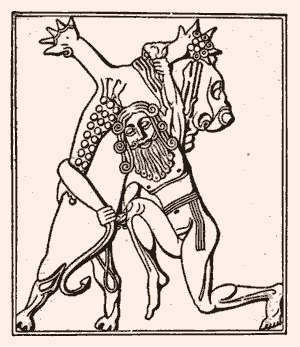
That too, is a very old idea. We didn’t realize just how old until we found it in the ancient tale of Gilgamesh. And when we say ancient, we mean ancient. When the tale was lost in the destruction of Nineveh in 612 BC, it was already 2,000 years old!
Gilgamesh was very popular throughout the ancient world. Lost lines were found in many of the languages of the Near East – Sumerian, Akkadian, Babylonian, Elamite, Hittite and more. And there are many variations of the tale.
While traveling Down Under, we picked up a copy of Martin Edmond’s Zone of the Marvelous: In Search of the Antipodes. (The antipodes is often used to mean Australia and New Zealand.) It was here we found the discussion on Gilgamesh.
“Gilgamesh is about an ancient Middle Eastern king’s quest for immortality and his coming to terms with the inevitability of death,” Edmond writes. Young Gilgamesh lives it up. He has many lovers. He parties and drinks a lot. In the process he angers the gods (by killing the Bull of Heaven). The gods decide to kill his pal, Enkidu, in retribution. Gilgamesh is distraught, “fearful…that his friend’s fate will also be his.”
Afraid of death, he goes on a journey to achieve immortality. We’ll skip over his many adventures here and focus on just one encounter. In the earlier versions of the story, he meets with Shiduri, who is a kind of tavern-keeper. She is the absurd woman in the tale.
Her advice to Gilgamesh is to give up his quest and accept his inevitable death. As Edmond writes: “Shiduri tries to dissuade him, using words later echoed in Ecclesiastes: ‘fill your belly with good things, day and night, dance and be merry, feast and rejoice…’”
Shiduri is the absurdist voice in this old tale. She is the one who gives the wise advice that says if you are going to die, you might as well live life to the fullest and not worry about your death. Shiduri advises Gilgamesh to live an absurd life.
We don’t know who put those words in her mouth. The author (or authors) of the tale is lost forever. But the fact that the words exist at all means there was an ancient absurd man somewhere back there in the mists of time.
Absurdity, perhaps, is as old as consciousness. When the first man (or woman) looked up at the sky - perhaps frustrated by his hunger or angry at the sun - and wondered why... and then accepted his fate, he was on his way to absurdity.
Tuesday, January 26, 2010
Circumstances Don't Matter!
Humans have existed for at least 200,000 years. Indoor plumbing, meanwhile, has been around for less than 4000 years (and widespread use of toilets less than 200 years). And yet, we imagine the vast majority of people who live in developed nations would find the concept of life without toilets to be well-nigh unbearable.
Indeed, the same is true of virtually any technology--once it becomes part of our daily routine it is hard to imagine life without it. The trouble, of course, is that we mistakenly equate the life we have with these tools and gadgets as better than the one we would have without them. Think of it this way--was everyone miserable 5000 years ago due to the lack of plumbing? Of course not--they had never experienced it, so how could they miss it? Hmm...
This gets at a point we have made in the past (and which Krishnamurti hammered home with a relentless consistency)--the "self" in which we believe so fervently, which we massage, groom, and defend at all costs...is simply a conglomeration of our past experiences (with a bit of genetics thrown in).
Here's a fun exercise--make a list of all the things you absolutely cannot live without. Not your videogame system or cellphone, but things you really need. If you are honest with yourself, you will eventually whittle this list down to one item only--food. Even shelter is a relatively recent human invention, and indeed there are millions (if not billions) who currently live without it. Yes, we realize humans (and other animals) tend to seek shelter for survival purposes, but this does not alter the point--it is certainly possible for one to survive without it.
The reason circumstances seem so important is because we interpret them through this lens of "who" we believe ourselves to be. Two people in identical circumstances will view their situations quite differently depending on their own personal history. But by adopting this identity we unwittingly rob ourselves of the freedom to live as we wish, instead entangling ourselves ever deeper in a tragic web of our own design.
The pauper who once was King is no worse off than the son of peasants; his belief thereof does not make it so.
Indeed, the same is true of virtually any technology--once it becomes part of our daily routine it is hard to imagine life without it. The trouble, of course, is that we mistakenly equate the life we have with these tools and gadgets as better than the one we would have without them. Think of it this way--was everyone miserable 5000 years ago due to the lack of plumbing? Of course not--they had never experienced it, so how could they miss it? Hmm...
This gets at a point we have made in the past (and which Krishnamurti hammered home with a relentless consistency)--the "self" in which we believe so fervently, which we massage, groom, and defend at all costs...is simply a conglomeration of our past experiences (with a bit of genetics thrown in).
Here's a fun exercise--make a list of all the things you absolutely cannot live without. Not your videogame system or cellphone, but things you really need. If you are honest with yourself, you will eventually whittle this list down to one item only--food. Even shelter is a relatively recent human invention, and indeed there are millions (if not billions) who currently live without it. Yes, we realize humans (and other animals) tend to seek shelter for survival purposes, but this does not alter the point--it is certainly possible for one to survive without it.
The reason circumstances seem so important is because we interpret them through this lens of "who" we believe ourselves to be. Two people in identical circumstances will view their situations quite differently depending on their own personal history. But by adopting this identity we unwittingly rob ourselves of the freedom to live as we wish, instead entangling ourselves ever deeper in a tragic web of our own design.
The pauper who once was King is no worse off than the son of peasants; his belief thereof does not make it so.
Sunday, January 24, 2010
After the people are gone, the land remains

We (at least one of us) have been traveling the past couple of weeks. Traveling always makes us feel especially absurd, as it pulls you out of your normal routines. This forces a certain different perspective.
Things that normally seem important to you when you are at home melt away in your new place. And no one knows who you are either, allowing you to sort of submerge your ego, or drop the curtains of your normal pretenses that you cherish so much back home.
In this case, we find ourselves in New Zealand, very far from home. It is a beautiful country of almost surreal landscapes… misty mountains and glacier-capped peaks, deep green valleys and rainforests, meandering rivers and alpine lakes of all shades of blue.
Stunning vistas like this always bring out the absurd, because it makes humanity seem so small. There is a Maori saying that says, “after the people are gone the land remains.” We saw it on a wooden sign nailed to a post on a dock. It is true. It is hard, we think, to maintain a viewpoint that puts humanity at the center of the universe in the face of such awesome beauty and such powerful natural forces that don’t care a whit about what we do or think.
We were feeling so absurd, we thought to post several times but couldn’t bring ourselves physically to the computer. We were so wrapped up in the moment, just taking it all in. But we worried not – nothing matters, after all, including this blog.
We write because it is a pleasure and because writing always helps to clarify and organize one’s thinking. And we’ve learned some things and gone down some alleys as result of writing this blog that we may not have gone down otherwise.
In any event, this explains our relative absence from the blog, but we promise to return and share our absurd thoughts on our return. We’ve scribbled some notes on napkins and hotel pads and on the back of receipts. More to come…
Tuesday, January 19, 2010
Of Time and Obligations
 We read an interesting short story the other day by JG Ballard titled "Chronopolis," in which society has reacted to the increased over-scheduling of life by banning clocks. The result is a culture in which no one is really sure what is supposed to happening when, and in which things (seemingly inevitably) go on either for too long or not long enough.
While we are not sure what message Ballard intended to send, we found the concept of a timeless society quite interesting. On reflection, it occurred to us that clocks are a very recent invention, and that humans lived (and thrived) for some time without them. (As, we might add, did the dinosaurs, who as George Will recently pointed out, "lived a thousand times longer than humans have yet lived.") Indeed, it seems almost passe to point out that we are the only known species to have created time-measuring devices of any sort.
The more we considered it, the more we realized that our obsession with time (for that is what it is) exerts a silent but powerful tyranny over our lives. Not only is virtually everything we do tied to time, but we have convinced ourselves that time is a benevolent master. Thus such comments as "I have to be there at 2:00" stir not resentment (Why? Why must I be there?) but rather pride (My importance is validated by this commitment).
This, of course, ties into the theme of busyness we have discussed in the past--namely, that people today have far more leisure time at their disposal than at any other time in human history (we are speaking mainly of people in the industrialized nations, for whom the problems of day-to-day survival are de minimus), and yet seem compelled to fill their days with "obligations."
Indeed, as we were thinking this issue through we came across a story in the Washington Post magazine that dealt with this very topic. The story discussed the author's life as a harried working mother; more specifically, it detailed the author's annoyance at a researcher who told her she had roughly 30 hours a week of "leisure time," and asked her to keep a diary of a typical week to prove it.
"As I kept my time diary, I realized that I kept putting leisure off, as if I were waiting to reach some mystical tipping point: If I could just finish cleaning out the crayons and shark teeth and math papers and toys and rocks (yes, rocks) from the kids' closets, fix the coffeepot, pay the bills, send that wedding present five months late -- then I could sit down and read a book and not feel guilty. As if leisure were something I needed to earn.
I just felt so busy. That sense of being overwhelmed, explained cultural sociologist Edson Rodriguez, 27, who teaches at the University of Southern California, is a status symbol these days. Everybody who aspires to be anybody is busy. Gone are the days when the goal of the wealthy and elite was to laze around doing nothing. These days, even billionaires are on tight schedules. 'We derive status from feeling overwhelmed,' Rodriguez says. 'So if I don't feel busy today, there's something wrong.'" (Emphasis added.)
There you have it. "We derive status from feeling overwhelmed." Why? Well, if we have all these things to do it must be due to our incredible importance. And not just to those waiting for us, but to humanity at large. After all, such an important individual, with so many critical things to do, could never...you know...die.
Human beings are an historical anomaly. We can foresee and comprehend our own death, yet can do nothing to stop it. While such concerns were of little import when our hours were filled with mere survival, they have become more pressing--and our need to somehow escape from them more urgent--in recent millennia. Thus the advent of religion, which essentially absolved people of the need to figure anything out--"God's will" being the ultimate "Get out of jail free" card.
However, as we have acquired knowledge about the physical world--the bulk of which conflicts directly with religious dogma--religion has become a less-reliable crutch for those hoping to escape the inevitability of their own demise. This has been compounded by the astounding strides made in technology and medicine over the past century, during which the average global lifespan increased from 30 to 65 (for Americans, lifespans grew from less than 50 to nearly 80).
In short, people are living far longer, more comfortable lives than ever before, but are still very much mortal. (Further, the knowledge that has led to such gains has been paralleled by increased knowledge about the workings of life, all of which points not to humans occupying some exalted niche, but rather to our being, to put it bluntly, a more complex form of larvae.) This paradox--our ability to make life longer and more enjoyable, but inability to actually cheat death--is at the root of today's crazed focus on busyness.
The thought of actually sitting quietly by oneself is so terrifying to most people (though by no means all) that they avoid it at all costs, convincing themselves that achievement is a formula for ultimate happiness (not today, but someday...), even as they are presented with evidence on a seemingly daily basis that those who have achieved the most...are still (as a general rule) profoundly unhappy.
Vive hodie!
Tuesday, January 12, 2010
Absurdity on the shores of Walden Pond
 “Men labor under a mistake. The better part of the man is soon ploughed into the soil for compost.”
- Henry David Thoreau
A fellow who writes such words or thinks such thoughts is half-way to absurdity.
Henry David Thoreau (1817-1862) likely needs no introduction. He is one of the greats of American letters. One of our absurd inspirations, Henry Miller, wrote that he had “unbounded respect and admiration” for Thoreau. “By living life his own ‘eccentric’ way,” Miller added, “Thoreau demonstrated the futility and absurdity of the life of the (so-called) masses. It was a deep, rich life which yielded him the maximum contentment. In the bare necessities he found adequate means for the enjoyment of life.”
Walden, the book he is most famous for, was a book we used to re-read every other year in our youth, it seemed. It was an important book in shaping our early life philosophy. In those formative years, Walden was an inspiration.
We still have the old copy which stirred us so long ago. Its margins well marked, highlighting favorite passages. We were pleased to find much absurdity in it.
Some random selections pulled from a recent browsing of Walden…
“We are made to exaggerate the importance of what work we do.”
“I am convinced, both by faith and experience, that to maintain one’s self on this earth is not a hardship but a pastime, if we will live simply and wisely.”
“Why should we be in such desperate haste to succeed, and in such desperate enterprises? If a man does not keep pace with his companions, perhaps it is because he hears a different drummer.”
“However mean your life is, meet it and live it; do not shun it and call it hard names… Love your life, poor as it is.”
Ah, the absurd. It is like holding a hot cup of joe between your cold hands on a frosty winter morning. Reading Thoreau you come to appreciate again how life is right here in front of you. It’s not hard to live a contented life. We make it hard because we are unwilling to release the baggage that makes things difficult, or that make contentedness elusive.
We’ll cite Henry Miller again, who writes so well of Thoreau. “'Life is bountiful’ he seems to be saying all the time. ‘Relax! Life is here, all about you, not there, not over the hill.’”
Self-emancipation from the chains of anti-absurd society is really at the heart of Thoreau’s message and is the example he set in his own life.
Monday, January 11, 2010
All in your head
How can one tell if The Matrix is based on reality? (Assume for the sake of simplicity that there is indeed some objective reality.) It's a trick question, of course - the genius of the movie is that there is no way to tell if we are free-standing individual beings interacting in the physical world...or merely brains hooked up to electrodes that simulate such an environment.
The more interesting question is how you would behave if you discovered the latter were actually the case. What if someone provided irrefutable proof that your perceptions of reality were no more than electrical impulses fed into a brain in a vat. Would it change how you live your life? Should it?
As you may have guessed, this is more than a theoretical exercise. Everything that you perceive as reality is, in point of fact, simply your brain processing electrical impulses. Whether or not such impulses are (as we assume) triggered by external stimuli is beside the point.
Beside the point?!? Really? How can that be? Surely it matters whether our family and friends are flesh and blood or mere wisps of imagination...doesn't it?
To answer this, let's go deeper. When we talk of family, for example, exactly what do we mean? Do we mean the physical incarnation of our wife and children? While this seems logical at first blush, it is easily falsified--consider the common lament of those with relatives who suffer from Alzheimer's: "It's not him/her anymore." So clearly there is something we mean besides the physical. But what?
What we refer to, of course, is this nebulous visage of the self--the thing that makes them "who they are." But as we have discussed ad nauseum in this blog, the concept of self makes sense only if one is prepared to accept some sort of duality--i.e., something beyond the physical, a stance riddled with contradictions and inconsistencies (which of your "selves" through the years is the true you? what of those with mental illness/brain damage?).
So again, who do we mean? The answer, as we see it, is that this concept of self is purely illusory; said a different way, the "person" we refer to when we speak of our wife is simply a construct in our own mind. That is not to say that there is not a physical manifestation of her, nor that others do not have a similar construct of this individual known as "our wife" in their own minds. But the concept that there is some independent entity--some "self" underlying the physical--is simply not true.
As Krishnamurti put it:
"There is fear in relationship, because in relationship we have created the image of you and me. The man and the woman each has an image of the other, a picture, a symbol, put together by time, of many days, many years, or an hour. And their relationship is between these two images. Look into it and you will see the actuality of it. We cling to the picture, to the image, and we are frightened of losing that image."
Indeed, the more one tries to pin down the "self" the more difficult it becomes--the best we can tell, what people refer to when they talk of "someone" is more or less some conglomeration of that individual's life experiences, coupled with genetic tendencies. We mash this together into an image of "who" they are, then convince ourselves this "self" actually exists. We do not notice the contradictions when we utter such statements as "he's really changed," or "she used to be much less anxious." In effect, we want to have it both ways--we want the comfort of believing there is some self independent of the physical, but also that this self can morph over time. When one thinks about this for any period of time...it is an incredibly fantastic assumption.
The main reason we believe it, of course, is that the illusion of our own self is so powerful. Indeed, we consider the feeling of self to be the most persistent and vexing aspect of human life--no matter how often we rationally tell ourselves that "we" do not exist, we cannot escape the feeling, deep down, that we actually do.
As Alexander Waugh put it in a recent review of a book on time: "we seem to understand time when we are reading about it, but as soon as we put the book down we are unable to explain it." Much the same could be said of the absurd...
The more interesting question is how you would behave if you discovered the latter were actually the case. What if someone provided irrefutable proof that your perceptions of reality were no more than electrical impulses fed into a brain in a vat. Would it change how you live your life? Should it?
As you may have guessed, this is more than a theoretical exercise. Everything that you perceive as reality is, in point of fact, simply your brain processing electrical impulses. Whether or not such impulses are (as we assume) triggered by external stimuli is beside the point.
Beside the point?!? Really? How can that be? Surely it matters whether our family and friends are flesh and blood or mere wisps of imagination...doesn't it?
To answer this, let's go deeper. When we talk of family, for example, exactly what do we mean? Do we mean the physical incarnation of our wife and children? While this seems logical at first blush, it is easily falsified--consider the common lament of those with relatives who suffer from Alzheimer's: "It's not him/her anymore." So clearly there is something we mean besides the physical. But what?
What we refer to, of course, is this nebulous visage of the self--the thing that makes them "who they are." But as we have discussed ad nauseum in this blog, the concept of self makes sense only if one is prepared to accept some sort of duality--i.e., something beyond the physical, a stance riddled with contradictions and inconsistencies (which of your "selves" through the years is the true you? what of those with mental illness/brain damage?).
So again, who do we mean? The answer, as we see it, is that this concept of self is purely illusory; said a different way, the "person" we refer to when we speak of our wife is simply a construct in our own mind. That is not to say that there is not a physical manifestation of her, nor that others do not have a similar construct of this individual known as "our wife" in their own minds. But the concept that there is some independent entity--some "self" underlying the physical--is simply not true.
As Krishnamurti put it:
"There is fear in relationship, because in relationship we have created the image of you and me. The man and the woman each has an image of the other, a picture, a symbol, put together by time, of many days, many years, or an hour. And their relationship is between these two images. Look into it and you will see the actuality of it. We cling to the picture, to the image, and we are frightened of losing that image."
Indeed, the more one tries to pin down the "self" the more difficult it becomes--the best we can tell, what people refer to when they talk of "someone" is more or less some conglomeration of that individual's life experiences, coupled with genetic tendencies. We mash this together into an image of "who" they are, then convince ourselves this "self" actually exists. We do not notice the contradictions when we utter such statements as "he's really changed," or "she used to be much less anxious." In effect, we want to have it both ways--we want the comfort of believing there is some self independent of the physical, but also that this self can morph over time. When one thinks about this for any period of time...it is an incredibly fantastic assumption.
The main reason we believe it, of course, is that the illusion of our own self is so powerful. Indeed, we consider the feeling of self to be the most persistent and vexing aspect of human life--no matter how often we rationally tell ourselves that "we" do not exist, we cannot escape the feeling, deep down, that we actually do.
As Alexander Waugh put it in a recent review of a book on time: "we seem to understand time when we are reading about it, but as soon as we put the book down we are unable to explain it." Much the same could be said of the absurd...
Friday, January 8, 2010
Rethinking happiness
We only caught the tail-end of the final episode – “Rethinking happiness” – of a three-part PBS series titled “This Emotional Life.” The snippets we caught dealt with some interesting ideas on happiness as they relate to age.
Older people, it seems, are generally happier than younger ones…. 65-year-olds are happier than 47-year-olds who are happier than 25-year-olds.
There are all kinds of reasons, but the gist of it, by our lights, is that older people are happier because they are more absurd.
One of the reasons researchers found for happiness in older people: they were less burdened by the future. “The future is a burden,” one of the researchers said. We plan for it. We worry about it. And it affects our present day happiness. Older people, perhaps because they have less of a future, worry less about it. “I know I don’t have that long to live,” says one elderly lady. “But it’s a rewarding a time.”
This idea is very absurd, as the ideal absurd man lives in the present and certainly does not fret over his future.
And, sitting there looking back over a life lived, older people realize they have less control over what happens… and gain some comfort from accepting what has happened. Acceptance, too, is a big part of the absurd. Just taking things as they come and making peace with the universe at it is.
Another idea: older people were more comfortable about who they were, their own strengths and weaknesses, and were more secure in their likes and dislikes… they were better at arranging their lives to suit them, rather than trying to meet some other, external, standard. True to the ideas of the absurd, happiness is within.
As we say, we only caught a little bit of this show, but we found some of the ideas fascinating and useful and pass them along for what they are worth. It also jibes with what we’ve speculated on before about age and the absurd.
Many of the things we think will make us happy, won’t. Happiness truly comes from the deep wells within – from acceptance, from living in the moment, from absurdity itself.
Older people, it seems, are generally happier than younger ones…. 65-year-olds are happier than 47-year-olds who are happier than 25-year-olds.
There are all kinds of reasons, but the gist of it, by our lights, is that older people are happier because they are more absurd.
One of the reasons researchers found for happiness in older people: they were less burdened by the future. “The future is a burden,” one of the researchers said. We plan for it. We worry about it. And it affects our present day happiness. Older people, perhaps because they have less of a future, worry less about it. “I know I don’t have that long to live,” says one elderly lady. “But it’s a rewarding a time.”
This idea is very absurd, as the ideal absurd man lives in the present and certainly does not fret over his future.
And, sitting there looking back over a life lived, older people realize they have less control over what happens… and gain some comfort from accepting what has happened. Acceptance, too, is a big part of the absurd. Just taking things as they come and making peace with the universe at it is.
Another idea: older people were more comfortable about who they were, their own strengths and weaknesses, and were more secure in their likes and dislikes… they were better at arranging their lives to suit them, rather than trying to meet some other, external, standard. True to the ideas of the absurd, happiness is within.
As we say, we only caught a little bit of this show, but we found some of the ideas fascinating and useful and pass them along for what they are worth. It also jibes with what we’ve speculated on before about age and the absurd.
Many of the things we think will make us happy, won’t. Happiness truly comes from the deep wells within – from acceptance, from living in the moment, from absurdity itself.
Wednesday, January 6, 2010
No plans, no goals… and no worries

“Life is what happens to you while you're busy making other plans.”
- John Lennon
The great old roads of Rome were often straight, so straight that they have become minor engineering marvels that still impress us today. Harry Eyres (“When straight is a bit narrow”) writes:
“The directness with which the Romans achieved their objectives can still astonish us: even our motorways are not as straight and pay more heed to natural contours than some of their roads.”
The Romans were military minded. Efficient. No fooling around. Their roads were there to create the shortest path between one point and their objective. All those towns ending in "–chester" or "–cester" derive their names from the Latin word castra which meant a sort of military camp.
Eyres suggests a “metaphorical consideration of this whole question of roads and paths.” He wonders if this idea of building fast and straight roads has come to dominate our thinking in other areas of life.
We think he has a point.
What particularly inspires this line of thought is the custom of making New Year’s resolutions. We don’t make any. And we find the practice, at least as most people do it, to be anti-absurd. People seem to want that clear objective, like a straight Roman road, that will take them to some desired point out in the future.
In a sense, many people invest their happiness in achieving these goals and objectives. If they don’t lose weight or get that promotion or clean out the basement, it will make them unhappy. It will bother them. They will feel like failures.
But really, none of it matters. Our concerns are so ridiculously petty, why magnify them by making resolutions? Goals are self-imposed chains. Throw them off! This reminds us of one our absurd inspirations, Henry Miller. “I don’t plan things in advance,” Miller wrote. “When I want to do something, I do it.”
The absurd man just is; he takes life as he finds it. This is not to say he can’t get better at a thing or improve his lot. He simply lets these grow naturally from his passions and interests. If you enjoy gardening, then garden to your heart’s content – and your garden will bloom under your cheerful efforts. And when it no longer interests you, then drop it. Don’t hold to some arbitrary goal you’ve made for yourself. Be free – and absurd. If nothing matters, then your plans don’t matter either.
When the Romans left, many of their roads fell into disuse. Obviously, the straight paths are not always preferred. The older roads of the “ancient Britons, Druids and other shaggy-haired characters who roamed the land” came back. The people took the old woodpaths that meandered through forests to uncertain ends. As Eyres writes, “Woodpaths don’t lead you definitively out of the woods but, then, by learning woodways and woodcraft, you might come to see the wood as somewhere full of possibility.”
What a great metaphor for the absurd, which focuses on the present, on living in the moment instead of some uncertain future (or life beyond death). Life is, indeed, full of possibilities. We find it freeing to open up to those possibilities and experiences, rather than try to fight to control your life – as if you could do such a thing anyway. The idea of the woodpaths also stands as a nice contradistinction to the straight Roman roads and goal-mindedness of anti-absurd society.
The absurd minded fellow doesn’t mind meandering. One never knows what one might find wandering down the uncertain woodpaths. And it doesn’t matter what lies in the path. The absurd man aims for contentedness wherever that path may lead.
Rees on absurdity
We came across the following comment from Sir Martin Rees and found it a wonderfully concise (and wildly thought-provoking) expression of absurdity...
“Most educated people are aware that we are the outcome of nearly 4 billion years of Darwinian selection, but many tend to think that humans are somehow the culmination. Our sun, however, is less than halfway through its lifespan. It will not be humans who watch the sun’s demise, 6 billion years from now. Any creatures that then exist will be as different from us as we are from bacteria or amoebae.”
“Most educated people are aware that we are the outcome of nearly 4 billion years of Darwinian selection, but many tend to think that humans are somehow the culmination. Our sun, however, is less than halfway through its lifespan. It will not be humans who watch the sun’s demise, 6 billion years from now. Any creatures that then exist will be as different from us as we are from bacteria or amoebae.”
Monday, January 4, 2010
The joy of detachment
Happy New Year! We trust everyone had a wonderful holiday season (buttressed, of course, by the knowledge it was no more or less meaningful than any other season...)
We have been thinking a lot about detachment lately - in short, the ability to view one's physical (and mental) incarnation as one would view any other individual, rather than believing our self occupies some special and exalted place. We have discussed this many times, as this whole issue of shedding identity is critical to truly embracing the absurd.
For example, have you ever observed someone stuck in traffic - throwing up their hands, pounding on the steering wheel, or even yelling at the cars in front of them - and thought how ridiculous they look? Of course, to the individual who is racing to pick up his kids, or get to a job interview, or to any other "important" appointment, such an attitude seems the height of callousness. And indeed, we (as everyone else) have been in situations where it seemed vitally important to get to...whatever crucial and life-altering event awaited us. (Although now that we think about it we can't recall exactly what was so important - but it sure seemed so at the time!)
The point of detachment, therefore, is to view oneself as we view anyone else - to jettison our "knowledge" of what is or is not "important," and instead move through life with a true sense of equanimity. This, of course, is easier said than done - while the rational part of our brain may know we look ridiculous seething in our car, it is simply not so easy to override the reptilian part that knows we are late for the interview.
One method we have found useful in such situations (and yes, this may be considered a "trick") is to follow events down their ultimate path. For example, why does it bother us that we are late for the job interview? Well, we might not get the job! Which means...we might not be able to pay our mortgage...which will mean we have to move to a smaller place (or live on the streets!)...which will be significantly less comfortable (and more dangerous) than living in our house. The ultimate worry, of course, is that we might have less money with which to buy things such as food...which might endanger our survival (and that of our family). Or perhaps we are worried that not getting the job will affect our wife's opinion of us (or the opinion of women in general), which will restrict our access to sex.
Once we have determined the underlying worry (and this pretty much always comes down to food, sex, and shelter), it is an easy jump to the conclusion that the whole thing is a purely biologically-driven response, with a nod to Richard Dawkins' insight that humans are, essentially, gene-replication machines.
In other words, we are not worried about the job. We are worried (as always) about our ability to survive and reproduce, since these are the features which have enabled our genes themselves to survive. Our belief that the job is "important" is a cover-up of sorts, a culturally-driven abstraction to shield us from the horror that job or no...we (and our family) are eventually going to die.
Consider this: approximately 146,000 people die every day (that's about 100 a minute). Someday it will be you. Do you want to spend your remaining days planning for the "future," trying to craft a "full and meaningful" life that will still, in the final analysis, be no more consequential than dinosaur droppings, or would you rather live each day (and minute) as its own, taking joy from the simple fact of being alive?
Detachment provides a shortcut to this joy...
We have been thinking a lot about detachment lately - in short, the ability to view one's physical (and mental) incarnation as one would view any other individual, rather than believing our self occupies some special and exalted place. We have discussed this many times, as this whole issue of shedding identity is critical to truly embracing the absurd.
For example, have you ever observed someone stuck in traffic - throwing up their hands, pounding on the steering wheel, or even yelling at the cars in front of them - and thought how ridiculous they look? Of course, to the individual who is racing to pick up his kids, or get to a job interview, or to any other "important" appointment, such an attitude seems the height of callousness. And indeed, we (as everyone else) have been in situations where it seemed vitally important to get to...whatever crucial and life-altering event awaited us. (Although now that we think about it we can't recall exactly what was so important - but it sure seemed so at the time!)
The point of detachment, therefore, is to view oneself as we view anyone else - to jettison our "knowledge" of what is or is not "important," and instead move through life with a true sense of equanimity. This, of course, is easier said than done - while the rational part of our brain may know we look ridiculous seething in our car, it is simply not so easy to override the reptilian part that knows we are late for the interview.
One method we have found useful in such situations (and yes, this may be considered a "trick") is to follow events down their ultimate path. For example, why does it bother us that we are late for the job interview? Well, we might not get the job! Which means...we might not be able to pay our mortgage...which will mean we have to move to a smaller place (or live on the streets!)...which will be significantly less comfortable (and more dangerous) than living in our house. The ultimate worry, of course, is that we might have less money with which to buy things such as food...which might endanger our survival (and that of our family). Or perhaps we are worried that not getting the job will affect our wife's opinion of us (or the opinion of women in general), which will restrict our access to sex.
Once we have determined the underlying worry (and this pretty much always comes down to food, sex, and shelter), it is an easy jump to the conclusion that the whole thing is a purely biologically-driven response, with a nod to Richard Dawkins' insight that humans are, essentially, gene-replication machines.
In other words, we are not worried about the job. We are worried (as always) about our ability to survive and reproduce, since these are the features which have enabled our genes themselves to survive. Our belief that the job is "important" is a cover-up of sorts, a culturally-driven abstraction to shield us from the horror that job or no...we (and our family) are eventually going to die.
Consider this: approximately 146,000 people die every day (that's about 100 a minute). Someday it will be you. Do you want to spend your remaining days planning for the "future," trying to craft a "full and meaningful" life that will still, in the final analysis, be no more consequential than dinosaur droppings, or would you rather live each day (and minute) as its own, taking joy from the simple fact of being alive?
Detachment provides a shortcut to this joy...
Wednesday, December 23, 2009
Walker, there is no road

We end the year with this bit of absurdity. Read it carefully and remember… there is no road:
Walker, your footsteps
are the road, and nothing more.
Walker, there is no road,
the road is made by walking.
Walking you make the road,
and turning to look behind
you see the path you never
again will step upon.
Walker, there is no road,
only foam trails on the sea.
By Antonio Machado, “Proverbs and Songs #29"
Translated by Willis Barnstone
Enjoy the holidays!
A cold hard (absurd) winter

We just finished reading Simon Ortiz’s Before and After the Lightning about a winter spent on the Rosebud Lakota Sioux Reservation in South Dakota. Ortiz teaches at the Reservation from November through mid-April – a season the Lakota call the time before the last lightning and after the first, bookends to the long winter.
It makes for good reading in a warm comfortable room by the fire on cold winter nights with snow on the ground outside. We also found some good absurd ideas in this book of prose and poems.
Nature figures as a major character in the book. There is the ever present cold of winter, of bare poplar trees, blue icy sky… and the wind, always the wind:
“The snowy wind is fierce, insistent, unrelenting, picking up dry snow off the hills, turning the hills into churning clouds and the sky, blending everything into on cold surging, exhaling, and forceful breath.”
And the vastness of the prairie…
“The prairie and more prairie of snow stretch for miles beyond miles, so vast it’s no use to estimate it. You just have to let it be, just like how you are at this present time in your life. You have it let I have its own tine and presence.”
Ortiz urges acceptance throughout… acceptance of time, space, pain, memory… a commitment to awareness of the natural world and our place in it… “The snowbanks have no idea of our coming nor of our leaving. It doesn’t matter.”
He writes about the passing of moons, suns, seasons… “Although it may snow again, it will not become ever the final one. It only changes as we change. It only becomes one more winter within the cycle of all time.”
The smallness of man becomes clear against the timeless forces of nature, against its power and indifference… reminders, of a kind, of the absurdity of our existence. Our own egos don’t help us see this absurd reality, as we seek cover under all kinds of guises… Ortiz recognizes this, too: “Our urgent selves have too much concern for burning ego that keeps us in mind within this world. It opens up from within the blindness.”
We enjoyed, too, how Ortiz stays planted in the world of experience. In the fashion of the absurd man, experience is all. There is a wonderful and simple little poem about horses in the woods by a creek, eating alfalfa. Ortiz remembers being there. He writes near the end, “But for that, nothing is there.” He reminds us throughout the book the role direct experience and memory has on the world as we see it.
There is quite a lot to chew on in this meaty little book. But the absurd thread is hard to miss – the commitment to staying in the present, rooted in the world of experience, the appreciation for the powerful cycles of nature and the smallness of man, the realization that ego is blinding and acceptance of the world as it is (or appears to be) not as we wish to make it.
Good stuff…
Tuesday, December 22, 2009
A sense of otherness

Interesting piece in the Economist on foreigners and the “thrill of being an outsider.” The premise begins this way:
“The desire of so many people, given the chance, to live in countries other than their own makes nonsense of a long-established consensus in politics and philosophy that the human animal is best off at home… The error of philosophy has been to assume that man, because he is a social animal, should belong to some particular society.”
We have talked before about how the absurd makes a mockery of so many of the identities to which people cling so dearly. Cultural attachments of any kind are things the absurd man holds to lightly, if at all.
It may be that this feeling – that cultural, religious and political attachments can be self-imposed chains –is more common than we suppose. The desire of so many to live in foreign lands is some evidence of this desire to slip these chains and escape.
As the Economist relates:
“Foreignness was a means of escape—physical, psychological and moral. In another country you could flee easy categorization by your education, your work, your class, your family, your accent, your politics. You could reinvent yourself, if only in your own mind. You were not caught up in the mundanities of the place you inhabited, any more than you wanted to be. You did not vote for the government, its problems were not your problems. You were irresponsible. Irresponsibility might seem to moralists an unsatisfactory condition for an adult, but in practice it can be a huge relief.”
The absurd man, though, would not need a new place. Absurdity is an attitude, a state of mind. It is all in how you look at things. You can continue to live right where you live and pursue your usual routines … but with the added perspective of the absurd – that none of it matters and to find contentment in that fact, as Sisyphus does in Camus’ reckoning of the ancient myth.
The absurd man believes that nothing matters – based on his experience and his questioning mind. He comes to see his existence as meaningless and the universe as indifferent.
But the absurd twist – and what makes the absurd man different than his many fellow travelers – is his embracing of this idea and his desire to live all the more passionately because of it. (Indeed, the absurd man seeks to maintain his “lucidity” as Camus put it; he wants to maintain the absurd and not hide from it by creating screens between him and his reality as he sees it).
This is something one can do anywhere and anytime.
The Economist writes that “foreignness is intrinsically stimulating. Like a good game of bridge, the condition of being foreign engages the mind constantly without ever tiring it.”
We’d argue that the absurd is very much like that. It definitely confers upon the absurd man a sense of otherness. He is apart. The absurd man is like the snow leopard; rarely encountered and incredibly stealthy amidst his surroundings. (Your neighbor may well be absurd, but it would be hard to tell.)
The absurd perspective is also always engaging and stimulating as it helps you look at everything in a completely different way than those around you. Every day becomes a new and interesting part of a journey that has no purpose, that seeks none and that has no measure of success or failure. It is a journey of liberation and contentedness in a world where people find such things are very rare…
Subscribe to:
Posts (Atom)