Monday, November 30, 2009

The Role of a Lifetime


We watched The Family Man again the other day. As we have noted, it is among our favorite films due to its wonderful (albeit almost certainly unintentional) template for living the absurd life. We return to it again here for two reasons. First, this issue is central to the concept we continue to explore in this blog--namely, how to live a content life in a decidedly non-absurd world, surrounded by non-absurd people. And second, as with most films, we pick up new things each time we watch it.

To recap the movie (from our prior post):

"Nicolas Cage plays a high-flying Wall Street exec (Jack Campbell), living what can only be described as the ultimate bachelor life--high-powered job in NYC, expensive car, beautiful women at his beck and call, etc. However, after a chance encounter with Don Cheadle (who plays something of a guardian angel), Campbell wakes up the next morning to find himself married (to his old girlfriend Tea Leoni) with two children, living in the NJ suburbs and working as a tire salesman. Basically, it is an alternate universe where Campbell made different decisions and thus his life turned out differently."

What we found interesting this time (and did not consider in our prior post) is that from Campbell's perspective, the people surrounding him in his "alternate life" do not really exist. Thus, he spends zero time worrying about what they are thinking, trying not to offend them, etc--to him, they are purely superficial characters in a very realistic play, perhaps akin to a lucid dream. In short, he is playing the role of someone who physically resembles "himself" in every way, but has a different background and thus different desires and emotions.

The point, of course, is that once one accepts the absurd, it is possible to play whatever role one chooses. Any of us is free, at any moment, to shed the personal experiences and history in which we invest so much meaning, and live each moment anew. Rich or poor, old or young, it makes no difference. It does not matter if one has children or not, lives alone or with family, is healthy or sick--none of it matters.

As Krishnamurti so eloquently put it:

“You cannot live without dying. You cannot live if you don't die psychologically every minute. This is not an intellectual paradox. To live completely, wholly, every day as if it were a new loveliness, there must be a dying to everything of yesterday, otherwise you live mechanically, and a mechanical mind can never know what love is or what freedom is. ...To die is to have a mind that is completely empty of itself, empty of all its daily longings, pleasures and agonies. Death is a renewal, a mutation, in which thought does not function at all because thought is old. When there is death there is something totally new. Freedom from the known is death, and then you are living.”

Who is the "real" Jack Campbell? What about the "real" Nicolas Cage? (Or the "real" you?) Such questions are not only unanswerable, but the more one attempts to answer them, the closer one comes to realizing their fundamental meaninglessness. Whether one chooses to accept it or not, the "person" we each believe ourselves to be is nothing more than a role we are free to change at any moment. By mindlessly playing this role day after day, we subject ourselves to the tyranny of the past, unwittingly (and unnecessarily) enslaving ourselves in the shackles of identity.

Monday, November 23, 2009

What we are thankful for


This is Thanksgiving week. Apropos of that, there was an op-ed about the Puritans in the Wall Street Journal last week by Amy Henry, titled “Idle Hands: Some Puritan Advice for the Unemployed.”

In thinking about anti-absurdity, it would be hard to find a more anti-absurd group than the Puritans. Henry sets out to defend the Puritans against the usual charges of overly-serious, fun-hating, work-loving, unhappy prudes. (And she misquotes C.S. Lewis. The following line is the work of H.L. Mencken: “Puritanism… the haunting fear that someone, somewhere, may be happy.”)

But in the end Henry only damns them further in our view.

Henry writes:

“More than just an annual turkey fest, the Puritans gave America a pedagogy of work and an attitude toward life that upsets the modern notion that a person's occupation equals his value. A man's worth, the Puritans might advise… lay in his service to God and to his fellow man, not in titles or financial portfolios. Rather than seeing life as a series of random events, the Puritan's belief in Providence imputed a profound sense of a loving God's purpose for him, a purpose that left very little room for despair.”

Well, we agree that no man should invest his sense of worth in a title or a financial portfolio. But we also see no difference between that and investing a sense of worth in a God or other people or anything else for that matter.

We think that man has no intrinsic worth or purpose; and that we might think more clearly and enjoy life more if we stopped thinking of humanity as some great exception in the scheme of things. Does a mountain have a purpose? Does a monkey? Does the pencil on my desk have “intrinsic worth”? Does anybody endure sleepless nights over it? Not the monkey.

And to write approvingly, in this day and age, that the “Puritan's belief in Providence imputed a profound sense of a loving God's purpose for him, a purpose that left very little room for despair” is to forfeit your intellect for flimflam. It is to toss your brain aside and fill your skull with sweet sounding syrupy goo.

Man does not need a sense of purpose to be happy, we argue on this blog. In fact, we go farther and say that a sense of purpose can easily lead one to unhappiness. Purpose implies an obligation that must be met, a goal. It also implies failure, it implies sacrifice, a burden… these are not happy thoughts to us.

As for idle hands… Well, idleness is a topic that we are fond of. (See our posts “In defense of idlers” and “Doing nothing”). Safe to say, we enjoy our idle moments.

On Thanksgiving Day, we will enjoy our roasted turkey ; we will savor the stuffing, the sweet potato, the cranberry sauce and the wine; and we will be merry in the companionship of our friends and family; we will be happy to be alive, to be there just then. We certainly will not wonder about our purpose or our sense of worth. Nothing matters in the end, so we’ll enjoy the moment… and we’ll be thankful for that.

Friday, November 20, 2009

Blinding identities


Thoughts after reading Out There Somewhere by Simon Ortiz…

Ortiz is an Acoma Pueblo poet. We kind of like his stuff, though we don’t understand half of it. There is still a certain cadence and rhythm to his writing that is appealing. And he tells some good stories.

He is not an absurd man, though this does not prevent him from stumbling on absurdity now and then. All poets, it seems, take an oath to awareness of a kind… the shimmer of a lake, the veins in a leaf, the wrinkles in an old man’s face, the gleam in a new mother’s eyes… they notice all manner of things, even things of a seemingly trivial nature.

Nonetheless, reading Ortiz made us wonder. He is very much wrapped up in his Native American identity. He identifies very strongly with the culture of the Acoma Pueblo.

As we are Americans of European descent, we can only imagine what it must be like to grow up on an Indian reservation… what it must be like to be part of a people so trampled on in history. Ortiz has obviously endured many slights and insults. He has seen the darker side of life on the Res… the alcohol and the drugs, the poverty, the frustrations.

To some degree, then, we sympathize with Ortiz. He is not always bitter or angry. His message is more one of hope in a resistance, in a creative struggle, to maintain his people’s identity.

But we wonder if attaching oneself so powerfully to an identity also blinds one to the absurdity of it all. We think it must, whether we invest our sense of self into a political party or a religion or an ethnic group.

Can one be dethatched, or enjoy that sense of equanimity that the absurd man covets if one is so invested in these groups?

Neither of us – Rick or Inigo – cultivates particularly strong attachments in this way. We do not “live through our children” as so many parents do, stressing out over every little failure or celebrating every little triumph. We are not loyal to any political party, in fact we no longer vote. We do not visit church, or the temple or the synagogue.

I suppose it is possible one could be loyal to a group and yet remain an absurd man, knowing nothing matters. We had a friend who was a devout Catholic. He went to church every Sunday. He was otherwise so rational and scientific. Once we asked him how he squared his work in science with his faith. He replied “I just like the pageantry of religion.” That phrase has stuck with us. He just liked it for its own sake, but put no special meaning on it.

Perhaps, then, one can remain part of a group like this and yet remain aware of the greater absurdity of existence, its meaninglessness and ultimate end in death.

In any event, we wish Ortiz well on his journey. And we thank him for a couple of hours of pleasurable reading. But for us, we think it is unwise to lean so heavily on identification with a group (of any kind) to find peace and contentment. That peace and contentment is within each of us, as the old sages - and the absurd men - have long known.

Thursday, November 19, 2009

The limits of what we can know


“Life is understood backwards, but must be lived forwards.”
-Soren Kierkegaard

We like the Dane, but we have a sense that perhaps we don’t (and can’t) really understand much of life backwards either.

It reminds us of the idea of the melting ice cube. If you see an ice cube on a table, you can predict what it might look like in a couple of hours. It would be reduced to a puddle of water. But if you came upon a puddle of water first, you could never be sure what created the puddle in the first place.

We would argue we know far less about everything than we think we do. Think about history. Even today, there is no consensus on the causes of WWI… or why the USSR fell when it did… or what caused the 1987 Crash… or the financial crisis of 2007-08…

Yes, there are many theories… but that’s the point. No one really knows why these things happened the moment they did.

Why did the 1987 crash happen on October 19th? Why that day and not any other? Why did the USSR unravel when only a few years before there were palpable fears in the US that we were falling behind the military might of the Soviets? Why did the stock market top in October 2007 and bottom in March 2009? Why those dates?

Again, no one really knows… but we think we do, and we give names to these ideas and theories…

But how good are those names?

Richard Feynman once told a story about a bird. He said there was a bird that in English we call a brown-throated thrush. In German, it’s called a halzenfugel. In Chinese, it’s called a chung ling.

But Feynman said that if you knew all the names, you still knew nothing about the bird. You knew only something about the people; what they called the bird.

In the same way, people’s ideas and theories for why things are as they are often are just that - words. They are names, not knowledge. True knowledge is very elusive.

What this has to do with the absurd is simply this: there are many names people give to things that they say create meaning, or that give life meaning. There are many religions of all kinds across the globe… political theories that aim to give meaning and purpose to life…social causes, traditions… and much more.

But these are just names. They tell us more about the people who believe them than they tell us about life itself. For it seems to us, as we can’t even answer basic questions of final causes in recorded history, even recent history, then we have no hope of penetrating the much greater mystery of the meaning of life, the universe and everything.

This, we think, is a kind of evidence of the absurd. As Camus wrote: “I don’t know whether this world has a meaning that transcends it. But I know that I do not know the meaning and that it is impossible for me just now to know it.”

Importantly, this absurd existence, this meaningless state, is what the absurd man accepts. More than accepts, the absurd man embraces his place and discovers, as Camus wrote, life “will be lived all the better if it has no meaning.” This, too, is part of the message of this blog…

Tuesday, November 17, 2009

The double-edged sword of abstraction

As we have discussed before, we enjoy sports quite a bit. Given that nothing is more meaningful than anything else, we would generally prefer to watch a sporting event than (for example) a political debate. In part this is because most people recognize the absurdity of sports (i.e., while many people may feel strongly about their team, few would put sports on their list of "important" things), but it is also because...well, we just enjoy it.

Now, at first blush this may seem at odds with the absurd, particularly since we have teams for which we "root" based purely on the area in which we spent our formative years. As Jerry Seinfeld so aptly put it, since the players on any given team are constantly changing, fans are essentially cheering for pieces of laundry. But far from being an impediment to enjoyment, we view this as an integral component of the "case" for sports, as it were. To wit, how can you not recognize the absurdity of the situation when you are suddenly rooting against the same person you cheered for yesterday...simply because he is wearing a different shirt?

What got us thinking about this was a sporting event we watched the other day (with Inigo, as it happens), in which "our" team (not Inigo's) not only lost, but lost in excruciating fashion (i.e., they looked sure to win, but lost at the last possible moment). Further, the "consequences" of the game will almost surely be significant, with our team likely to be placed in a less advantageous position should they make the playoffs. It was, in short, a bad loss.

Now, there were a couple of things about this we found interesting. To begin with, we found it difficult to place this event in proper context--despite our strong belief in the absurd, we nevertheless found ourselves reliving the loss in our head, wishing the game had ended differently, and thinking of various "bad" outcomes that could ultimately ensue for the team. This is, to be honest, a bit embarrassing--here we are preaching the virtues of living the absurd life, and we are obsessing over a football game?!?

On the other hand, this very reaction provided us with an invaluable "teachable" moment for ourselves. Put simply, we began to investigate why we found this upsetting, and to see if there were broader lessons to be learned. More specifically, we wanted to get to the "first principle," i.e., the underlying issue that caused us to lose perspective...even when we knew it was ridiculous!

As we see it, our reaction was an example of the double-edged sword of abstraction.

As Douglas Hofstadter explored in his terrific book "I Am a Strange Loop," humans (and all living beings, for that matter) by necessity live in a world of abstraction. In other words, it is far more useful to "see" a steak on one's plate (for example) than a seething mass of particles, despite the fact that both are accurate descriptions of the object in question. Further, there are many different levels of abstraction.

For example, at a basic level a sporting event is simply a group of people running around with a ball; it is only our "knowledge" (of the rules of the game, win-loss records of the teams, etc.) that gives this motion significance. Our "concern" over our team's ultimate prospects for the rest of the season, meanwhile, take the abstraction up another level. Indeed, at the top of the chain is the question: why will we feel good if they win the championship? We have no financial stake in the outcome; we do not know these people; and, as noted, our feelings for the "team" are independent of individuals (i.e., the team itself is yet another abstraction).

Indeed, the only tangible benefit to their winning seems to be our ability to share this joy with other fans...and lord it over those who root for different teams (!) This is circular logic in the extreme - said a different way, we hope our team will win so we can celebrate with others who have the same hope. What kind of madness be this?

Going in the other direction, the individuals who comprise the "team" are also abstractions (if you believe, as we do, that there is no self) - simply random collections of matter complex enough to become self-referential. Further, we were not physically at the game, but rather watched it on television at a bar.

Thus, one could logically argue either that the cause of our angst was a tough loss that really damaged our team's chances of winning the championship...or a collection of flickering lights on a screen. Both are correct; neither is a "better" explanation than the other.

And this is where abstraction becomes a double-edged sword. For while it is certainly true that the individual who "sees" the steak is more likely to survive and pass on his genes, this seems less likely to be true of those who follow sports teams.

Said a different way, while abstraction is crucial to our survival, it is also the source of most (perhaps all) of our worries and regrets.

Looking back, we also realized that by building up the game prior to its occurrence (talking to friends, etc) we had enhanced the abstraction in our own mind. In a very real sense, we believed that the game mattered--that we would be "better off" if our team won, and worse off if they lost. The sheer idiocy of this position was swamped by our genetic nature to see things as abstractions if we are not sufficiently careful.

Indeed, the spread of technology means many people live much of their lives in a state of near-constant abstraction. Communications are via email and telephone, while most "knowledge" is gained through reading (writing being an abstraction of others' thoughts). That this would give many people a false sense of superiority (for lack of a better term) is not surprising, and explains much of what passes for "wisdom" these days.

It is, for example, much easier to offer a "solution" to a broad social problem (e.g., the US government should run the health care system--think for a minute about how many abstractions are embedded in that one statement) than to ease your neighbor's suffering (or your own!).

Well, we've rambled enough for one day, but let us close with this thought - while we were initially upset that our team lost, the fact that they did gave us a wonderful opportunity for self-reflection, and (we believe) gave us yet another fresh perspective on the absurd. It puts us in mind of one of our favorite Homer Simpson quotes: "Donuts...is there anything they can't do?"

Until next time...

Monday, November 16, 2009

Can you create your own luck?


Can you create your own luck?

An older essay – from 2003 –from Richard Wiseman, at the UK Telegraph, explores the question: “Be lucky - it's an easy skill to learn.”

After highlighting some interesting research and studies, Wiseman concludes with some ways you can change your luck.

Along similar lines, this reminds us of an old book by Max Gunther called The Luck Factor. Gunther, summarizing his own thesis:

“Is is possible to change one’s luck by making practical changes within or around oneself?

Yes, it is possible, and that is what this book is about… For it turns out that there are perceptible difference between the consistently lucky and the unlucky. In general, and with exceptions, the luckiest men and women are those who have adopted certain approaches to life and have mastered certain kinds of internal psychological manipulation. I call this array of traits and attitudes the Luck Adjustment.”

So what do we make of all this from the absurd perspective?

From an absurd perspective, the seeming randomness of the universe bolsters the idea of the world’s inherent absurdity – its essential meaninglessness and indifference to the plight of humanity.

Also, what we call “good luck” and “bad luck” are really rather hollow concepts in the context of the absurd. An absurd man views such vicissitudes of fortune with great equanimity and less judgment about whether his circumstance is “good” or “bad.” Of course, this is not easy to do. And it doesn’t mean the absurd man can’t have preferences or opinions. It simply means that he appreciates with some detachment his place in the world.

The wiki definition for equanimity is worth reproducing here:

“Equanimity describes the unattached awareness of one's experience as a result of perceiving the impermanence of momentary reality. It is a peace of mind and abiding calmness that cannot be shaken by any grade of both fortunate circumstance and unfortunate one.”

That’s pretty good… and sums up how the absurd man views luck, with equanimity. This is not unique to absurdity, by the way, and this view is shared by other religions and philosophies.

Absurdity, then – recognizing that liberating insight that nothing really matters – is a kind of “luck adjustment.” An absurd man recognizes the greatest stroke of luck is that he exists at all!

Friday, November 13, 2009

On simplicity

A reader forwarded on the following comment, posted in response to a column about death on the NY Times Happy Days blog:

"I thought I was going to die in an earthquake and it was terrifying especially since I had my child with me and contemplated how to ease his death as I faced my own. But as I age and see the end rushing at me, I am training myself to accept it. Sort of. Maybe I am hoping that by the time it comes, I am more at peace with it than the younger me.

I don’t think of meaning and happiness. Life has no meaning and searching for it is silly. We should spend our time reducing suffering of others we share this planet with, both people and animals. If we can, we should make the world less harsh, and encourage exploration and science because we are a curious people. Happiness comes and goes and we know what makes us happy and if we can, we should do those things. There is no value in misery.

Death does not give me meaning. That makes no sense to me. This frantic search for meaning leaves me cold. The reframing of religion as spiritual, does likewise. There is no god, there is no meaning. And yet, I reach out to people all the time to try and help reduce their pain. I am compelled to do so. People tell me my life is meaningful. No, my acts have meaning for those I help, and while that is good, it does not mean I have a meaningful life. I am alive and that is what is important. And then I will be dead. And that will be that. Nothing is “allotted” to us. That assumes an “allotor” which isn’t the case. It’s hard to accept at first that this is all there is, and the only meaning is what you make, but once you do, it’s liberating. I’ve really enjoyed this journey. It’s been great to be here and I hope the end is peaceful and wanted when it comes, but don’t we all."

There is much to like in this brief piece, specifically the ease with which the writer conveys the fundamental simplicity of the absurd. Searching for meaning? Silly. But helping others? Good. Not because it has "meaning," but simply because it is the human thing to do.

At its core, the absurd (at least to us) is simply a method for living a peaceful, contented life. The fact that it is also a very consistent belief system is nice, but more of a side benefit. A few months back we read a piece in the Atlantic titled "What Makes Us Happy." It was about a group of people researchers tracked from college through the rest of their lives, with the goal of figuring out what made some people happier than others. The author seemed a bit nonplussed at the results, as if there were no consistent thread, but to us it was simple. As an individual described as "the study's exemplar" put it: "I have an overriding sense (or philosophy) that it’s all a big nothing—or ‘chasing after wind’ as it says in Ecclesiastes and therefore, at least up to the present, nothing has caused me too much grief.”

Live simply, be content with what you have, and be nice to others. And...have a nice weekend!

Wednesday, November 11, 2009

The Snow Leopard


In 1973, author Peter Matthiessen and biologist George Schaller set out for Nepal, hiking hundreds of miles through mountain passes with a varying team of Sherpas and porters.

The MacGuffin (as the Hollywood folks like to say) or the thing that sets the story in motion is the pair’s quest to study the rare Himalayan blue sheep found at the upper altitudes of Nepal.

The duo also hopes to see an even rarer creature that inhabits those mountainsides and is often found near the blue sheep – the elusive snow leopard, said to be so stealthy, you could be mere yards from it and not see or hear it.

But the book of the journey, The Snow Leopard, also is something of a spiritual quest for the author. Matthiessen hopes to visit the revered Lama of Shey, who resides at Crystal Mountain.

So, with all these elements, we have our premise and the quest begins. There are all kinds of adventures and hardships along the way. The journey is perilous – Matthiessen, at times, is forced to cross narrow ridges on his hands and knees, facing drop-offs of hundreds of feet down sheer mountain cliffs, should he stumble. The adventurers must tackle with all the elements that have beset travelers in this part of the world since the beginning of time – high altitudes, extreme cold, tricky weather, a hardscrabble landscape and much more. Nepal is one of those places where you can get frostbit and sunburn on the same day.

But the quest really simply gets the story going. The real story is the personal journey of its author. Matthiessen, a student of Zen Buddhism, is an introspective writer and makes all manner of wise philosophical observations along the way. This is where the absurd comes in. (Zen and the absurd, we’ve noticed, have various things in common, like brothers.)

There is the idea of acceptance, of taking the world as it is. He finds and admires this trait in his Sherpas. “So open, so without defense, therefore so free,” he writes “accepting like the variable airs the large and small events of every day.”

And in other passages, he makes these observations again and again. (“That happy go lucky spirit, that acceptance which is not fatalism but a deep trust in life, made me ashamed.”)

But he, too, finds acceptance... and in this acceptance, happiness. “I feel calm, and ready to accept whatever comes, and therefore happy.”

The struggles on the mountain slopes are interesting, too… The mountains test him in every way and he struggles with various emotions. On such a perilous trek, the travelers often seem to have death perched on their shoulders.

Faced with certain death if he makes a wrong move on the mountain slopes, Matthiessen finds peace in the absurd, in the idea that what happens doesn’t matter, that it’s not really important. He even quotes Camus at one point, in talking about his own leap into the absurd. This, he writes, “means not recklessness but acceptance, not passivity but nonattachment.”

There is also a focus on the here and now, which goes hand in hand with absurdity…

“Confronted by the uncouth specter of old age, disease, and death, we are thrown back upon the present, on this moment, here, right now, for that is all there is. And surely this is the paradise of children, that they are at rest in the present, like frogs or rabbits.”

Focusing on the here and now also opens up new possibilities and pleasures. As Matthiessen writes: “When one pays attention to the present, there is great pleasure in awareness of small things.”

Time also loses meaning on the long trek through the mountains, leading to more absurd conclusions:

“I have long since lost track of the day of the week, and the great events that must be taking place in the world we left behind are as illusory as events from a future century. It is not so much that we are going back in time as that time seems circular, and past and future have lost meaning. I understand much better now Einstein’s remark that the only real time is that of the observer, who carries with him his own time and space.”

He is quite alert to the screens we use to hide the absurdity of our existence. And that seeing this means being open to “the experience that individual existence, ego, the ‘reality’ of matter and phenomena are no more than fleeting and illusory arrangements of molecules. The weary self of masks and screens, defenses, preconceptions, and opinions that, propped up by ideas and words, imagines itself to be some sort of entity (in a society of like entities) may suddenly fall away, dissolve into formless flux where concepts such as “death” and “life,” “time” and “space,” “past” and “future” have no meaning.”

It’s a merry, meditative sort of book and a much-loved classic full of worthy wisdom. We thought we’d share these snippets with you, to give you a taste of the book.

And what of the quest? What of the snow leopard? We won’t give it away…

Tuesday, November 10, 2009

The Men Who Stare at Goats


We saw this movie over the weekend. Can’t say it was a great movie. It was okay and had its moments. We saw it after one reviewer characterized it as “absurdist” and described the Jeff Bridges character as “the Dude in fatigues.” As we are big fans of the Big Lebowski, this clinched it.

Jeff Simon of the Buffalo News seems to get at the nub of the movie in his review:

“A few generations now have been trained by movies and literature to think of war in the modern era as absurd. We're living in a Jon Stewart/Stephen Colbert era. The reason, for instance, that I stopped watching TV's "24" after its second season is that absolutely everyone on the show began to seem mad as hatters but no one seemed to suspect it.

That makes "The Men Who Stare at Goats" a minor but solid success, in that our story is told onscreen — wildly — by a journalist who went to war when his wife started taking up with his one-armed editor. He's played by Ewan McGregor, whose constant mix of earnestness, befuddlement, desperation and self-pity will be instantly recognizable to other members of his species…

The Western idea that war isn't just hell but absurd, too, began with Jaroslav Hasek's "The Good Soldier Schweik" in 1923, took solid hold in the '60s with "Dr. Strangelove" and "Catch-22," and has been something of a staple ever since Bush/Cheney made absurdism downright mainstream, if not mandatory.”

We like that last line…

But the premise of the movie involves a unit the army creates to harness the paranormal potential of its soldiers. We won’t get into all the details here. But suffice to say, we’re talking psychic powers here. The movie is based on a book by Jon Ronson. The movie begins with the intriguing line that “more of this is true than you would believe.”

As another reviewer put it: “regardless of how much is or is not true - this amusing jaunt of a movie comes off as an effective distant cousin of Joseph Heller’s “Catch 22″ as it presents us with the manic absurdity of war through the absurd lengths to which armies will go to fight it…”

If the movie has an absurd conclusion, we suppose that is it. It makes us, mankind, look rather ridiculous. This is often a good thing, because in seeing humankind’s activities in this light, maybe we look at ourselves a little differently and take our efforts less seriously. Maybe we look at the world in a simpler way, through the tangle of screens – tradition, social norms, religion, politics and the like – that we put up between reality and us.

The absurd helps break down those screens because the absurd, through its recognition of death as the ultimate end and through its belief in the meaninglessness of existence, helps us see the futility of much of what men do. It helps to call a spade a spade, or a goat a goat.

We’ve been dipping into Camus’ Lyrical Essays of late. There are some great lines on this front at the end of the essay “Between Yes and No.” Camus writes:

“Yes, everything is simple. It is men who complicate things. Don’t let them tell us any stories. Don’t let them say about the man condemned to death: “He is going to pay his debt to society,” but: “They’re going to chop his head off.” It may seem like nothing. But is does make a difference. There are some people who prefer to look at their destiny straight in the eye.”

So it is with the absurd. And while Men Who Stare at Goats is not a great movie, it nudges us, in a light-hearted way, to reconsider what we think we know about war - in particular, the effort in Iraq and like efforts abroad - and wonder if it’s all worth it.

Monday, November 9, 2009

Some kind of hell...

"Imagine if you suddenly learned that the people, the places, the moments most important to you were not gone, not dead, but worse, had never been. What kind of hell would that be?" --Psychiatrist (Dr. Rosen) referring to schizophrenic John Nash in A Beautiful Mind.

Yes, just imagine. Imagine if you discovered your whole past had been a lie, an illusion, a fantasy. (Take your time...)

It's funny, this thing we call identity. It feels like the most concrete thing in the world--the concept of "who" we are, the things "we" have experienced, our "own" internal wants, desires, feelings, emotions, and thoughts. And yet, for all its soundness, we have this nagging sense something is amiss. After all, if "we" are not the same person we were 20 years ago (and who could feasibly make such a claim?), then when did the shift occur? Could we not also argue we are not the same as last year, last week, or this morning? Could it simply be that these shifts occur so gradually we do not notice them, or do we really believe the (rather fantastic) notion there is some ethereal "self" traveling alongside us?

So...is this hell? It is, we must admit, a bit cooler than we expected. To paraphrase Patrick Henry, if this be hell, make the most of it! For we must be blunt, the "hell" to which Dr. Rosen refers is the world we inhabit each day--the knowledge (or belief, if you prefer) that all we have ever done, felt, and experienced has been but the most vivid of illusions; that none of it truly "exists"; that the sense we have of a separate identity, of a self, of a fundamental "being" is nothing more than some evolutionary trick of the mind.

But far from being hell, we find this state of being the most liberating and exhilarating destination imaginable. Yes, our past is but a mirage! Our future as well! Even this present moment, the reality of which could be doubted only by delusionals and cranks...even this is but smoke and mirrors, a full-length movie in which each of us unwittingly plays the starring role.

Should we not celebrate this insight and shout it from the rooftops? This is not hell--it is heaven, contentedness, pure and eternal bliss. Unfortunately, while the entrance is forever unlocked, most spend their entire lives pounding ever more frantically on the door, desperate for someone, anyone, to show up and let them in. Or as David Foster Wallace once put it, we are "pounding on this door, pounding and pounding, not just wanting admission but needing it, we don't know what it is but we can feel it, this total desperation to enter, pounding and pushing and kicking, etc. Then, finally, the door opens...and it opens outward: we've been inside what we wanted all along."

Friday, November 6, 2009

Forget it!


Our post the other day got us thinking… Thomas Carlyle wrote “Happy the people whose annals are blank.” This is another way of saying “Happy are those who have no history” or, even better, since we all have a history of some sort, “Happy are those who can forget.”

Forgetfulness has its absurd applications. As Camus pointed out, there really is no past or future… there is only a succession of present moments. That is why the absurd man focuses on living in the moment, an idea basically shared by many Eastern and Native American philosophies.

To think that way, though, one must have no regrets. One must be able to forget. One must be able to forget the stupid slip of the tongue at the party last night, the embarrassing mistake at work the other day, the pain of past errors and indiscretions, of old arguments, slights, rivalries… One must be able to look past all that and start afresh every day.

By contrast, a man of long simmering resentments, feelings of failure and regret, who stews over past actions, laments over lost opportunities would be the opposite… a sort of anti-absurd man.

We sometimes have this thought experiment where we imagine ourselves as men of, say, 85 years old, reflecting on our life. What will we remember? What will we forget? We think that an 85 year old man, reflecting back, finds that much of what he thought important when younger very unimportant – hence only heightening the sense of an absurd existence.

In fact, we don’t need this thought experiment to see that this will be true. Sitting here now and looking back over our life, we can point to times when we were upset or when we really wanted something and didn’t get it, and the disappointment we felt then…

What a waste! As we can see now looking back, these things really didn’t matter. They didn’t matter even then; it’s the passage of the years that make this very obvious today. Our life took different paths, things happened otherwise… things could always have happened differently, but they happened the way they did. We accept it and we make the best of whatever situation we find ourselves in.

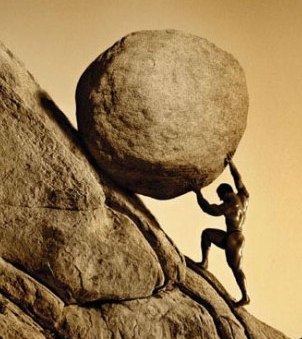
Nothing really matters… that is the liberating insight. That’s why Sisyphus is happy, even in his ceaseless pushing. That’s what Camus so forcefully argued. It’s what this blog is all about.

The absurd man does not let his past hold his present in chains. He forgets and the chains fall away as if made of spider silk…

Wednesday, November 4, 2009

What is Happiness?


What is happiness? It’s a big question.

That syphilitic madman Nietzsche said “Happiness is a woman.” In certain circumstances, maybe he’s right!

That dour 19th century thinker Thomas Carlyle said, “Happy the people whose annals are blank.” Or put another way, the happiest people are those that have no history. Hmmm…

That grand old man of American letters, Ralph Waldo Emerson, had a more modest view of happiness. “To fill the hour – that is happiness,” he said.

Or maybe this is all wrong… happiness is not something you go after or define.

One of our favorites, Henry Miller said: “Happiness is desirable, but it is a by-product, the result of a way of life, not a goal which is forever beyond one’s grasp. Happiness is achieved en route… To make happiness the goal is to kill it in advance.”

We like it…

That difficult Dane and sometimes absurd man, Soren Kierkegaard, saw happiness as within us: “A man who as a physical being is always turned toward the outside, thinking that his happiness lies outside him, finally turns inward and discovers that the source is within him.”

We like that, too…

And our oft-quoted absurd hero, Albert Camus, asked “But what is happiness except the simple harmony between a man and the life he leads?”

Ah, the absurd man and the absurd life he leads in this, the absurd universe…

But perhaps the best comes from Theophile Gautier, who wrote in 1845: “Happiness is white and pink.” So that’s what colors it is!

Tuesday, November 3, 2009

The Wine Soaked Wanderings of Li Po

Li Po was a Chinese poet, who lived and wrote during the Tang period (AD 712– 760). When we discovered that two of our favorite poets, Charles Bukowski and Jim Harrison – both absurd men in their own ways – paid him tribute, we decided to check him out for ourselves.

Li Po loves his wine. He is a sort of Chinese Dylan Thomas. It seems he is drinking or drunk in about a quarter of his poems. Titles include “Drinking Alone Beneath the Moon” “Drinking in the Mountains with a Recluse” “Drunk on Tunk-Kuan Mountain” “Drinking with Shih Lang-Chung” and more of same… He often refers to himself as being drunk: “I have been drunk all day… It’s like a boundless dream here in this world, nothing anywhere to trouble us.”

This is not an accident, for the ancient Chinese were fond of drinking to forget self, to seek a clarity they couldn’t find sober…

As translator David Hinton writes: “Usually in Chinese poetry, the practice of wine involves drinking just enough so the ego fades and perception is clarified. Tao Chien called this state “idleness” (hsien): wu-wei as stillness. But although Li Po certainly cultivates such stillness, he usually ends up thoroughly drunk, a state in which he is released fully into his most authentic and enlightened self.”

As contemporary Tu Fu wrote of Li Po: “For Li Po, it’s a hundred poems per gallon of wine / then sleep in the winehouses of Ch’ang-an markets.”

Li Po has a powerful absurdist streak. His poems are rooted in the physical world – in the moon, the mountains, his food and drink, the cool air, the sun… He always writes beautifully of these things: “Mountains set apart over the river / two peaks face each other. Reflecting / chill colors of shoreline pine, waves / shatter apart into rock-torn bloom.” Or this:

“Two rivers inscribing a lit inlay of mirror,
a pair of fallen rainbows for bridges
kitchen-smoke veins cold orange groves,
and autumn stain ancient wu-tung trees.”

Li Po tries hard to free himself of himself. As he writes in an absurd passage:

“Once I’m drunk, all heaven and earth vanish, leaving me suddenly alone in bed, forgetting the person I am even exists. Of all our joys, this must be the deepest.”

He is often carefree, aware of his mortality and celebrating that fact, another absurdist trait. “You never get what you want in this life,” he writes, “so why not shake your hair loose on a boat at play in dawn light?” He often did things other eminent poets of his day would never do, such as mix with “low lifes” at inns and winehouses in rural China. “My life a blaze of spent abundance,” he writes near the end of his life…

Much about his life is shrouded in mystery and myth. We know he was quite a wanderer. And there are many entertaining legends about him. One of my favorites: When introduced to an important governor in China, Li Po did not make a satisfactory sign of deference and was scolded for his show of disrespect. He supposedly quipped: “Wine makes its own manners.”

And, as legend has it, he died falling off a boat while drunk, trying to embrace the moon. Absurd man to the last.

Monday, November 2, 2009

Predictably Irrational

We recently read an interview with Dan Ariely, a professor at Duke University and author of Predictably Irrational. (He also maintains a blog here.)

Ariely’s personal story is worth relating briefly here… He suffered third degree burns on over 70% of his body after the explosion of a large magnesium flare. He was 18-years old at the time and had to suffer through years of rehabilitation.

“I felt partially separated from society and as a consequence started to observe the very activities that were once my daily routine as if I were an outsider,” he says. Talk about an absurd experience, though one that nobody would want to share…

Ariely’s research focuses on how we make decisions, with a particular emphasis on behavioral biases or effects we may not be aware of.

One of the ideas explored in the book have to do with the idea of ownership of things or ideas, which relates to our post yesterday, “more with less.”

Here is Ariely:

“The basic idea is that ownership changes our perspective, which applies to both material things as well as points of view. One principle involved is that the more work you put into something, the more ownership you begin to feel for it. For example, I can say from personal experience that pride of ownership is inversely proportional to the ease with which I’ve been able to assemble furniture. We have a term for that: the “Ikea effect.”

Once we take ownership of an idea – whether it’s related to politics or sports or investing – a lot of changes take place. We probably fall in love with the idea more than we should. We value it for more than it’s worth. And quite often, we have trouble letting go of it because we can’t stand the idea of its loss. What are you left with then? A rigid and unyielding ideology that can be quite detrimental to clear thought.”

So beyond absurd or other minimalist sensibilities, there are also scientific reasons validating how ownership of things (and, importantly, ideas) can weigh like chains on your thinking.

In the interview, he also relates a new project he is working on around the idea of alter ego:

“Our first idea is sort of an “alter-ego” application. If you are tempted to buy something, you choose some trusted friend or family member from your contact list and then are prompted to ask yourself, “What advice would this person give me?” You don’t actually ask the person at this point, but the goal is to force you to think with an outside perspective.

The second step is then to find out from that person what they actually would say. The first step causes you to reflect, which is important, and the second allows you to learn from others to inform longer-term decisions. We’re actually looking at lots of things that allow you to use your cell phone as a time buffer between your intentions and your actual behavior.”

The idea of asking what other people think is not particularly interesting or absurd, but the idea of looking at yourself and your actions with some distance is helpful and one we’ve talked about before on this blog. Again, it seems there is some scientific evidence supporting the idea that thinking with an outside perspective improves your decision-making.

We’ve not read Ariely’s book, which seeks to answer a variety of interesting questions… but if you have, post your comments here.

Friday, October 30, 2009

More with Less


In his reflective preface to the 1958 republication of The Wrong Side and The Right Side, Albert Camus wrote:

“Although I live without worrying about tomorrow now, and count myself among the privileged, I don’t know how to own things… I cling like a miser to the freedom that disappears as soon as there is an excess of things.”

We think these words, written by a 45-year-old Camus only a couple of years before his death, are very wise. They reflect the wisdom of many sages before him who reached the same conclusion.

Henry David Thoreau, for instance, wrote in Walden: “I see young men, my townsmen, whose misfortune it is to have inherited farms, houses, barns, cattle and farming tools; for these are more easily acquired than got rid of.” (Thoreau, by the way, had an absurdist streak, too. “Men labor under a mistake,” he once wrote, for “man is soon ploughed into the soil for compost.” But that is a story for another time…)

The idea has relevance for the absurd. We have often written than one can’t find happiness in things. It seems simple, but it goes against the powerful thrust of society’s pressures… bombarded as we are with ads encouraging to us to buy new cars and bigger houses and more stylish jeans… “You deserve it,” these modern sirens coo…

But it’s more than just advertising. People, too, expect you to buy new things. If you make a certain amount of money, you are expected to own a certain kind of house in a certain kind of neighborhood. Wealth is a nice car and new clothes…

Even before we could articulate the absurd, we resisted such pressures. We have always resisted this ceaseless drive for more things… for more money, for a better career.

We drive an old 96 Chevy. It has dents and scratches. The upholstery is coming undone. The carpet on the floors is worn nearly bare. We make enough money to buy a new car without any problems, but we choose to stick with the old one.

This is a pattern in our life in many ways. Our mother thinks us cheap… but that is not it. It is not frugality but rather indifference to many of the things society thinks we ought to spend money on.

We don’t value money in itself and we are willing to pay up for certain things, like good food and beer. A plateful of fresh oysters is a treat not to be passed up lightly. And we willingly pony up to travel to faraway places to collect new experiences. We think, now that we read Camus’ words again, that we implicitly understood what he was saying all along. Things are a burden. To invest your happiness in things is to invite disaster and to lose your freedoms.

“I don’t envy anyone anything,” Camus writes in the same preface. This is a trait we find very admirable. The complete inability to feel envy is a great thing. We likewise do not begrudge our neighbor’s desires for bigger houses or fancier cars. We choose to spend that money in other ways.

But we do recommend that you re-read Camus’ wise words up top. Living without concern for tomorrow is an absurdist point of view. Live in the present, live for the experiences of living and don’t be so quick to trade your freedoms for things. In end, we’re all headed to the same place – oblivion.

In an essay called “Irony,” written when Camus was only in his twenties, he ends with some wise words on the varying paths to the same destiny that all of us take. “Death for us all, but his own death to each. After all, the sun still warms our bones for us.”

This essay and preface and lots of other goodies are all found in the Lyrical and Critical Essays pictured here.

Dangerous adoration

We read a terrifically absurd story in the New Yorker last night, about a man (Viana) who films his girlfriend all day, every day, because he adores her and "she'll die one day." He also tells someone he has just met that he plans to kill his girlfriend precisely because he adores her:

"I would rather kill her than allow my adoration to die, you understand. I would rather kill her than allow her to leave me, than allow my adoration to continue without its object. I can delay it for as long as possible, but it’s only a matter of time."

We found this an interesting exposition of a problem explored elsewhere in this blog--namely, the question of why one cannot agree that the universe is ultimately meaningless, but still create "meaning" for oneself. The reason, as we see it, is that in creating this "personal meaning," one also creates conflict and strife, since to favor one set of events over another is (by definition) to lead down a very slippery slope.

It is easy to view Viana as ridiculous, but is his vanity really so different from that of most people? We would argue the difference is mere shades of gray--anyone who believes "his" world has meaning (and is thus, to him, more important than others' worlds) must then be prepared to do whatever it takes to defend it. This is why the family members of heads of state are so closely guarded--we realize that presidents would make objectively irrational decisions (eg, release terrorists who would do great harm to others) if forced to decide between this and the loss of a child.

Of course, we all shake our heads at such an example and say "Well, who could blame them?" But that is exactly the point! The protective nature we feel toward our offspring (for example) is simply a mirage propagated by the fact that we are, at root, gene replication machines. Thus, we all understand how a president would sacrifice thousands of lives to save his own child--who would not do so? And yet...how is this different from Viana?

The fact is that everything we feel is a fraud; more importantly, the quest for "self-created meaning" is the most dangerous of mirages. For once we begin to stratify people and events, we are all Vianas. Viana is willing to kill to preserve his adoration. Would you be willing to kill to save your wife? How about your children? How many "other people's children" would equal one of your own?

We are not saying these are easy issues--we wrestle with them every day. But the fact of the matter is that one who believes in "self-created meaning" must also believe his personal universe is "different," and "special," and (most importantly) "more meaningful" than those of others. (How could it be otherwise?) We all feel this way; it is an integral part of our nature, genetically handed down through thousands of generations. It feels as natural as anything in the world.

It is also a lie.

Thursday, October 29, 2009

The Leaden-Eyed

We came across this poem the other day while reading Patricia Highsmith's Strangers on a Train. We found it a wonderful elucidation of the absurd lifestyle - although, like all poetry, it is certainly open to multiple interpretations...

The Leaden-Eyed
by Vachel Lindsay

Let not young souls be smothered out before
They do quaint deeds and fully flaunt their pride.
It is the world’s one crime its babes grow dull,
Its poor are oxlike, limp and leaden-eyed

Not that they starve, but starve so dreamlessly;
Not that they sow, but that they seldom reap;
Not that they serve, but have no gods to serve;
Not that they die, but that they die like sheep.

Tuesday, October 27, 2009

More absurd moments

“To be happy, we must not be too concerned with others.”
- Albert Camus

We were driving to make a 10 am meeting today… We were an hour away, but it was raining and the traffic was bad. We knew we wouldn’t make it the moment we rolled out of the driveway. We would be late… not only late, but royally late… late by maybe as much as an hour…

As we rolled along the beltway at 15 miles per hour, we reflected on this predicament. We could feel a part of us did not want to be late and worried what others might think. But our inner absurd man told us not to worry. We knew being late would change nothing really. It meant nothing. It didn’t matter. It was not worth getting upset over.

And yet still there was this part of us that was annoyed at being late. We had to fight it down, like trying to wrestle down a petulant younger brother.

But in thinking about it on the way, we realized again how much of the absurd goes against the hard wiring in our brain. There is something there that pushes us in anti-absurd directions. The absurd does not come naturally, we admit. It takes a conscious effort to retrain the mind to think differently.

By the time we arrived at our meeting, we were feeling very absurd… Nothing mattered. We were relaxed and cool. Life was good. The absurd, if nothing else, is a great mechanism to cope with life’s petty frustrations…

One other anecdote from the weekend… We were meeting with our family for dinner. Mom and dad, brother, wife and kids… And the conversation at dinner, as it often does, turns to matters of utter inconsequence… Whether or not my brother’s bathtub was as white as it ought to be… Whether or not we should get new cabinet hinges to fix the squeaks in the old hinges… Whether so and so go the job he was looking for… It was the usual riff raff of family get togethers.

We pined for some more interesting conversation… This trivia and effluvia had us wanting to walk off a pier… but again, the absurd kicked in. If nothing matters, then nothing matters – not even the things we think are important or more interesting.

We’ve talked about this before… about how, viewed through an absurd prism, a presidential election, for instance, is of no greater importance than a Sunday NFL game. And though we’d much rather pay attention to the latter than the former, we have to admit the game means nothing – win or lose. But neither does anything else…

In fact, this whole post is inconsequential, as is this whole blog… But we digress… We pounded out this post only to illustrate the absurd in action in every day situations. And, in fact, this is what interests us most about the absurd – not the abstract, but the concrete. Not the pie-in-the-sky ideals, but the usefulness in daily living.

We are particularly interested in examples of the absurd life - flesh and blood examples, living and dead, but also absurd depictions in books and film and art and more. (We encourage you to send us your favorites.)

In the end, the proof of the pudding is in the eating, as the old saying goes. We find the absurd helps us push our rock – even if, as with the absurd hero Sisyphus, the rock only rolls back down the hill again – and be happy in the ceaseless and meaningless pushing.

It as the great Albert Camus put it: “You will never be happy if you continue to search for what happiness consists of. You will never live if you are looking for the meaning of life.”

Monday, October 26, 2009

Trick or treat?

A reader (and fellow blogger) left the following comment on a recent post:

"A shift in perspective can lessen the impact of an event...but it does seem to me to be a trick that one can play [on] oneself, which may work sometime, and not...actual freedom from the impact."

This is a very interesting point, and one worth exploring. To begin, let us say we essentially agree with our reader's statement--in fact, many (if not all) of the strategies we have suggested in this blog could be categorized the same way. None, in and of themselves, are intended (nor should they be expected) to effect fundamental changes in one's perception of the world. After all, no matter how hard we work at pretending to be Nicolas Cage, such efforts to delude ourselves are simply that. Aren't they?

Regular readers will notice we have (purposely) wandered into a thicket here--if one views "reality" and the concept of self as delusions, then what does it mean to say one is deluding oneself in the first place? Let's come back to that...

Again, our reader is correct that our "recommendations" are essentially thinly-disguised methods for imposing an alternate view of reality on oneself, and do not prima facie change anything about a given situation. If (to return to an earlier discussion) our wife has an affair, pretending it happened 300 years ago (or to someone else) doesn't change the fact that she did in fact have the affair; moreover, any comfort we take from this alternate view of events seems to come from fooling ourselves rather than representing a long-term solution to the pain we understandably feel. (In our reader's words, it is "a trick," rather than "actual freedom from the event.")

However, in our opinion this is to focus on the effect rather than the cause. Put a different way, the point of all these tricks is to get one to focus on the fact that our feelings and emotions are not representative of some larger "truth"; instead, they merely represent millions of years of genetic hard-wiring. Consider again the example of our wife's affair. Why does it bother us? Well, she and I promised each other we would be "faithful." Why did we do that? (Indeed, monogamy is the rare exception in nature.) Most likely, human monogamy is a tradition that grew out of agrarian cultures where it was advantageous (i.e., increased one's chances of survival) to set up a family "unit" to work the land. Going further, why did we find her (or women in general) attractive in the first place? On and on, until...we come to the root of the issue, which is that we are all (as Richard Dawkins so eloquently put it) "gene survival machines," and all the things that seem so important and relevant turn out to simply be byproducts of whatever survival strategy worked best for our ancestors.

To return to the original issue, our reader is correct that the "strategies" we offer on this blog for dealing with the absurdity of human existence are nothing more than tricks--but that is precisely the point! Let us put it this way. The "conventional wisdom" is that things have meaning, and this belief system is constantly reinforced by extraordinarily powerful genetic and cultural factors. To cite just one example, our knowledge that the sex drive is entirely due to evolutionary factors does little to diminish its effectiveness.

Thus, even those who recognize the absurdity of the human condition--who believe, as we do, that the entire notion of "existence" is cut from whole cloth, right down to the concept of the self--find it difficult to maintain this view on a day-to-day basis, as it goes against everything we see and hear (not to mention being taught to believe, essentially from birth). It is with this in mind that we offer these tricks; not to delude ourselves, but precisely the opposite--to remind ourselves, on a fairly consistent basis, that reality itself is the true delusion.

Friday, October 23, 2009

Don't Panic!


“Far out in the uncharted backwaters of the unfashionable end of the western spiral arm of the Galaxy lies a small unregarded yellow sun. Orbiting this at a distance of roughly ninety-two million miles is an utterly insignificant little blue-green planet whose apedescended life forms are so amazingly primitive that they still think digital watches are a pretty neat idea’”

- The Hitchhiker’s Guide to the Galaxy, by Douglas Adams

Who didn’t love Douglas Adam’s Hitchhiker’s Guide to the Galaxy books when they were young teens?

We bring up the Guide today because there is a new book in the series, written by Eoin Colfer called “And Another Thing.” This got us thinking about those well-loved books of Adam’s all over again.

The absurd comes to us all in different ways and through different experiences. Bomstein and I have often mused over cold beers and brats at Absurd HQ about how we liked certain writers or books or movies and couldn’t put our finger on exactly what linked many of these things together at the time.

In retrospect, we now can see the absurd DNA that links many of these things. There is the cool detachment from self and ego… the recognition and acceptance of an ultimate (and inescapable) end in death… a willingness to poke fun of and ridicule some of man’s most cherished beliefs about himself and the his place in the universe… and a desire to live life all the more fully and intensely because of the meaninglessness of it all.

We would say that the Hitchhiker’s series has a fair dose of absurdity. In fact, we would go so far as to say that absurdity is an underlying theme throughout the whole series. Things are constantly happening that have no meaning and that appear entirely random. Humans are portrayed as totally insignificant and the great cosmos completely apathetic to whatever befalls humans or any other creatures.

I mean we’re talking about a book that begins with the casual destruction of the Earth to make way for an intergalactic freeway. No one really seems to miss it or morn over its loss.

In the stories, the Hitchhiker’s Guide becomes a character all its own. Adams writes “entries” from the guide at the head of each chapter, at least in the early going. These entries are usually funny but also have some point to make about the ridiculousness of the human condition and or the universe itself. (“In the beginning the Universe was created. This has made a lot of people very angry and has been widely regarded as a bad move.”)

The words inscribed on the guide’s cover are “Don’t Panic,” which is, in a way, a sort of absurd summing up as far as what to do in a crisis. After all, if nothing matters, why panic?

We did a little internet search just to see what was out there as far as drawing the connection between the Guide series and the absurd. Turns out, there is quite a bit of stuff, including a dissertation by one Margaretha Alletta van der Colff.

She writes of the main character, Arthur Dent:

“In Arthur Dent, we see reflected the character of Meursault, a character created by Albert Camus in The Outsider, who embodies the absurdity of the human condition and the ambiguity inherent in every individual life, as well as the solitary struggle to construct meaning. Arthur Dent lives in a bubble, a bubble filled with everyday, inconsequential phenomena such as kettles, plugs, refrigerators and, of course, tea.”

There is also a whole bit in the book about discovering the answer to life, the universe and everything. The answer, it turns out, is 42. In other words, there is no meaning – at least not one we can understand. Colff writes:

“Therefore, at the end of this novel, Ford and Arthur realise the futility of trying to discover life’s ultimate meaning, since this is utterly elusive. When approached by two girls on prehistoric Earth, Ford explains the absurdity thus, ‘My friend and I were just contemplating the meaning of life. Frivolous exercise’ (Adams, 1995: 306).”

And then comes the great absurd epiphany, which separates the absurd man from all other non-believing skeptics and existentialists:

“As a grand finale, Ford also echoes Camus’s suggestion that we should celebrate and love life instead of imposing an enigmatic, ultimate meaning on it, by referring to the vestal beauty of prehistoric Earth: ‘…Forget all of it. Nothing matters. Look, it’s a beautiful day, enjoy it. The sun, the green of the hills, the river down in the valley, the burning trees’ (Adams, 1995: 307).”

If you want to explore her dissertation yourself, you can find it here:

upetd.up.ac.za/thesis/available/etd-08212008.../dissertation.pdf

It is, of course, academic, but we found it worth perusing...and the liberally sprinkled quotes from the books made it entertaining.

And remember... Don't panic!