

 Posts
Posts


Humans have existed for at least 200,000 years. Indoor plumbing, meanwhile, has been around for less than 4000 years (and widespread use of toilets less than 200 years). And yet, we imagine the vast majority of people who live in developed nations would find the concept of life without toilets to be well-nigh unbearable.
Indeed, the same is true of virtually any technology--once it becomes part of our daily routine it is hard to imagine life without it. The trouble, of course, is that we mistakenly equate the life we have with these tools and gadgets as better than the one we would have without them. Think of it this way--was everyone miserable 5000 years ago due to the lack of plumbing? Of course not--they had never experienced it, so how could they miss it? Hmm...
This gets at a point we have made in the past (and which Krishnamurti hammered home with a relentless consistency)--the "self" in which we believe so fervently, which we massage, groom, and defend at all costs...is simply a conglomeration of our past experiences (with a bit of genetics thrown in).
Here's a fun exercise--make a list of all the things you absolutely cannot live without. Not your videogame system or cellphone, but things you really need. If you are honest with yourself, you will eventually whittle this list down to one item only--food. Even shelter is a relatively recent human invention, and indeed there are millions (if not billions) who currently live without it. Yes, we realize humans (and other animals) tend to seek shelter for survival purposes, but this does not alter the point--it is certainly possible for one to survive without it.
The reason circumstances seem so important is because we interpret them through this lens of "who" we believe ourselves to be. Two people in identical circumstances will view their situations quite differently depending on their own personal history. But by adopting this identity we unwittingly rob ourselves of the freedom to live as we wish, instead entangling ourselves ever deeper in a tragic web of our own design.
The pauper who once was King is no worse off than the son of peasants; his belief thereof does not make it so.
Tuesday, January 26, 2010


Sunday, January 24, 2010
After the people are gone, the land remains

We (at least one of us) have been traveling the past couple of weeks. Traveling always makes us feel especially absurd, as it pulls you out of your normal routines. This forces a certain different perspective.
Things that normally seem important to you when you are at home melt away in your new place. And no one knows who you are either, allowing you to sort of submerge your ego, or drop the curtains of your normal pretenses that you cherish so much back home.
In this case, we find ourselves in New Zealand, very far from home. It is a beautiful country of almost surreal landscapes… misty mountains and glacier-capped peaks, deep green valleys and rainforests, meandering rivers and alpine lakes of all shades of blue.
Stunning vistas like this always bring out the absurd, because it makes humanity seem so small. There is a Maori saying that says, “after the people are gone the land remains.” We saw it on a wooden sign nailed to a post on a dock. It is true. It is hard, we think, to maintain a viewpoint that puts humanity at the center of the universe in the face of such awesome beauty and such powerful natural forces that don’t care a whit about what we do or think.
We were feeling so absurd, we thought to post several times but couldn’t bring ourselves physically to the computer. We were so wrapped up in the moment, just taking it all in. But we worried not – nothing matters, after all, including this blog.
We write because it is a pleasure and because writing always helps to clarify and organize one’s thinking. And we’ve learned some things and gone down some alleys as result of writing this blog that we may not have gone down otherwise.
In any event, this explains our relative absence from the blog, but we promise to return and share our absurd thoughts on our return. We’ve scribbled some notes on napkins and hotel pads and on the back of receipts. More to come…
Tuesday, January 19, 2010
Of Time and Obligations
 We read an interesting short story the other day by JG Ballard titled "Chronopolis," in which society has reacted to the increased over-scheduling of life by banning clocks. The result is a culture in which no one is really sure what is supposed to happening when, and in which things (seemingly inevitably) go on either for too long or not long enough.
While we are not sure what message Ballard intended to send, we found the concept of a timeless society quite interesting. On reflection, it occurred to us that clocks are a very recent invention, and that humans lived (and thrived) for some time without them. (As, we might add, did the dinosaurs, who as George Will recently pointed out, "lived a thousand times longer than humans have yet lived.") Indeed, it seems almost passe to point out that we are the only known species to have created time-measuring devices of any sort.
The more we considered it, the more we realized that our obsession with time (for that is what it is) exerts a silent but powerful tyranny over our lives. Not only is virtually everything we do tied to time, but we have convinced ourselves that time is a benevolent master. Thus such comments as "I have to be there at 2:00" stir not resentment (Why? Why must I be there?) but rather pride (My importance is validated by this commitment).
This, of course, ties into the theme of busyness we have discussed in the past--namely, that people today have far more leisure time at their disposal than at any other time in human history (we are speaking mainly of people in the industrialized nations, for whom the problems of day-to-day survival are de minimus), and yet seem compelled to fill their days with "obligations."
Indeed, as we were thinking this issue through we came across a story in the Washington Post magazine that dealt with this very topic. The story discussed the author's life as a harried working mother; more specifically, it detailed the author's annoyance at a researcher who told her she had roughly 30 hours a week of "leisure time," and asked her to keep a diary of a typical week to prove it.
"As I kept my time diary, I realized that I kept putting leisure off, as if I were waiting to reach some mystical tipping point: If I could just finish cleaning out the crayons and shark teeth and math papers and toys and rocks (yes, rocks) from the kids' closets, fix the coffeepot, pay the bills, send that wedding present five months late -- then I could sit down and read a book and not feel guilty. As if leisure were something I needed to earn.
I just felt so busy. That sense of being overwhelmed, explained cultural sociologist Edson Rodriguez, 27, who teaches at the University of Southern California, is a status symbol these days. Everybody who aspires to be anybody is busy. Gone are the days when the goal of the wealthy and elite was to laze around doing nothing. These days, even billionaires are on tight schedules. 'We derive status from feeling overwhelmed,' Rodriguez says. 'So if I don't feel busy today, there's something wrong.'" (Emphasis added.)
There you have it. "We derive status from feeling overwhelmed." Why? Well, if we have all these things to do it must be due to our incredible importance. And not just to those waiting for us, but to humanity at large. After all, such an important individual, with so many critical things to do, could never...you know...die.
Human beings are an historical anomaly. We can foresee and comprehend our own death, yet can do nothing to stop it. While such concerns were of little import when our hours were filled with mere survival, they have become more pressing--and our need to somehow escape from them more urgent--in recent millennia. Thus the advent of religion, which essentially absolved people of the need to figure anything out--"God's will" being the ultimate "Get out of jail free" card.
However, as we have acquired knowledge about the physical world--the bulk of which conflicts directly with religious dogma--religion has become a less-reliable crutch for those hoping to escape the inevitability of their own demise. This has been compounded by the astounding strides made in technology and medicine over the past century, during which the average global lifespan increased from 30 to 65 (for Americans, lifespans grew from less than 50 to nearly 80).
In short, people are living far longer, more comfortable lives than ever before, but are still very much mortal. (Further, the knowledge that has led to such gains has been paralleled by increased knowledge about the workings of life, all of which points not to humans occupying some exalted niche, but rather to our being, to put it bluntly, a more complex form of larvae.) This paradox--our ability to make life longer and more enjoyable, but inability to actually cheat death--is at the root of today's crazed focus on busyness.
The thought of actually sitting quietly by oneself is so terrifying to most people (though by no means all) that they avoid it at all costs, convincing themselves that achievement is a formula for ultimate happiness (not today, but someday...), even as they are presented with evidence on a seemingly daily basis that those who have achieved the most...are still (as a general rule) profoundly unhappy.
Vive hodie!
Tuesday, January 12, 2010
Absurdity on the shores of Walden Pond
 “Men labor under a mistake. The better part of the man is soon ploughed into the soil for compost.”
- Henry David Thoreau
A fellow who writes such words or thinks such thoughts is half-way to absurdity.
Henry David Thoreau (1817-1862) likely needs no introduction. He is one of the greats of American letters. One of our absurd inspirations, Henry Miller, wrote that he had “unbounded respect and admiration” for Thoreau. “By living life his own ‘eccentric’ way,” Miller added, “Thoreau demonstrated the futility and absurdity of the life of the (so-called) masses. It was a deep, rich life which yielded him the maximum contentment. In the bare necessities he found adequate means for the enjoyment of life.”
Walden, the book he is most famous for, was a book we used to re-read every other year in our youth, it seemed. It was an important book in shaping our early life philosophy. In those formative years, Walden was an inspiration.
We still have the old copy which stirred us so long ago. Its margins well marked, highlighting favorite passages. We were pleased to find much absurdity in it.
Some random selections pulled from a recent browsing of Walden…
“We are made to exaggerate the importance of what work we do.”
“I am convinced, both by faith and experience, that to maintain one’s self on this earth is not a hardship but a pastime, if we will live simply and wisely.”
“Why should we be in such desperate haste to succeed, and in such desperate enterprises? If a man does not keep pace with his companions, perhaps it is because he hears a different drummer.”
“However mean your life is, meet it and live it; do not shun it and call it hard names… Love your life, poor as it is.”
Ah, the absurd. It is like holding a hot cup of joe between your cold hands on a frosty winter morning. Reading Thoreau you come to appreciate again how life is right here in front of you. It’s not hard to live a contented life. We make it hard because we are unwilling to release the baggage that makes things difficult, or that make contentedness elusive.
We’ll cite Henry Miller again, who writes so well of Thoreau. “'Life is bountiful’ he seems to be saying all the time. ‘Relax! Life is here, all about you, not there, not over the hill.’”
Self-emancipation from the chains of anti-absurd society is really at the heart of Thoreau’s message and is the example he set in his own life.
Monday, January 11, 2010
All in your head
How can one tell if The Matrix is based on reality? (Assume for the sake of simplicity that there is indeed some objective reality.) It's a trick question, of course - the genius of the movie is that there is no way to tell if we are free-standing individual beings interacting in the physical world...or merely brains hooked up to electrodes that simulate such an environment.
The more interesting question is how you would behave if you discovered the latter were actually the case. What if someone provided irrefutable proof that your perceptions of reality were no more than electrical impulses fed into a brain in a vat. Would it change how you live your life? Should it?
As you may have guessed, this is more than a theoretical exercise. Everything that you perceive as reality is, in point of fact, simply your brain processing electrical impulses. Whether or not such impulses are (as we assume) triggered by external stimuli is beside the point.
Beside the point?!? Really? How can that be? Surely it matters whether our family and friends are flesh and blood or mere wisps of imagination...doesn't it?
To answer this, let's go deeper. When we talk of family, for example, exactly what do we mean? Do we mean the physical incarnation of our wife and children? While this seems logical at first blush, it is easily falsified--consider the common lament of those with relatives who suffer from Alzheimer's: "It's not him/her anymore." So clearly there is something we mean besides the physical. But what?
What we refer to, of course, is this nebulous visage of the self--the thing that makes them "who they are." But as we have discussed ad nauseum in this blog, the concept of self makes sense only if one is prepared to accept some sort of duality--i.e., something beyond the physical, a stance riddled with contradictions and inconsistencies (which of your "selves" through the years is the true you? what of those with mental illness/brain damage?).
So again, who do we mean? The answer, as we see it, is that this concept of self is purely illusory; said a different way, the "person" we refer to when we speak of our wife is simply a construct in our own mind. That is not to say that there is not a physical manifestation of her, nor that others do not have a similar construct of this individual known as "our wife" in their own minds. But the concept that there is some independent entity--some "self" underlying the physical--is simply not true.
As Krishnamurti put it:
"There is fear in relationship, because in relationship we have created the image of you and me. The man and the woman each has an image of the other, a picture, a symbol, put together by time, of many days, many years, or an hour. And their relationship is between these two images. Look into it and you will see the actuality of it. We cling to the picture, to the image, and we are frightened of losing that image."
Indeed, the more one tries to pin down the "self" the more difficult it becomes--the best we can tell, what people refer to when they talk of "someone" is more or less some conglomeration of that individual's life experiences, coupled with genetic tendencies. We mash this together into an image of "who" they are, then convince ourselves this "self" actually exists. We do not notice the contradictions when we utter such statements as "he's really changed," or "she used to be much less anxious." In effect, we want to have it both ways--we want the comfort of believing there is some self independent of the physical, but also that this self can morph over time. When one thinks about this for any period of time...it is an incredibly fantastic assumption.
The main reason we believe it, of course, is that the illusion of our own self is so powerful. Indeed, we consider the feeling of self to be the most persistent and vexing aspect of human life--no matter how often we rationally tell ourselves that "we" do not exist, we cannot escape the feeling, deep down, that we actually do.
As Alexander Waugh put it in a recent review of a book on time: "we seem to understand time when we are reading about it, but as soon as we put the book down we are unable to explain it." Much the same could be said of the absurd...
The more interesting question is how you would behave if you discovered the latter were actually the case. What if someone provided irrefutable proof that your perceptions of reality were no more than electrical impulses fed into a brain in a vat. Would it change how you live your life? Should it?
As you may have guessed, this is more than a theoretical exercise. Everything that you perceive as reality is, in point of fact, simply your brain processing electrical impulses. Whether or not such impulses are (as we assume) triggered by external stimuli is beside the point.
Beside the point?!? Really? How can that be? Surely it matters whether our family and friends are flesh and blood or mere wisps of imagination...doesn't it?
To answer this, let's go deeper. When we talk of family, for example, exactly what do we mean? Do we mean the physical incarnation of our wife and children? While this seems logical at first blush, it is easily falsified--consider the common lament of those with relatives who suffer from Alzheimer's: "It's not him/her anymore." So clearly there is something we mean besides the physical. But what?
What we refer to, of course, is this nebulous visage of the self--the thing that makes them "who they are." But as we have discussed ad nauseum in this blog, the concept of self makes sense only if one is prepared to accept some sort of duality--i.e., something beyond the physical, a stance riddled with contradictions and inconsistencies (which of your "selves" through the years is the true you? what of those with mental illness/brain damage?).
So again, who do we mean? The answer, as we see it, is that this concept of self is purely illusory; said a different way, the "person" we refer to when we speak of our wife is simply a construct in our own mind. That is not to say that there is not a physical manifestation of her, nor that others do not have a similar construct of this individual known as "our wife" in their own minds. But the concept that there is some independent entity--some "self" underlying the physical--is simply not true.
As Krishnamurti put it:
"There is fear in relationship, because in relationship we have created the image of you and me. The man and the woman each has an image of the other, a picture, a symbol, put together by time, of many days, many years, or an hour. And their relationship is between these two images. Look into it and you will see the actuality of it. We cling to the picture, to the image, and we are frightened of losing that image."
Indeed, the more one tries to pin down the "self" the more difficult it becomes--the best we can tell, what people refer to when they talk of "someone" is more or less some conglomeration of that individual's life experiences, coupled with genetic tendencies. We mash this together into an image of "who" they are, then convince ourselves this "self" actually exists. We do not notice the contradictions when we utter such statements as "he's really changed," or "she used to be much less anxious." In effect, we want to have it both ways--we want the comfort of believing there is some self independent of the physical, but also that this self can morph over time. When one thinks about this for any period of time...it is an incredibly fantastic assumption.
The main reason we believe it, of course, is that the illusion of our own self is so powerful. Indeed, we consider the feeling of self to be the most persistent and vexing aspect of human life--no matter how often we rationally tell ourselves that "we" do not exist, we cannot escape the feeling, deep down, that we actually do.
As Alexander Waugh put it in a recent review of a book on time: "we seem to understand time when we are reading about it, but as soon as we put the book down we are unable to explain it." Much the same could be said of the absurd...
Friday, January 8, 2010
Rethinking happiness
We only caught the tail-end of the final episode – “Rethinking happiness” – of a three-part PBS series titled “This Emotional Life.” The snippets we caught dealt with some interesting ideas on happiness as they relate to age.
Older people, it seems, are generally happier than younger ones…. 65-year-olds are happier than 47-year-olds who are happier than 25-year-olds.
There are all kinds of reasons, but the gist of it, by our lights, is that older people are happier because they are more absurd.
One of the reasons researchers found for happiness in older people: they were less burdened by the future. “The future is a burden,” one of the researchers said. We plan for it. We worry about it. And it affects our present day happiness. Older people, perhaps because they have less of a future, worry less about it. “I know I don’t have that long to live,” says one elderly lady. “But it’s a rewarding a time.”
This idea is very absurd, as the ideal absurd man lives in the present and certainly does not fret over his future.
And, sitting there looking back over a life lived, older people realize they have less control over what happens… and gain some comfort from accepting what has happened. Acceptance, too, is a big part of the absurd. Just taking things as they come and making peace with the universe at it is.
Another idea: older people were more comfortable about who they were, their own strengths and weaknesses, and were more secure in their likes and dislikes… they were better at arranging their lives to suit them, rather than trying to meet some other, external, standard. True to the ideas of the absurd, happiness is within.
As we say, we only caught a little bit of this show, but we found some of the ideas fascinating and useful and pass them along for what they are worth. It also jibes with what we’ve speculated on before about age and the absurd.
Many of the things we think will make us happy, won’t. Happiness truly comes from the deep wells within – from acceptance, from living in the moment, from absurdity itself.
Older people, it seems, are generally happier than younger ones…. 65-year-olds are happier than 47-year-olds who are happier than 25-year-olds.
There are all kinds of reasons, but the gist of it, by our lights, is that older people are happier because they are more absurd.
One of the reasons researchers found for happiness in older people: they were less burdened by the future. “The future is a burden,” one of the researchers said. We plan for it. We worry about it. And it affects our present day happiness. Older people, perhaps because they have less of a future, worry less about it. “I know I don’t have that long to live,” says one elderly lady. “But it’s a rewarding a time.”
This idea is very absurd, as the ideal absurd man lives in the present and certainly does not fret over his future.
And, sitting there looking back over a life lived, older people realize they have less control over what happens… and gain some comfort from accepting what has happened. Acceptance, too, is a big part of the absurd. Just taking things as they come and making peace with the universe at it is.
Another idea: older people were more comfortable about who they were, their own strengths and weaknesses, and were more secure in their likes and dislikes… they were better at arranging their lives to suit them, rather than trying to meet some other, external, standard. True to the ideas of the absurd, happiness is within.
As we say, we only caught a little bit of this show, but we found some of the ideas fascinating and useful and pass them along for what they are worth. It also jibes with what we’ve speculated on before about age and the absurd.
Many of the things we think will make us happy, won’t. Happiness truly comes from the deep wells within – from acceptance, from living in the moment, from absurdity itself.
Wednesday, January 6, 2010
No plans, no goals… and no worries

“Life is what happens to you while you're busy making other plans.”
- John Lennon
The great old roads of Rome were often straight, so straight that they have become minor engineering marvels that still impress us today. Harry Eyres (“When straight is a bit narrow”) writes:
“The directness with which the Romans achieved their objectives can still astonish us: even our motorways are not as straight and pay more heed to natural contours than some of their roads.”
The Romans were military minded. Efficient. No fooling around. Their roads were there to create the shortest path between one point and their objective. All those towns ending in "–chester" or "–cester" derive their names from the Latin word castra which meant a sort of military camp.
Eyres suggests a “metaphorical consideration of this whole question of roads and paths.” He wonders if this idea of building fast and straight roads has come to dominate our thinking in other areas of life.
We think he has a point.
What particularly inspires this line of thought is the custom of making New Year’s resolutions. We don’t make any. And we find the practice, at least as most people do it, to be anti-absurd. People seem to want that clear objective, like a straight Roman road, that will take them to some desired point out in the future.
In a sense, many people invest their happiness in achieving these goals and objectives. If they don’t lose weight or get that promotion or clean out the basement, it will make them unhappy. It will bother them. They will feel like failures.
But really, none of it matters. Our concerns are so ridiculously petty, why magnify them by making resolutions? Goals are self-imposed chains. Throw them off! This reminds us of one our absurd inspirations, Henry Miller. “I don’t plan things in advance,” Miller wrote. “When I want to do something, I do it.”
The absurd man just is; he takes life as he finds it. This is not to say he can’t get better at a thing or improve his lot. He simply lets these grow naturally from his passions and interests. If you enjoy gardening, then garden to your heart’s content – and your garden will bloom under your cheerful efforts. And when it no longer interests you, then drop it. Don’t hold to some arbitrary goal you’ve made for yourself. Be free – and absurd. If nothing matters, then your plans don’t matter either.
When the Romans left, many of their roads fell into disuse. Obviously, the straight paths are not always preferred. The older roads of the “ancient Britons, Druids and other shaggy-haired characters who roamed the land” came back. The people took the old woodpaths that meandered through forests to uncertain ends. As Eyres writes, “Woodpaths don’t lead you definitively out of the woods but, then, by learning woodways and woodcraft, you might come to see the wood as somewhere full of possibility.”
What a great metaphor for the absurd, which focuses on the present, on living in the moment instead of some uncertain future (or life beyond death). Life is, indeed, full of possibilities. We find it freeing to open up to those possibilities and experiences, rather than try to fight to control your life – as if you could do such a thing anyway. The idea of the woodpaths also stands as a nice contradistinction to the straight Roman roads and goal-mindedness of anti-absurd society.
The absurd minded fellow doesn’t mind meandering. One never knows what one might find wandering down the uncertain woodpaths. And it doesn’t matter what lies in the path. The absurd man aims for contentedness wherever that path may lead.
Rees on absurdity
We came across the following comment from Sir Martin Rees and found it a wonderfully concise (and wildly thought-provoking) expression of absurdity...
“Most educated people are aware that we are the outcome of nearly 4 billion years of Darwinian selection, but many tend to think that humans are somehow the culmination. Our sun, however, is less than halfway through its lifespan. It will not be humans who watch the sun’s demise, 6 billion years from now. Any creatures that then exist will be as different from us as we are from bacteria or amoebae.”
“Most educated people are aware that we are the outcome of nearly 4 billion years of Darwinian selection, but many tend to think that humans are somehow the culmination. Our sun, however, is less than halfway through its lifespan. It will not be humans who watch the sun’s demise, 6 billion years from now. Any creatures that then exist will be as different from us as we are from bacteria or amoebae.”
Monday, January 4, 2010
The joy of detachment
Happy New Year! We trust everyone had a wonderful holiday season (buttressed, of course, by the knowledge it was no more or less meaningful than any other season...)
We have been thinking a lot about detachment lately - in short, the ability to view one's physical (and mental) incarnation as one would view any other individual, rather than believing our self occupies some special and exalted place. We have discussed this many times, as this whole issue of shedding identity is critical to truly embracing the absurd.
For example, have you ever observed someone stuck in traffic - throwing up their hands, pounding on the steering wheel, or even yelling at the cars in front of them - and thought how ridiculous they look? Of course, to the individual who is racing to pick up his kids, or get to a job interview, or to any other "important" appointment, such an attitude seems the height of callousness. And indeed, we (as everyone else) have been in situations where it seemed vitally important to get to...whatever crucial and life-altering event awaited us. (Although now that we think about it we can't recall exactly what was so important - but it sure seemed so at the time!)
The point of detachment, therefore, is to view oneself as we view anyone else - to jettison our "knowledge" of what is or is not "important," and instead move through life with a true sense of equanimity. This, of course, is easier said than done - while the rational part of our brain may know we look ridiculous seething in our car, it is simply not so easy to override the reptilian part that knows we are late for the interview.
One method we have found useful in such situations (and yes, this may be considered a "trick") is to follow events down their ultimate path. For example, why does it bother us that we are late for the job interview? Well, we might not get the job! Which means...we might not be able to pay our mortgage...which will mean we have to move to a smaller place (or live on the streets!)...which will be significantly less comfortable (and more dangerous) than living in our house. The ultimate worry, of course, is that we might have less money with which to buy things such as food...which might endanger our survival (and that of our family). Or perhaps we are worried that not getting the job will affect our wife's opinion of us (or the opinion of women in general), which will restrict our access to sex.
Once we have determined the underlying worry (and this pretty much always comes down to food, sex, and shelter), it is an easy jump to the conclusion that the whole thing is a purely biologically-driven response, with a nod to Richard Dawkins' insight that humans are, essentially, gene-replication machines.
In other words, we are not worried about the job. We are worried (as always) about our ability to survive and reproduce, since these are the features which have enabled our genes themselves to survive. Our belief that the job is "important" is a cover-up of sorts, a culturally-driven abstraction to shield us from the horror that job or no...we (and our family) are eventually going to die.
Consider this: approximately 146,000 people die every day (that's about 100 a minute). Someday it will be you. Do you want to spend your remaining days planning for the "future," trying to craft a "full and meaningful" life that will still, in the final analysis, be no more consequential than dinosaur droppings, or would you rather live each day (and minute) as its own, taking joy from the simple fact of being alive?
Detachment provides a shortcut to this joy...
We have been thinking a lot about detachment lately - in short, the ability to view one's physical (and mental) incarnation as one would view any other individual, rather than believing our self occupies some special and exalted place. We have discussed this many times, as this whole issue of shedding identity is critical to truly embracing the absurd.
For example, have you ever observed someone stuck in traffic - throwing up their hands, pounding on the steering wheel, or even yelling at the cars in front of them - and thought how ridiculous they look? Of course, to the individual who is racing to pick up his kids, or get to a job interview, or to any other "important" appointment, such an attitude seems the height of callousness. And indeed, we (as everyone else) have been in situations where it seemed vitally important to get to...whatever crucial and life-altering event awaited us. (Although now that we think about it we can't recall exactly what was so important - but it sure seemed so at the time!)
The point of detachment, therefore, is to view oneself as we view anyone else - to jettison our "knowledge" of what is or is not "important," and instead move through life with a true sense of equanimity. This, of course, is easier said than done - while the rational part of our brain may know we look ridiculous seething in our car, it is simply not so easy to override the reptilian part that knows we are late for the interview.
One method we have found useful in such situations (and yes, this may be considered a "trick") is to follow events down their ultimate path. For example, why does it bother us that we are late for the job interview? Well, we might not get the job! Which means...we might not be able to pay our mortgage...which will mean we have to move to a smaller place (or live on the streets!)...which will be significantly less comfortable (and more dangerous) than living in our house. The ultimate worry, of course, is that we might have less money with which to buy things such as food...which might endanger our survival (and that of our family). Or perhaps we are worried that not getting the job will affect our wife's opinion of us (or the opinion of women in general), which will restrict our access to sex.
Once we have determined the underlying worry (and this pretty much always comes down to food, sex, and shelter), it is an easy jump to the conclusion that the whole thing is a purely biologically-driven response, with a nod to Richard Dawkins' insight that humans are, essentially, gene-replication machines.
In other words, we are not worried about the job. We are worried (as always) about our ability to survive and reproduce, since these are the features which have enabled our genes themselves to survive. Our belief that the job is "important" is a cover-up of sorts, a culturally-driven abstraction to shield us from the horror that job or no...we (and our family) are eventually going to die.
Consider this: approximately 146,000 people die every day (that's about 100 a minute). Someday it will be you. Do you want to spend your remaining days planning for the "future," trying to craft a "full and meaningful" life that will still, in the final analysis, be no more consequential than dinosaur droppings, or would you rather live each day (and minute) as its own, taking joy from the simple fact of being alive?
Detachment provides a shortcut to this joy...
Wednesday, December 23, 2009
Walker, there is no road

We end the year with this bit of absurdity. Read it carefully and remember… there is no road:
Walker, your footsteps
are the road, and nothing more.
Walker, there is no road,
the road is made by walking.
Walking you make the road,
and turning to look behind
you see the path you never
again will step upon.
Walker, there is no road,
only foam trails on the sea.
By Antonio Machado, “Proverbs and Songs #29"
Translated by Willis Barnstone
Enjoy the holidays!
A cold hard (absurd) winter

We just finished reading Simon Ortiz’s Before and After the Lightning about a winter spent on the Rosebud Lakota Sioux Reservation in South Dakota. Ortiz teaches at the Reservation from November through mid-April – a season the Lakota call the time before the last lightning and after the first, bookends to the long winter.
It makes for good reading in a warm comfortable room by the fire on cold winter nights with snow on the ground outside. We also found some good absurd ideas in this book of prose and poems.
Nature figures as a major character in the book. There is the ever present cold of winter, of bare poplar trees, blue icy sky… and the wind, always the wind:
“The snowy wind is fierce, insistent, unrelenting, picking up dry snow off the hills, turning the hills into churning clouds and the sky, blending everything into on cold surging, exhaling, and forceful breath.”
And the vastness of the prairie…
“The prairie and more prairie of snow stretch for miles beyond miles, so vast it’s no use to estimate it. You just have to let it be, just like how you are at this present time in your life. You have it let I have its own tine and presence.”
Ortiz urges acceptance throughout… acceptance of time, space, pain, memory… a commitment to awareness of the natural world and our place in it… “The snowbanks have no idea of our coming nor of our leaving. It doesn’t matter.”
He writes about the passing of moons, suns, seasons… “Although it may snow again, it will not become ever the final one. It only changes as we change. It only becomes one more winter within the cycle of all time.”
The smallness of man becomes clear against the timeless forces of nature, against its power and indifference… reminders, of a kind, of the absurdity of our existence. Our own egos don’t help us see this absurd reality, as we seek cover under all kinds of guises… Ortiz recognizes this, too: “Our urgent selves have too much concern for burning ego that keeps us in mind within this world. It opens up from within the blindness.”
We enjoyed, too, how Ortiz stays planted in the world of experience. In the fashion of the absurd man, experience is all. There is a wonderful and simple little poem about horses in the woods by a creek, eating alfalfa. Ortiz remembers being there. He writes near the end, “But for that, nothing is there.” He reminds us throughout the book the role direct experience and memory has on the world as we see it.
There is quite a lot to chew on in this meaty little book. But the absurd thread is hard to miss – the commitment to staying in the present, rooted in the world of experience, the appreciation for the powerful cycles of nature and the smallness of man, the realization that ego is blinding and acceptance of the world as it is (or appears to be) not as we wish to make it.
Good stuff…
Tuesday, December 22, 2009
A sense of otherness

Interesting piece in the Economist on foreigners and the “thrill of being an outsider.” The premise begins this way:
“The desire of so many people, given the chance, to live in countries other than their own makes nonsense of a long-established consensus in politics and philosophy that the human animal is best off at home… The error of philosophy has been to assume that man, because he is a social animal, should belong to some particular society.”
We have talked before about how the absurd makes a mockery of so many of the identities to which people cling so dearly. Cultural attachments of any kind are things the absurd man holds to lightly, if at all.
It may be that this feeling – that cultural, religious and political attachments can be self-imposed chains –is more common than we suppose. The desire of so many to live in foreign lands is some evidence of this desire to slip these chains and escape.
As the Economist relates:
“Foreignness was a means of escape—physical, psychological and moral. In another country you could flee easy categorization by your education, your work, your class, your family, your accent, your politics. You could reinvent yourself, if only in your own mind. You were not caught up in the mundanities of the place you inhabited, any more than you wanted to be. You did not vote for the government, its problems were not your problems. You were irresponsible. Irresponsibility might seem to moralists an unsatisfactory condition for an adult, but in practice it can be a huge relief.”
The absurd man, though, would not need a new place. Absurdity is an attitude, a state of mind. It is all in how you look at things. You can continue to live right where you live and pursue your usual routines … but with the added perspective of the absurd – that none of it matters and to find contentment in that fact, as Sisyphus does in Camus’ reckoning of the ancient myth.
The absurd man believes that nothing matters – based on his experience and his questioning mind. He comes to see his existence as meaningless and the universe as indifferent.
But the absurd twist – and what makes the absurd man different than his many fellow travelers – is his embracing of this idea and his desire to live all the more passionately because of it. (Indeed, the absurd man seeks to maintain his “lucidity” as Camus put it; he wants to maintain the absurd and not hide from it by creating screens between him and his reality as he sees it).
This is something one can do anywhere and anytime.
The Economist writes that “foreignness is intrinsically stimulating. Like a good game of bridge, the condition of being foreign engages the mind constantly without ever tiring it.”
We’d argue that the absurd is very much like that. It definitely confers upon the absurd man a sense of otherness. He is apart. The absurd man is like the snow leopard; rarely encountered and incredibly stealthy amidst his surroundings. (Your neighbor may well be absurd, but it would be hard to tell.)
The absurd perspective is also always engaging and stimulating as it helps you look at everything in a completely different way than those around you. Every day becomes a new and interesting part of a journey that has no purpose, that seeks none and that has no measure of success or failure. It is a journey of liberation and contentedness in a world where people find such things are very rare…
Saturday, December 19, 2009
Don't sweat those holiday plans

We – Inigo and Rick – were enjoying hearty stouts and wood-grilled bratwursts the other day at a comfortable alehouse nearby we dub Absurd HQ. (We call it that simply because we meet there so often and talk about the absurd. Now, just walking in the door makes us feel very absurd.)
Part of the conversation this time centered on anti-absurd behavior around the holiday season, mostly from our wives.
It is ironic that Christmas is a holiday that evokes cheerful goodwill and merriment, because it sure seems to cause a lot of stress among so many. Gifts have to be bought. Decorations have to be laid out. Intricate plans emerge. There are parties to go and cards to mail and preparations of all sorts.
Well… this weekend we got a history-making snowstorm on the Atlantic seaboard. We peer out of our window and see the glowing Christmas lights on our neighbors’ houses. White snow blankets all. Even the street has yet to see a plow. It is extremely beautiful. We gaze out of our window in wonder at nature’s fine handiwork.
But our wife was not so pleased when word broke that this storm was on its way. “Our plans are ruined!” she declared. The party we were to host we cancelled. The Nutcracker play we were supposed to go to on Saturday was also canceled. The city shut down.
“So what?” we said. “It doesn’t matter. We’ll play in the snow. The kids will be delighted.” She came around to our way of thinking. Really, there was nothing to do but accept it. It’s not as if we could change the weather. And it quickly becomes obvious it’s not worth stewing over.
So, we played for hours with the kids in the snow. We had a great dinner with goodies we had bought for the party. It all worked out just fine.
We think this illustrates some points of the absurd in microcosm. In life, too, things happen that “ruin” our plans. Things happen that we must accept because we cannot change them. And none of it is not worth getting upset over. You just have to keep pushing that rock and learn to accept.
The absurd man accepts. That is an important part of his worldview. As Camus put it, “what [the absurd man] demands of himself is to live solely with what he knows, to accommodate himself to what it is.”
That seems like such simple wisdom to us. And yet so many people seem so willing to carry so many self-imposed burdens. The absurd has helped us in this regard. For the absurd man doesn’t worry because he knows nothing matters in the end. He will die at some point in time unknown to him; but he will certainly die. He does not take the leap of faith that there is some world that awaits him beyond death’s door. The absurd man embraces the seeming pointless and random character of existence and aims to live his life with passion in the here and now.
The absurd doesn’t have all of the answers, but it does seem to make the questions superfluous. It certainly puts those plans in perspective...
Enjoy the snow!
Wednesday, December 16, 2009
The Dude’s Next Act
 “I used to be somebody…now I’m somebody else.”
- Jeff Bridges as Bad Blake in the “Crazy Heart”
We’ve written about our affection for the Dude. Jeff Bridges, as it turns out, is pretty dude-like himself.
His latest movie is called “Crazy Heart.” It’s about a down and out country singer. The movie got a glowing review today in the Wall Street Journal and we’re putting it on our “must see” list.
Albert Camus used the example of the actor to illustrate features of the absurd life. “The actor’s realm is that of the fleeting,” Camus wrote in The Myth of Sisyphus. He plays many roles, slipping easily into different lives. He deals in the illusion of self and identity. A skilled actor is, in a way, a skilled illusionist.
Critic Pauline Kael once said Bridges "may be the most natural and least self-conscious screen actor that has ever lived." Perhaps his absurdist views help him in this regard. And playing the roles he’s played probably also helps him see the absurd.
Bridges talked about his role in a recent interview here. In the interview, Bridges talks about the line we quote up top.
He says: “I love that line in the first song: "I used to be somebody, now I'm somebody else." I think when Bad wrote that song he was probably thinking, I used to be famous and now I'm on the bottom of the heap. But you can flip that around: I used to be an alcoholic and now I'm looking up. You don't have to be who you think you are.”
We think that’s right. You don’t have to be who you think you are. In fact, who you think you are is a powerful illusion. You are only a bundle of nerves and tissues and bones. A strange loop. If so, then (with some effort and time, we realize) you can, to a large extent, change yourself. You can “play” different roles.
We – Rick and Inigo – often play this kind of game with each other. We’ll say how we are “playing the role of someone going to a meeting.” We find it a helpful way to remember the absurd. (And it also makes for interesting meetings. Amazing what one sees when one consciously plays a role with the absurd in mind.)
Or the absurd can help you just accept the way the things are. That’s a key part of the absurd, too. Simple acceptance.
We liked this exchange in the interview, which again channels some absurdity.
WSJ: In what ways do you channel The Dude in your life?
Bridges: I think on a good day I'm feeling pretty comfortable in my skin, digging myself just the way I am. That's probably Dude-ish. I do my best to not work.
WSJ: Has that laid-back approach come with age?
Bridges: Unlike a lot of actors, my father [veteran TV actor Lloyd Bridges] really loved all aspects of showbiz and encouraged his kids to go into it. Like most kids, I didn't want to do what my parents wanted me to. I had 10 movies under my belt before I decided this is what I want to do. I always had a capricious way of taking my roles—this attitude of, "I don't know if I really want to do this." That's still my attitude. I do it for my own enjoyment.
There is some hard won wisdom, we think. The absurd man also aims for that acceptance. The absurd man also needs no purpose nor does he layer his work with meaning. To do what one wants to do for the sake of enjoyment is reason enough.
Tuesday, December 15, 2009
Longevity secrets of the very old
Oscar Niemeyer is Brazil’s most famous architect. He designed Rio’s Sambadrome – a famous parade ground where samba schools compete during Carnival. He designed the Niteroi Contemporary Art Museum, also in Rio. It’s a bold saucer-shaped structure surrounded by a giant reflecting pool at its base. Niemeyer has designed some of Brazil’s most famous buildings.
Niemeyer just turned 102 years old. But he’s not reflecting much on that birthday, it seems, choosing instead to continue his life’s love working on various projects. "Turning 102 is crap, and there is nothing to commemorate," he told AFP.
What follows are some thoughts on those who have lived a very long life. We find absurdity peppers their thoughts. We begin with Niemeyer. We don’t know if Niemeyer is an absurd man or not, but he voices some absurdist opinions. First, there is his view on his birthday. Niemeyer seems well-potted in the present moment. No thoughts of legacy here. He seems to enjoy life in the present. As the AFP notes:
“Even in old age, Niemeyer continues to flaunt his love of life. He still enjoys his cigars -- "an old habit that I cultivate with much gusto." Four years ago, at age 98 and a widower, he married his 60-year-old secretary.”
As a friend of ours put it: “I hope when I'm that age, I'll still be smooth enough to pull 60-year-old babes...”
And lastly, Niemeyer shares what we think may be is his secret to a long life: "I don't fear death," he told the Rio newspaper O Dia this week. The absurd man also does not fear death, knowing it is as natural as the sun rising and setting, or the rhythm of the seasons.
The very old always fascinate. In our day job, we make our living in financial markets. There are quite a few old practitioners who plied their trades well into their 90s. Phil Carret, a legendary investing figure who lived to 101, was asked his secret to a long life. “Never worry,” was his reply.
Another famous investor, John Templeton, died last year at the age of 95. Phil Fischer died at 96. Then there is Irving Kahn, the oldest active investor on Wall Street today. He’s 103 years old. Roy Neuberger is another, though retired, he’s 106.
This has led to much speculation as to why these investors have lived so long. One common speculation is that all of these men were long-term investors. They were patient. They were independent. They were cool customers who didn’t panic. They all showed a great deal of equanimity during their lives.
As one Business Times correspondent put it: “[These] investors are said to sleep better at night. And conceivably, they are not so highly strung. Their stress level would be lower than those who chase after the market and whose mood swings along with it.”
Well, we can’t say for sure whether any of these men were really absurd. But we can say the absurd makes us feel equanimity with the world as it is. We can say the absurd reduces stress. After all, if nothing matters, there is nothing to worry about. Absurdity makes us mellow out.
And perhaps the absurd, too, will also bring better odds of a long contented life.
Niemeyer just turned 102 years old. But he’s not reflecting much on that birthday, it seems, choosing instead to continue his life’s love working on various projects. "Turning 102 is crap, and there is nothing to commemorate," he told AFP.
What follows are some thoughts on those who have lived a very long life. We find absurdity peppers their thoughts. We begin with Niemeyer. We don’t know if Niemeyer is an absurd man or not, but he voices some absurdist opinions. First, there is his view on his birthday. Niemeyer seems well-potted in the present moment. No thoughts of legacy here. He seems to enjoy life in the present. As the AFP notes:
“Even in old age, Niemeyer continues to flaunt his love of life. He still enjoys his cigars -- "an old habit that I cultivate with much gusto." Four years ago, at age 98 and a widower, he married his 60-year-old secretary.”
As a friend of ours put it: “I hope when I'm that age, I'll still be smooth enough to pull 60-year-old babes...”
And lastly, Niemeyer shares what we think may be is his secret to a long life: "I don't fear death," he told the Rio newspaper O Dia this week. The absurd man also does not fear death, knowing it is as natural as the sun rising and setting, or the rhythm of the seasons.
The very old always fascinate. In our day job, we make our living in financial markets. There are quite a few old practitioners who plied their trades well into their 90s. Phil Carret, a legendary investing figure who lived to 101, was asked his secret to a long life. “Never worry,” was his reply.
Another famous investor, John Templeton, died last year at the age of 95. Phil Fischer died at 96. Then there is Irving Kahn, the oldest active investor on Wall Street today. He’s 103 years old. Roy Neuberger is another, though retired, he’s 106.
This has led to much speculation as to why these investors have lived so long. One common speculation is that all of these men were long-term investors. They were patient. They were independent. They were cool customers who didn’t panic. They all showed a great deal of equanimity during their lives.
As one Business Times correspondent put it: “[These] investors are said to sleep better at night. And conceivably, they are not so highly strung. Their stress level would be lower than those who chase after the market and whose mood swings along with it.”
Well, we can’t say for sure whether any of these men were really absurd. But we can say the absurd makes us feel equanimity with the world as it is. We can say the absurd reduces stress. After all, if nothing matters, there is nothing to worry about. Absurdity makes us mellow out.
And perhaps the absurd, too, will also bring better odds of a long contented life.
Monday, December 14, 2009
In Search Of Serenity
We recently discussed an experience in which we were in an extremely peaceful and calm setting in one moment (outside at a community pool in the early evening, watching three or four people swim laps), then in a chaotic environment the next (driving our bickering children home). As we noted, even though we knew during the car ride that we should not feel differently than we did at the pool, the fact was that we did. And this has practical implications for the difficulties of implementing the absurd in everyday life.
Indeed, while we sometimes speak in absolutes on this blog (e.g., that all experiences are equivalent), we also recognize that such an outlook seems in conflict with the reality of human existence. For example, while we know that it does not "matter" whether we spend our time having sex or sitting on a rock, we (and we assume most others) would prefer the sex. The fact that this is based entirely on biological forces is more or less irrelevant--to deny the desire is, it could be argued, to deny our underlying human nature.
Further (and more to the point), no matter how strongly we believe in the absurd, we have thus far been unable to completely distance ourselves from our non-absurd self, which appears to lurk just behind us (with seemingly inexhaustible patience), ready and waiting for us to let down our guard. We long ago lost track of the number of times we "caught" ourselves being non-absurd and promised to "do better" in the future. Now we simply laugh such "transgressions" off--while we would like to think we will someday banish such slips, we are no longer so sure...
Indeed, we were struck to come across the following passage in Pico Iyer's recent book The Open Road:
"He (the Dalai Lama) told me that sometimes he felt that he could never do enough, and that nothing he did could ever really affect things....He told me that it was 'up to us poor humans to make the effort,' one step at a time, and again, as if invoking the final words of the Buddha, he spoke of 'constant effort, tireless effort, purusing clear goals with sincere effort.'
Indeed, while we sometimes speak in absolutes on this blog (e.g., that all experiences are equivalent), we also recognize that such an outlook seems in conflict with the reality of human existence. For example, while we know that it does not "matter" whether we spend our time having sex or sitting on a rock, we (and we assume most others) would prefer the sex. The fact that this is based entirely on biological forces is more or less irrelevant--to deny the desire is, it could be argued, to deny our underlying human nature.
Further (and more to the point), no matter how strongly we believe in the absurd, we have thus far been unable to completely distance ourselves from our non-absurd self, which appears to lurk just behind us (with seemingly inexhaustible patience), ready and waiting for us to let down our guard. We long ago lost track of the number of times we "caught" ourselves being non-absurd and promised to "do better" in the future. Now we simply laugh such "transgressions" off--while we would like to think we will someday banish such slips, we are no longer so sure...
Indeed, we were struck to come across the following passage in Pico Iyer's recent book The Open Road:
"He (the Dalai Lama) told me that sometimes he felt that he could never do enough, and that nothing he did could ever really affect things....He told me that it was 'up to us poor humans to make the effort,' one step at a time, and again, as if invoking the final words of the Buddha, he spoke of 'constant effort, tireless effort, purusing clear goals with sincere effort.'
Then as we were walking out of the room, he went back and turned off the light. It's such a small thing, he said, it hardly makes a difference at all. And yet nothing is lost in the doing of it, and maybe a little good can come of it, if more and more people remember this small gesture in more and more rooms.
Six thousand days or so after that morning...I thought about that simple gesture of turning off the light. Every one of those six thousand days, it seemed to me, I had had some revelation, encountered some wisdom, scribbled down sentences I'd read or come up with myself about the meaning of the universe, the way to lead a better life, the essence of the soul, the unreality of the soul. I had had more lightning flashes and moments of illumination than I could count in the next six thousand years. And yet now, on this bright autumn morning, I could remember not a one of them, except the simple, practical task of turning off the light. Not enlightenment, not universal charity, not the Golden Rule or the wisdom of the ages: just something I could do several times a day." (Emphasis added.)
Six thousand days or so after that morning...I thought about that simple gesture of turning off the light. Every one of those six thousand days, it seemed to me, I had had some revelation, encountered some wisdom, scribbled down sentences I'd read or come up with myself about the meaning of the universe, the way to lead a better life, the essence of the soul, the unreality of the soul. I had had more lightning flashes and moments of illumination than I could count in the next six thousand years. And yet now, on this bright autumn morning, I could remember not a one of them, except the simple, practical task of turning off the light. Not enlightenment, not universal charity, not the Golden Rule or the wisdom of the ages: just something I could do several times a day." (Emphasis added.)
We have quoted Iyer several times in this blog, and hold him in very high regard in our unofficial "Pantheon of the Absurd." So to hear that he--after more than 20 years of absurdity--continues to struggle with the same issues as do we...well, it was something of a shock. However, as with the absurd itself, after a time we came to see this as rather a good thing. Put simply, while Iyer's experience may indicate we will always be subject to periodic bouts of anti-absurdity, it also suggests we should suffer such lapses with equanimity, rather than seeking to banish them. Better, in short, to accept some modicum of human nature than to strive (as it were) for some ever-higher plateau of absurdity (oh, the irony!).
Indeed, the whole thing puts us in mind of something a fellow golfer once said to us, along the lines of "Why should you expect to hit shots like pro golfers when you only play once a week?" In other words, while it may well be possible for those who devote their lives to meditation to feel calm and peaceful no matter the situation, it is almost surely unrealistic to believe such an existence is possible for those who choose to devote less time and effort to such a goal.
But maybe that's not such a bad thing after all...
Indeed, the whole thing puts us in mind of something a fellow golfer once said to us, along the lines of "Why should you expect to hit shots like pro golfers when you only play once a week?" In other words, while it may well be possible for those who devote their lives to meditation to feel calm and peaceful no matter the situation, it is almost surely unrealistic to believe such an existence is possible for those who choose to devote less time and effort to such a goal.
But maybe that's not such a bad thing after all...
Friday, December 11, 2009
Madoff unhappy? Maybe not...
 You remember Bernie Madoff, con man extraordinaire? The 71-year-old Madoff made off with billions by snookering investors in what was the greatest Ponzi scheme not run by a government.
Well, Madoff is now serving time in Butner Federal Correctional Complex in little old Butner, North Carolina. No more Manhattan penthouse. No more country clubs. No more living the big rich life among the moneyed elites.
He must be miserable right? As Harlene Horowitz, one of those who lost a bundle in Madoff’s scam, put it: “For someone who lived so high, he can’t be happy in his surroundings.”
We disagree. He can be happy. He might not be, but it is possible…
In today’s Wall Street Journal, there is a piece on Madoff’s prison life. He told his lawyers that the food was good and he liked the people he had met in prison. He takes daily walks. He chats with fellow inmates such as crime boss Carmine Persico and spy Jonathan Pollard. Madoff even seems to have admirers in prison. As one inmate said, “To every con artist, he is the godfather, the don.”
Nancy Fineman interviewed Madoff in prison. She had this to say: “To me, it was all like he was on stage. He was well-spoken and you could tell he thought about what he was going to say. He’s just used to being in command and telling his story.”
It is an interesting choice of words. We often refer on this blog to the idea of how we are all playing roles. We are like actors on a stage. And, in fact, Camus used the actor as an example of an absurd man in his book the Myth of Sisyphus.
Madoff may or may not be happy in his current surroundings. We can’t say whether he is or isn’t. But the question does bring up an interesting absurd angle. We think Horowitz makes a poor assumption in saying Madoff “can’t be happy.” On the contrary, we think, if he was an absurd man, he could very well be happy in prison.
This is an important point in Camus’ view of the absurd. It’s why Sisyphus, despite his ceaseless meaningless struggle, can be happy. It’s why in Camus’ novel The Stranger, a condemned man finds happiness. “I opened myself to the gentle indifference of the world,” says the narrator of The Stranger. “I was happy again.”
An absurd man can be happy or content anywhere. That is part of the power of the absurd point of view. (It is easier said than done, we know, as we’ve written, too, about the challenges of being absurd in a world filled with anti-absurd people.)
This point of view may well disturb those who would like to see Madoff suffer. But really, his happiness is in his control. Like Sisyphus, we all have our rocks we push. It's up to us how we think about our rock.
If Madoff embraced absurdity, he could find that he, too, can be happy again.
Thursday, December 10, 2009
Roman Polanski--Absurd Man!
 We read a fascinating account of the Roman Polanski legal issue last night in the New Yorker. In short, the case is far more complex--and much more interesting!--than one would assume from media reports. But while the entire article is worth reading, the most pertinent pieces to us were the following quotes--the first from Jeff Berg, Polanski's longtime agent, and the second from Peter Gethers, who edited Polanski's autobiography and wrote two screenplays with him.
(For context--Polanski's pregnant mother was gassed at Auschwitz when he was three years old, while he and his father survived. His first wife, Sharon Tate, was famously murdered along with three friends by the Manson "family." Basically he has had more than his share of hardship.)
Berg--"He has a world view which has been informed by terrible events, unspeakable events, that have never soured him as a person. There is no bitterness, no anger, though there is memory."
Gethers--"Roman is not defeated by anything. He doesn't regret the things that happen to him, because he understands that things just happen. He is neither in denial not apologetic about his life. He wouldn't use the word, but it's a very existential approach to life." (Emphasis added.)
The article goes on to say that "Polanski's early life seems to have instilled in him a voraciousness for experience--intellectual, physical, sexual," and to describe his exploits in Gstaad (Switzerland), which he discovered to be (in his words) "the finishing school capital of the world, [with] hundreds of fresh-faced, nubile young girls of all nationalities."
We found this story particularly interesting in light of the discussion we have recently been having regarding Tiger Woods, who has in many ways led a very similar life to Polanski (e.g., seeking extreme experiences, including the company of multiple young women), but seems to be the antithesis of absurd. So what makes them different?
The answer, it seems to us, is that Polanski is living for today, not tomorrow...and certainly not yesterday. "Things just happen." What a wonderful way to describe the absurd. Things happen, and then we move on to something new. Polanski, in contrast to Woods, seems remarkably unconcerned with his reputation, or leaving a legacy, or being "the best" at something. He appears content to live his life to the fullest, seeking experiences not for some ultimate purpose or personal validation, but simply for the experiences themselves.
So, in the spirit of the holidays, we raise a glass to you, Roman Polanski--absurd man!
Monday, December 7, 2009
Go ahead, soil your legacy!
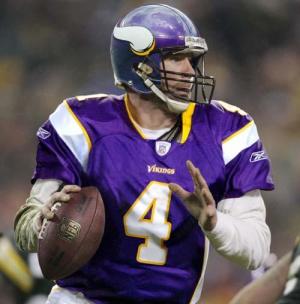 Last night we watched the 40-year-old quarterback Brett Favre on Sunday Night Football. Though his Vikings lost to the Phoenix Cardinals, Favre is still having a great season, the best in his long career.
Favre became the butt of numerous jokes in recent years for his on and off retirements. To recap: He played for many years with the Green Bay Packers. He retired, but then came back to sign with the Jets. He played a season with them, then retired again. But then came out of retirement again to play for the Vikings.
Whenever a great athlete is in the last stages of his career, there are a bunch of people who call for his retirement. It’s always some variation of the basic argument that they do not want to see the player soil his legacy by ending his career as a mere shadow of his former self. This was certainly the case with Favre.
With Favre, there was the added drama of playing for different teams. There was also a chorus of people who found Favre in a uniform other than the green and gold of the Green Bay Packers as some kind of tragedy.
These attitudes are all illustrative of un-absurdity. If Favre enjoys playing and can get in someone’s lineup, then he should play – and not care a whit about such nonsense as his “legacy”.
The absurd man believes that life ends in death… and that it is final. There is no doorway to another world beyond it. Therefore, the idea of a legacy strikes the absurd man as… well… ridiculous. Certainly, it’s not worth fretting over.
And yet, this attitude that one’s reputation after death is important pervades society. Terry Teachout wrote a column about this in the Wall Street Journal titled “When Artists Dry Up.”
He wrote about a number of artists who achieved some kind of excellence and then quit or didn’t produce anything after reaching those heights. He mentions Jean Sibelius, for instance, a great Finnish composer. Teachout writes:
“I doff my hat to Sibelius, who knew that it’s better to quit while you’re ahead than to sully your posthumous reputation by continuing to ‘create’ after you no longer have anything new to say.”
Gee, what a sad and pathetic outlook on life… We say to hell with one’s posthumous reputation. If Sibelius wanted to compose but didn’t out of fear that his performance might sully his posthumous reputation, then we say Sibelius was a misguided and anti-absurd fellow. The absurd man’s advice would’ve been to compose to his heart’s content and damn what other people think.
We are of a mind much more like the great Samuel Johnson, the 18th century critic, wit and sometime absurd man, as we’ve noted.
Johnson said: “I am not obliged to do anymore. No man is obliged to do as much as he can do. A man is to have part of his life for himself.”
Pressed by the pesky Boswell as to why he didn’t enjoy writing more rather than less, Dr. Johnson said: “Sir, you MAY wonder.” (Teachout quotes this exchange at the top of his column, but misses the point entirely.)
We doff our hat to those who live their life as they wish (as long as they do not infringe upon our equal right to do likewise) and give no worry to their posthumous reputation!
So go ahead, soil your legacy!
Sunday, December 6, 2009
“Put on a brave front and brazen it through”
“It turns out her whole life was just a lie,” a friend was telling use the other day. “She said she was a former Miss USA… and she wasn’t. She said she was a former Redskin cheerleader… and she wasn’t.”
The “she” he was referring to was Michaele Salahi, who probably needs no introduction by now. “Yet,” our friend continued, “She managed to get into a cheerleader reunion party. Fooled everyone. Afterwards, people were wondering how she knew all the cheers.”
The madcap and twisted story of Michaele and Tareq Salahi, the “gate-crashers” at Obama’s state dinner, has an absurd angle. It shows us how shallow and tenuous identity really is. It shows how easy some find it to slip into – and out of – any number of roles.
The Salahis seemed to have fooled lots of people because they simply looked the part. They played their desired roles to perfection. I think Robin Givhan, of the Washington Post nailed it here – as it relates to the gate-crashing episode – in her column “Why they got in”:
“Few of the stories that have been written and produced about Michaele and Tareq Salahi have failed to mention Michaele's platinum blond locks and her reed-thin figure. She is, indeed, a striking woman who maintains a shade of blond that typically isn't seen on anyone over the age of 2. She also has the kind of lean body that, while not voluptuous or curvy in a va-va-voom way, is reminiscent of a model's. She has chiseled cheekbones and an enormous smile. And while one could debate whether she is attractive -- to each their own, after all -- she conforms to the cultural standards of what a wealthy, privileged, important person is assumed to look like…” (Italics added.)
The Salahis follow a long line of such role players. Michaele is like another Frank Abagnale, whose life inspired the 2002 movie Catch Me If You Can. Abagnale conned lots of people into believing he was, at different times, an airline pilot, a doctor, attorney and parish prosecutor.
The truth is, though, we’re all playing roles.… We (Rick and Inigo) often joke about how we are going to play the role of “devoted employee” or “concerned parent.” If self is an illusion, then we really are whatever role we can pull off, like actors trying out and living different characters.
This line of thought also reminds us of the fictional exploits of Harry Flashman. The Flashman series by George MacDonald Fraser is a first-person account of a 19th century (unwilling) adventurer, Harry Flashman, who gets himself unwittingly in all kinds of unlikely situations and often finds himself in the middle of historical battles – such as the battle of Little Bighorn or the Charge of the Light Brigade or the Sepoy Mutiny.

In the series, Flashman plays many parts … Danish prince, Texas slave-dealer, Arab sheikh, Cheyenne Dog Soldier, Yankee Navy Lieutenant, Afghan horse trader, Sepoy soldier, and many others… All of which leads Flashman to a very absurd conclusion:
“The truth is we all live under false pretences much of the time; you just have to put on a bold face and brazen it through.”
The “she” he was referring to was Michaele Salahi, who probably needs no introduction by now. “Yet,” our friend continued, “She managed to get into a cheerleader reunion party. Fooled everyone. Afterwards, people were wondering how she knew all the cheers.”
The madcap and twisted story of Michaele and Tareq Salahi, the “gate-crashers” at Obama’s state dinner, has an absurd angle. It shows us how shallow and tenuous identity really is. It shows how easy some find it to slip into – and out of – any number of roles.
The Salahis seemed to have fooled lots of people because they simply looked the part. They played their desired roles to perfection. I think Robin Givhan, of the Washington Post nailed it here – as it relates to the gate-crashing episode – in her column “Why they got in”:
“Few of the stories that have been written and produced about Michaele and Tareq Salahi have failed to mention Michaele's platinum blond locks and her reed-thin figure. She is, indeed, a striking woman who maintains a shade of blond that typically isn't seen on anyone over the age of 2. She also has the kind of lean body that, while not voluptuous or curvy in a va-va-voom way, is reminiscent of a model's. She has chiseled cheekbones and an enormous smile. And while one could debate whether she is attractive -- to each their own, after all -- she conforms to the cultural standards of what a wealthy, privileged, important person is assumed to look like…” (Italics added.)
The Salahis follow a long line of such role players. Michaele is like another Frank Abagnale, whose life inspired the 2002 movie Catch Me If You Can. Abagnale conned lots of people into believing he was, at different times, an airline pilot, a doctor, attorney and parish prosecutor.
The truth is, though, we’re all playing roles.… We (Rick and Inigo) often joke about how we are going to play the role of “devoted employee” or “concerned parent.” If self is an illusion, then we really are whatever role we can pull off, like actors trying out and living different characters.
This line of thought also reminds us of the fictional exploits of Harry Flashman. The Flashman series by George MacDonald Fraser is a first-person account of a 19th century (unwilling) adventurer, Harry Flashman, who gets himself unwittingly in all kinds of unlikely situations and often finds himself in the middle of historical battles – such as the battle of Little Bighorn or the Charge of the Light Brigade or the Sepoy Mutiny.
In the series, Flashman plays many parts … Danish prince, Texas slave-dealer, Arab sheikh, Cheyenne Dog Soldier, Yankee Navy Lieutenant, Afghan horse trader, Sepoy soldier, and many others… All of which leads Flashman to a very absurd conclusion:
“The truth is we all live under false pretences much of the time; you just have to put on a bold face and brazen it through.”
Subscribe to:
Posts (Atom)